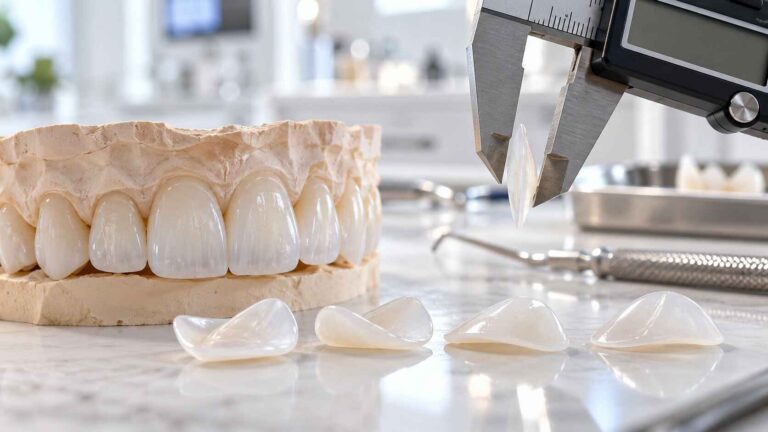
À l'intention des laboratoires dentaires, des cliniques, des distributeurs et des équipes d'approvisionnement qui comparent les couronnes en zircone, les couronnes en disilicate de lithium, les facettes, les services OEM ou les commandes de restaurations en gros.
Indiquez-nous le type de produit, le matériau, le volume mensuel, le pays de destination et votre demande d'échantillon afin que notre équipe commerciale puisse vous proposer la prochaine étape la plus adaptée.
Facettes polies ou vitrifiées : quelle finition offre une réflexion de la lumière la plus naturelle ?
Même un placage brillant peut paraître artificiel.
Cela peut sembler contradictoire tant que l'on continue à considérer la brillance comme synonyme d'esthétique naturelle, car l'aspect de facettes en porcelaine est le résultat d'une interaction dynamique entre la réflexion spéculaire, la diffusion diffuse, la courbure faciale, la texture microscopique, la translucidité de la céramique, la structure dentaire sous-jacente et l'angle d'observation de la restauration.
Alors pourquoi continuons-nous à demander aux laboratoires de simplement réaliser un facette “ ultra-brillante ” ?
Je pense que le débat entre « poli » et « émaillé » est souvent mal posé. La question pertinente n’est pas quelle technique permet d'obtenir le plus de brillance ?. La question est de savoir quelle stratégie de finition permet à la surface en céramique de réfléchir la lumière selon un motif similaire à celui de l'émail qui la jouxte.
Ce sont là des objectifs très différents.
Cette étude rend cette distinction délicate. Le polissage mécanique peut produire un brillant et une finesse comparables à ceux du glaçage, voire supérieurs dans certaines combinaisons de matériaux. Le glaçage permet d’obtenir une surface exceptionnellement lisse, semblable à du verre, mais un brillant trop uniforme peut masquer visuellement la structure de surface soigneusement conçue. À l’inverse, une séquence de polissage mal exécutée peut laisser des rayures et provoquer une diffusion incontrôlée de la lumière, ce qui donne à un placage un aspect terne.
Il n'y a pas de vainqueur incontestable.
Pour une réflexion de la lumière naturelle, j'opterais pour cette finition au cas par cas, en fonction de la céramique, de la morphologie de la surface, de l'émail environnant et du degré de brillance localisée requis — et non selon une pratique habituelle en laboratoire.
Pour obtenir des facettes en porcelaine d'aspect naturel, il faut un reflet contrôlé, et non un éclat maximal
L'émail naturel ne se comporte pas comme un carrelage de salle de bains poli.
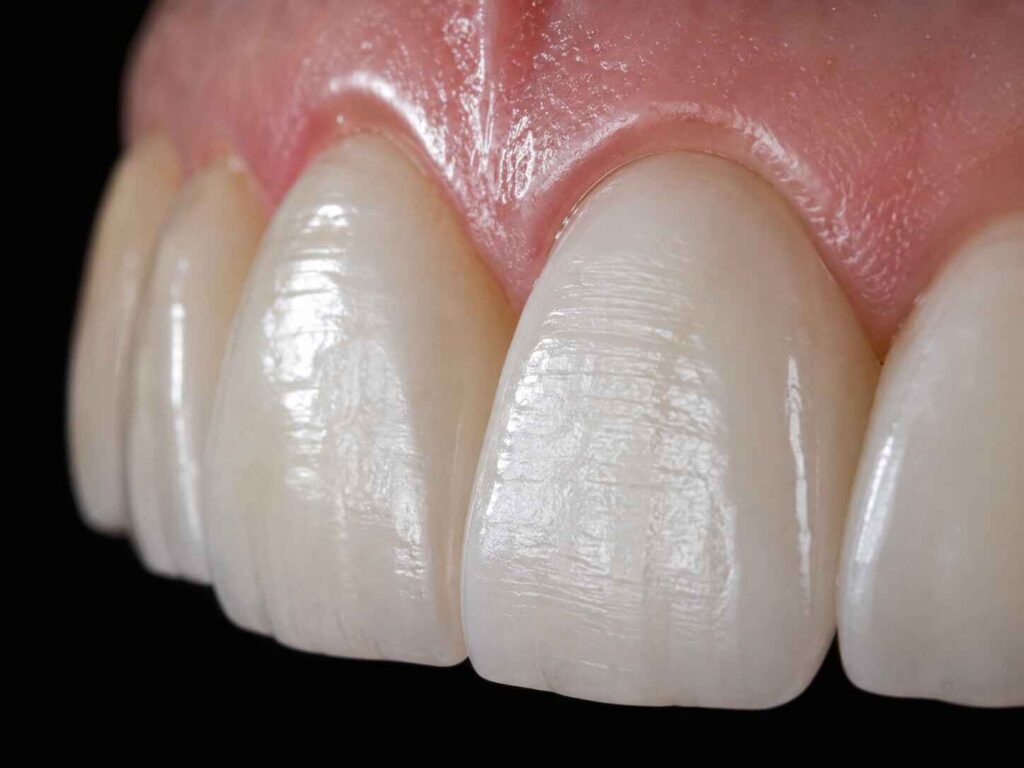
Si l'on observe attentivement une incisive centrale non traitée sous un éclairage directionnel, on constate que sa face faciale présente plusieurs couches optiques de géométrie : une convexité générale, des lobes de développement, des angles de lignes de transition, des dépressions peu profondes, des facettes d'usure, des périkymata et des irrégularités extrêmement fines.
Ces éléments divisent, concentrent, adoucissent et redirigent la lumière réfléchie.
Le guide d'Artist Dental Lab sur texture de surface des placages fait la même distinction pratique : le contour du visage et la microtexture modifient la largeur, la luminosité, la longueur et l'âge apparents, car ils influencent l'emplacement des reflets.
C'est pourquoi je me méfie lorsqu'une facette ne semble impressionnante que sous une lampe annulaire.
Les restaurations d'aspect naturel doivent durer :
Lumière naturelle diffuse
LED pour salles d'opération
La photographie sur smartphone
Flash direct
Éclairage latéral
Mouvement des lèvres
Différents angles de vue
Conditions de surface humides et sèches
Le reflet bouge.
Une restauration présentant un seul reflet frontal large et continu peut paraître extrêmement brillante sur une photographie, tout en donnant une impression de platitude peu naturelle en mouvement, notamment lorsque l'émail adjacent non traité produit des reflets plus petits et moins uniformes.
L'objectif n'est donc pas d'obtenir un brillant maximal des facettes en porcelaine.
C'est brillance compatible.
La réflexion spéculaire ne représente que la moitié du tableau
Une surface en céramique très lisse favorise une réflexion spéculaire plus intense et mieux organisée. Une surface plus irrégulière disperse la lumière incidente dans davantage de directions, ce qui augmente la diffusion.
Aucun de ces deux extrêmes ne semble naturellement convaincant.
Si le ponçage est trop agressif, le placage peut perdre son éclat, présenter des irrégularités ou devenir terne.
Si le brillant est trop uniforme, la surface peut paraître artificielle.
Les restaurations antérieures les plus convaincantes se situent généralement entre ces deux extrêmes : elles sont lisses et faciles à nettoyer d'un point de vue macroscopique, tout en conservant une orientation de surface suffisamment marquée pour diviser un reflet d'aspect artificiel en zones de réflexion anatomiquement significatives.
C'est pourquoi angles de transition dans les facettes méritent autant d'attention que le matériau de finition. Les angles des lignes mésio-faciale et disto-faciale définissent la zone réfléchissante centrale ; leur modification peut altérer la largeur apparente de la dent, même lorsque la dimension mésio-distale réelle reste pratiquement inchangée.
Une finition de surface ne peut pas compenser une géométrie défectueuse.
Facettes polies ou facettes émaillées : quelle est la différence concrète ?
La terminologie semble simple.
Ce n'est pas le cas.
Polissage de la céramique dentaire affine mécaniquement la surface céramique à l'aide d'abrasifs adaptés au matériau, de caoutchoucs de polissage, de meules, de brosses ou de pâtes diamantées, jusqu'à ce que les rayures résultant du façonnage soient progressivement atténuées.
Le glaçage consiste à appliquer un traitement de surface par cuisson afin d'obtenir une finition extérieure lisse. Selon le système céramique utilisé, cela peut impliquer l'utilisation de pâtes de glaçage compatibles, de sprays, de colorants ou de procédures de cuisson spécifiées par le fabricant.
IPS e.max CAD constitue un bon exemple, car Ivoclar prend actuellement en charge plusieurs méthodes de traitement. Le fabricant décrit un processus dans lequel la restauration pré-cristallisée peut être polie jusqu’à obtenir un brillant intense, puis cristallisée. sans vitrage supplémentaire, tout en proposant des options de coloration et de glaçage, ainsi que de glaçage par pulvérisation. IPS e.max CAD est une vitrocéramique à base de disilicate de lithium, généralement représentée par la formule cristalline Li₂Si₂O₅. Ivoclar indique actuellement une résistance moyenne à la flexion biaxiale de 530 MPa après cristallisation.
Cela devrait suffire à mettre fin à l'idée selon laquelle une restauration E.max conforme aux règles nécessite automatiquement une couche de glaçage visible.
Ce n'est pas le cas.
Comparaison rapide entre les facettes en porcelaine polie et les facettes en porcelaine émaillée
Facteur
Facettes polies
Facettes émaillées
Création de surfaces
Finition mécanique avec une séquence de polissage spécifique à la céramique
Matériau de glaçure cuit ou cycle de finition lié à la glaçure
Brillance potentielle
De faible à très élevé, selon le système et la séquence
Généralement élevés et uniformes
Contrôle de la microtexture
Le technicien peut préserver ou affiner de manière sélective certaines parties de l'anatomie locale
Si elle est appliquée en quantité excessive, la glaçure peut atténuer visuellement les détails subtils de la surface.
Contrôle local de la brillance
Excellent lorsqu'il est pratiqué de manière réfléchie
Souvent plus homogène sur l'ensemble de la zone traitée
Après ajustement
Peut souvent être remis à neuf à l'aide d'un système adapté au matériau
Un ajustement par émaillage nécessite une restauration de la surface par la suite
Risque principal
Rayures résiduelles ou polissage excessif
Une uniformité excessive, semblable à celle du verre, ou une perte de texture optique
Candidature solide
Cas nécessitant une réflexion localisée hautement contrôlée
Boîtiers présentant une surface cuite lisse et homogène
Naturalité
Peut être excellent
Peut être excellent
Un vainqueur tout trouvé ?
Non
Non
Cette dernière ligne est plus importante que toutes celles qui la précèdent.
Les études ne corroborent pas l'idée selon laquelle “ le glaçage est toujours meilleur ”
C'est là que les légendes du milieu commencent à s'effriter.
A Étude de 2025 portant sur 104 échantillons de céramique ont évalué le polissage mécanique et le glaçage sur trois céramiques monolithiques à base de disilicate de lithium et une zircone ultra-translucide. Les auteurs ont conclu que les procédés de finition de surface avaient une influence significative sur la brillance et la rugosité, et que les systèmes de polissage mécanique offraient des performances similaires, voire supérieures, à celles du glaçage, selon le matériau. Consultez l'étude de 2025 sur la brillance et la rugosité de la céramique.
Relis ça.
Le polissage n'est pas forcément une alternative de second choix au glaçage.
Les données de 2026 rendent cette dépendance vis-à-vis des matières premières encore plus difficile à ignorer
Un mois de juin 2026 BMC Santé bucco-dentaire étude testée 80 spécimens, répartis en huit groupes de dix, en utilisant des céramiques à base de disilicate de lithium et de silicate de lithium renforcé à la zircone, avec des systèmes de polissage et de glaçage spécifiques à chaque fabricant ou interchangés.
Le résultat n'a pas donné lieu à un titre simpliste du type “ le polissage l'emporte ” ou “ le glaçage l'emporte ”.
La rugosité de surface variait en fonction du type de céramique et du protocole de finition. Les chercheurs ont également constaté que les échantillons émaillés présentaient des valeurs d'angle de contact d'environ de deux à cinq fois plus élevé que les spécimens polis des deux groupes de céramiques testés. Lire l'étude complète publiée dans BMC Oral Health.
C'est important, car le traitement de surface modifie les propriétés physiques mesurables.
Mais c'est le cas pas prouver que les patients percevront une finition comme étant plus esthétique.
Cette distinction est souvent négligée dans le domaine du marketing.
Une étude de 2025 sur la transmission de la lumière met en évidence une autre hypothèse fragile
Il y a une découverte encore plus intéressante.
Une étude menée en 2025 a évalué la finition de surface, la brillance, l'épaisseur de la céramique et la transmission des longueurs d'onde violettes et bleues à travers les céramiques Celtra Duo et IPS e.max CAD.
À 1,5 mm d'épaisseur, seulement environ 6% de lumière violette à 396 nm et environ 21–261 TP3T de lumière bleue à 476 nm a traversé la céramique. À 3,0 mm, pratiquement aucune lumière violette et seulement environ 6–9% de la lumière bleue a été détectée dans les échantillons. Plus important encore dans le cadre de cette analyse, la brillance et le pourcentage de transmission lumineuse n’ont montré qu’une faible corrélation, avec un R² inférieur à 0,25. Consultez cette étude sur le site de la Bibliothèque nationale de médecine des États-Unis.
La brillance et la transmission lumineuse ne sont pas les mêmes propriétés optiques.
C'est important.
Cela signifie que nous devrions cesser de réduire le “ comportement face à la lumière naturelle ” à une simple valeur mesurée par un glossimètre.
Pourquoi les facettes en céramique peuvent parfois paraître trop parfaites
Glaze présente des avantages indéniables.
Un protocole de glaçage soigneusement mis en œuvre permet d'obtenir une surface exceptionnellement lisse et un aspect final très bien maîtrisé. Il peut également faciliter la caractérisation externe lorsque des colorants et des matériaux de glaçage compatibles font partie du système céramique.
Mais il y a un piège visuel.
L'uniformité devient visible.
Si le vernis recouvre une texture extrêmement fine, une surface qui présentait auparavant de légères variations de relief peut paraître visuellement plus homogène. Le vernis peut alors créer un reflet large et net, au lieu des reflets fragmentés visibles sur l'émail voisin.
Cela peut s'avérer souhaitable dans certains cas impliquant plusieurs unités.
Cela peut avoir des conséquences désastreuses sur la dent #8, située à côté de la dent intacte #9.
La réflexion d'Artist Dental Lab sur périkymates dans les placages explique pourquoi une anatomie tertiaire peu marquée peut diviser les reflets larges en reflets plus petits. Mais cela met également en garde contre les sillons trop prononcés ; si l'observateur remarque la texture elle-même, c'est que le technicien est allé trop loin.
C'est exactement ça, l'équilibre.
Nous voulons que le effet de texture.
Nous ne voulons pas que les spectateurs scrutent les rainures.
Dans quels cas je privilégierais un vitrage contrôlé
Je considérerais qu'une stratégie « glacée » est particulièrement justifiable lorsque :
Le protocole validé par le fabricant le spécifie pour la céramique et la méthode de caractérisation choisies.
Les colorations externes doivent être protégées dans le cadre du système prescrit.
On souhaite obtenir une finition très homogène sur plusieurs restaurations.
La texture de la surface a été spécialement conçue pour résister au cycle final de glaçage.
Le vernis peut être appliqué sans masquer les éléments microanatomiques importants.
Les restaurations voisines présentent déjà une finition au four similaire.
Remarquez ce qui manque.
“ Parce que les facettes vitrifiées ont un aspect plus naturel. ”
Cette affirmation est trop simpliste pour être utile.
Pourquoi les facettes polies peuvent produire un reflet plus proche de celui de l'émail
Le polissage mécanique offre au technicien un autre type de contrôle.
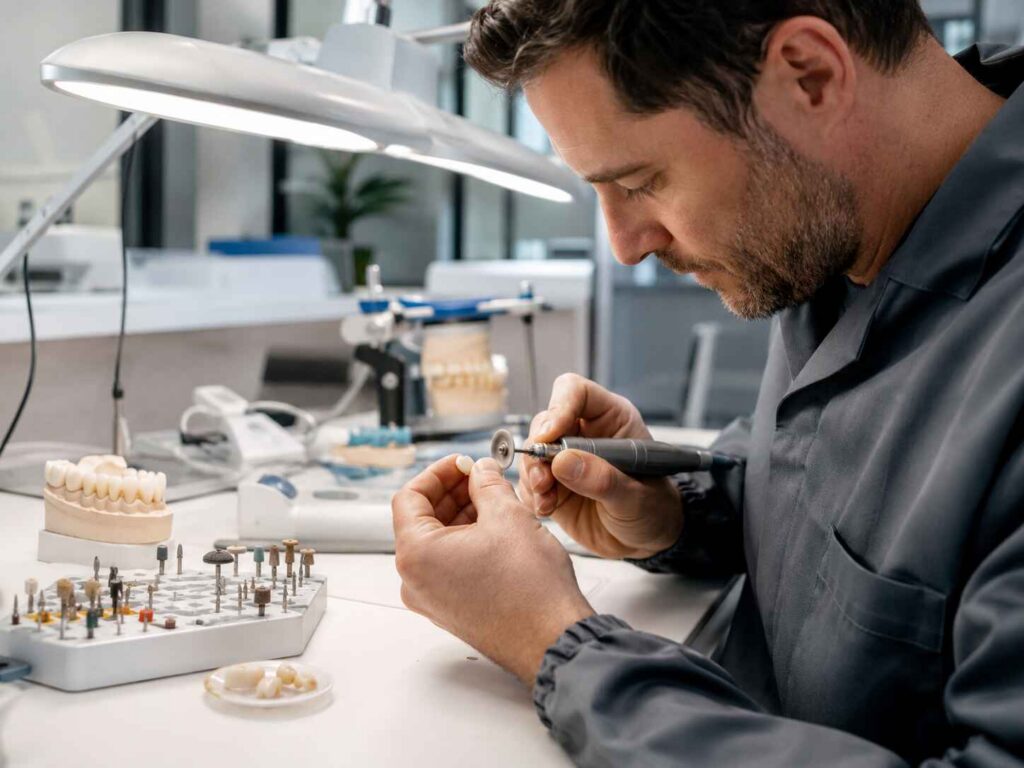
Au lieu d'appliquer un traitement de finition relativement uniforme sur toute la surface faciale, le céramiste peut affiner différentes zones tout en préservant la morphologie tridimensionnelle réelle qui détermine la réflexion.
Cela peut s'avérer extrêmement efficace.
Imaginez une incisive centrale présentant :
Un tiers central modérément réfléchissant
Réflexe cervical moins marqué
Des lobes faciaux visibles mais discrets
Limites réfléchissantes proximales plus étroites
Microtexture horizontale peu marquée
Une zone incisale plus lisse due à une usure simulée
Un brillant uniforme sur chaque millimètre carré pourrait aller à l'encontre de cette anatomie.
Le polissage sélectif peut y contribuer.
Mais cela demande du savoir-faire.
Une opération de polissage réalisée à la hâte n'est pas un “ polissage naturel ”. Il s'agit simplement de céramique non finie.
Les travaux de recherche sur le disilicate de lithium menés en 2021 et référencés dans PubMed ont conclu que la rugosité obtenue dépendait fortement de la combinaison spécifique de céramique et de système de finition, plutôt que sur le polissage en tant que procédure universelle. Consultez l'étude sur la finition au disilicate de lithium sur PubMed.
Voilà la dure réalité concernant les facettes en céramique :
Le mot poli ça ne m'apprend pratiquement rien.
J'ai besoin de savoir comment.
Un polissage excessif est également un échec
Un technicien peut faire briller un placage jusqu'à lui ôter toute vie.
Si une finition mécanique agressive réduit l'anatomie faciale au point que la restauration ressemble à une coque lisse et convexe, la surface peut certes atteindre un brillant impressionnant, mais elle perdra en même temps la géométrie directionnelle qui lui conférait son réalisme.
C'est pourquoi le guide correspondant d'Artist Dental Lab sur repolissage des facettes en porcelaine distingue la finesse microscopique de la morphologie visible. Il est possible de restaurer la finesse dans de nombreux cas ; en revanche, reconstituer l’anatomie de surface qui a été physiquement abrasée constitue un tout autre problème.
La fluidité ne suffit pas.
Facettes polies ou vitrifiées : quelle finition offre l'aspect le plus naturel ?
Voici ma réponse.
Une facette correctement polie offre souvent au technicien un meilleur contrôle sur les reflets localisés, semblables à ceux de l'émail, tandis qu'une facette correctement vitrifiée peut offrir une excellente finesse et un éclat maîtrisé ; aucune de ces deux finitions n'est intrinsèquement plus naturelle, et le meilleur résultat est celui dont la brillance finale correspond à celle de l'émail réel du patient et préserve la morphologie faciale souhaitée.
C'est moins pratique que de choisir un gagnant.
C'est également plus facile à justifier.
Pour un sourire complet de six ou huit éléments, où le laboratoire contrôle toutes les surfaces antérieures visibles, une finition émaillée harmonisée peut paraître extrêmement convaincante, car les restaurations adjacentes partagent le même langage optique.
Un placage central unique, c'est différent.
La dent naturelle voisine sert de référence.
Aucun argument marketing concernant la céramique ne peut rivaliser avec cette comparaison.
C'est aussi pour cette raison que l'importance de l'esthétique des facettes ne peut être dissociée de la brillance. Une zone de reflets étendue peut donner à une restauration un aspect plus lumineux, même lorsque sa teinte nominale est correcte, tandis qu’une zone réfléchissante mieux maîtrisée peut réduire visuellement cette luminosité sans modifier la désignation de la teinte de la céramique.
De nombreux décalages de teinte apparents sont en partie dus à des décalages de réflexion.
Le matériau change la réponse
“La distinction ” poli ou émaillé » n'a aucun sens si l'on ne précise pas de quel type de céramique il s'agit.
C'est là une autre faiblesse des débats généraux sur les placages.
Facettes en disilicate de lithium
IPS e.max CAD et les autres systèmes à base de disilicate de lithium permettent de réaliser aussi bien des restaurations polies que vitrifiées, à condition de respecter les procédures compatibles.
Ivoclar décrit de manière explicite les processus de traitement « poli/cristallisé » et « émaillé/cristallisé » pour l'IPS e.max CAD.
Pour les cliniques utilisant Facettes E.max, je prescrirais donc le résultat optique plutôt que de définir aveuglément le vernis : intensité de brillance souhaitée, dent de référence, intensité de la texture de surface, largeur de réflexion, et si la caractérisation localisée doit rester visible.
Facettes en porcelaine feldspathique
La céramique feldspathique offre à un céramiste expérimenté une grande liberté quant à la caractérisation interne et à la morphologie externe délicate de ses pièces.
C'est précisément pour cette raison qu'il faut faire preuve de retenue dans la finition.
Lorsque le choix de la porcelaine feldspathique vise à imiter subtilement l'émail, il n'est guère judicieux de masquer les détails délicats sous une finition vitreuse exagérée.
Facettes en zircone
La zircone pose un tout autre problème en matière de finition de surface.
Sa microstructure diffère considérablement de celle des vitrocéramiques à base de silice ; c'est pourquoi les systèmes de polissage et les protocoles de glaçage ne peuvent pas être simplement transposés d'un matériau à l'autre sous prétexte qu'un technicien préfère un kit en particulier.
Les études de 2025 et 2026 mentionnées ci-dessus vont dans le même sens : Le choix de la finition en fonction du matériau est important.
La prescription de finition que j'enverrais à un laboratoire dentaire
“ Brillance naturelle. ”
Je rejetterais cette instruction.
Ce n'est pas suffisamment mesurable.
Une prescription sérieuse concernant des facettes en céramique antérieures doit indiquer au laboratoire comment la surface est censée se comporter sous l'effet de la lumière.
Par exemple :
Matériau : IPS e.max CAD MT Dent concernée : #8 Référence : non traité #9 Valeur finale : correspondance #9 sous une lumière naturelle diffuse Texture du visage : anatomie secondaire modérée Perikymata : légère, uniquement sur le tiers moyen à incisif Largeur réfléchissante : miroir #9 plutôt que la largeur totale du visage Glossaire cervical : légèrement en baisse Note sur le tiers central : match #9 Finition incisale : une anatomie superficielle plus lisse et plus sobre Angles des lignes : dent controlatérale symétrique Fin : séquence de polissage/glacis approuvée, choisie pour reproduire la réflexion de référence Photographie : références frontales, à 45 degrés, incisales, polarisées et à lumière latérale
Nous disposons désormais d'une notice de fabrication.
“ Fais comme si c'était naturel ” n'en fait pas partie.
Pour les restaurations antérieures complexes, les recommandations d’Artist Dental Lab concernant l’évaluation Facettes unitaires ou multiples Ce point est particulièrement pertinent, car une incisive centrale voisine non traitée met en évidence les différences de teinte, de translucidité, d'angles de ligne, de texture et de brillance de manière bien plus marquée qu'un traitement coordonné portant sur plusieurs dents.
Ce que je vérifierais avant de valider la surface finale du placage
Ne vous fiez pas à une seule photo de face pour évaluer la brillance.
Utilisez plusieurs conditions.
1. Vérifier la lumière diffuse
Le placage conserve-t-il sa valeur globale sans présenter de point chaud trop marqué ?
2. Utilisez un éclairage latéral directionnel
Cela met en évidence les lobes faciaux, la microtexture, les zones plates et un lissage excessif.
3. Comparer la largeur de la réflexion
La réflexion centrale brillante doit s'harmoniser logiquement avec la dent adjacente.
Si l'incisive centrale restaurée présente un reflet sur la quasi-totalité de sa largeur faciale, tandis que la dent controlatérale présente des limites de réflexion plus étroites, le problème peut être lié au contour plutôt qu'à la teinte de la céramique.
4. Regardez à 45 degrés
Une restauration peut paraître parfaite vue de face, mais perdre tout son éclat lorsqu'on la regarde sous un angle oblique.
5. Évaluer le mouvement
Le point de repère doit se déplacer naturellement lorsque le patient change la position de sa tête.
Les photos ne le montrent pas.
6. Évaluez l'état de la surface mouillée
La salive modifie la façon dont les surfaces interagissent avec la lumière.
La facette se trouve dans la bouche, et non sur une paillasse de laboratoire.
7. Comparez la texture avant de demander plus de brillance
Lorsqu'un facette semble terne, la réaction instinctive est souvent de “ la polir davantage ”.”
Mais si le véritable problème réside dans un mauvais positionnement de l'angle de la ligne ou dans une convexité excessive du visage, l'ajout de brillance peut accentuer cette imperfection.
Commençons par la géométrie.
Terminer deuxième.
FAQ
Les facettes polies ont-elles un aspect plus naturel que les facettes émaillées ?
Les facettes polies peuvent paraître plus naturelles lorsqu’une séquence de polissage spécifique à la céramique permet d’obtenir une surface lisse tout en préservant la texture faciale propre au patient, les angles des lignes de transition et les variations localisées de brillance ; toutefois, les facettes polies ne sont pas intrinsèquement supérieures aux facettes émaillées, car le type de matériau, le système de polissage, le contour, l’émail adjacent et la qualité de la finition influent tous sur le rendu naturel perçu.
Dans un cas antérieur complexe, je comparerais la réflexion finale à celle des dents de référence naturelles plutôt que de choisir une finition en me basant uniquement sur son nom.
Les facettes en porcelaine émaillée ont-elles un aspect trop brillant ?
Les facettes en porcelaine émaillée paraissent trop brillantes lorsque leur réflexion spéculaire finale est nettement plus étendue, plus vive ou plus uniforme que celle de l'émail naturel environnant, en particulier si une couche d'émail trop épaisse masque visuellement les subtiles textures du visage ; un émaillage correctement maîtrisé peut néanmoins offrir un résultat esthétique très naturel lorsque la brillance, le contour, l'anatomie de la surface et les dents adjacentes sont harmonisés.
Le problème ne vient pas du vernis en soi. Le problème réside dans la non-correspondance optique.
Quelle finition de placage offre la réflexion de la lumière la plus naturelle ?
La finition de facette qui offre la réflexion de la lumière la plus naturelle est celle qui présente une surface polie ou vitrifiée adaptée au matériau, dont l'intensité de brillance, la microtexture, la courbure de la face, les angles des lignes de transition et la largeur de la zone réfléchissante reproduisent le plus fidèlement l'émail naturel du patient sous différents angles d'éclairage, plutôt que de se contenter de produire la brillance la plus élevée mesurable ou photographiable.
Dans le cas d'une facette centrale isolée, la dent controlatérale non traitée constitue généralement la référence visuelle la plus évidente.
Les facettes E.max peuvent-elles être polies plutôt que glacées ?
Les facettes E.max peuvent être finies à l'aide de protocoles de polissage homologués, sans qu'il soit nécessaire d'appliquer une couche de glaçage supplémentaire dans le cadre des protocoles IPS e.max CAD appropriés. En effet, Ivoclar décrit actuellement un procédé dans lequel la restauration est polie jusqu'à obtenir un brillant élevé à l'état pré-cristallisé, puis cristallisée sans glaçage supplémentaire ni personnalisation externe individuelle.
Le processus exact doit toutefois respecter les instructions en vigueur pour le matériau et le procédé de fabrication concernés.
Le polissage d'une facette en porcelaine enlève-t-il sa texture de surface ?
Le polissage d'une facette en porcelaine peut réduire ou éliminer la texture de surface lorsqu'une quantité excessive de céramique est retirée mécaniquement ; toutefois, une séquence de polissage contrôlée et adaptée au matériau permet de lisser les rayures microscopiques tout en préservant les caractéristiques intentionnelles plus importantes, telles que les lobes de développement, les angles des lignes de transition, les sillons peu profonds, les marques d'usure et les périkymates modérés, qui influencent la manière dont la restauration reflète la lumière.
Une fois que l'anatomie physique a été effacée, aucun polissage supplémentaire ne peut la reconstituer.
Une finition très brillante est-elle toujours souhaitable pour les facettes en porcelaine ?
Une brillance élevée n’est pas toujours souhaitable pour les facettes en porcelaine, car l’émail naturel ne présente pas un niveau de réflexion identique chez tous les patients, sur toutes les dents, dans toutes les tranches d’âge et dans toutes les zones du visage ; l’objectif à atteindre est une surface céramique lisse et facile à nettoyer, dont la répartition de la brillance correspond aux références naturelles et met en valeur, sans la dominer, l’anatomie de surface souhaitée pour la restauration.
Une incisive centrale usée de 55 ans et une incisive latérale jeune et non usée ne doivent pas nécessairement bénéficier automatiquement de la même finition optique.
Un laboratoire dentaire doit-il vernir ou polir une facette centrale isolée ?
Un laboratoire dentaire doit opter pour un polissage, un glaçage ou une combinaison contrôlée pour une facette centrale unique, en s'alignant sur la teinte, la texture, la largeur de la zone réfléchissante, le brillant de surface et le comportement de la céramique de la dent controlatérale non traitée ; en effet, une restauration unique est directement comparée à l'émail naturel et même de légers écarts peuvent paraître plus visibles que dans le cas d'un ensemble coordonné de plusieurs facettes.
Dans ce genre de cas, des photos prises sous un éclairage directionnel sont plus utiles que la mention “ très brillant ”.”
Conclusion : préconisez la réflexion, et non le terme “ gloss ”
Le débat opposant les placages polis aux placages vitrifiés trouve une réponse d'une simplicité séduisante.
Malheureusement, ce n'est pas le bon.
Les facettes polies ne sont pas forcément plus naturelles. Les facettes émaillées ne sont pas forcément plus lisses d'un point de vue esthétique.
Les données disponibles montrent que les résultats obtenus en matière de polissage et de glaçage dépendent fortement du type de céramique, du procédé de finition de surface et du protocole de traitement. Les recherches indiquent également que la brillance ne doit pas être considérée comme un substitut à la translucidité ou au comportement global de la lumière.
Ce qui importe sur le plan clinique, c'est le résultat final de la réflexion.
Pour évaluer une facette en porcelaine, je vérifierais si la largeur de ses reflets, sa luminosité, sa texture, les angles de ses contours, sa translucidité et son rendu sous différents éclairages s'harmonisent avec les dents environnantes.
Ce n'est pas parce que quelqu'un peut affirmer qu'il était glacé.
Ce n'est pas parce que quelqu'un peut dire que c'était bien ficelé.
Et certainement pas par la façon dont il brille avec intensité sous une lampe annulaire.
Pour une facette antérieure unique, un dossier de sourire comprenant plusieurs éléments, une évaluation du matériau E.max ou tout cas nécessitant de préciser la texture et la brillance exactes de la surface avant la fabrication, veuillez envoyer les photos de référence, les fichiers STL, la teinte du moignon, le modèle provisoire validé, le type de céramique souhaité et le profil de réflexion souhaité à Laboratoire dentaire Artist : examen des dossiers et consultation.
Définissez d'abord le comportement de la lumière. Choisissez ensuite la finition qui permettra de le reproduire fidèlement.