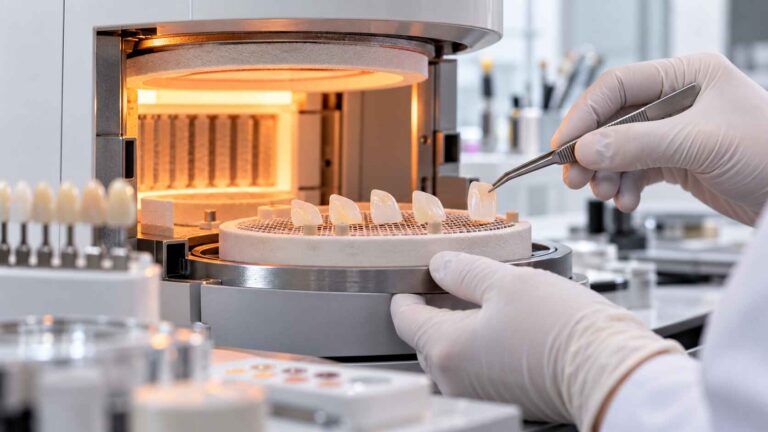
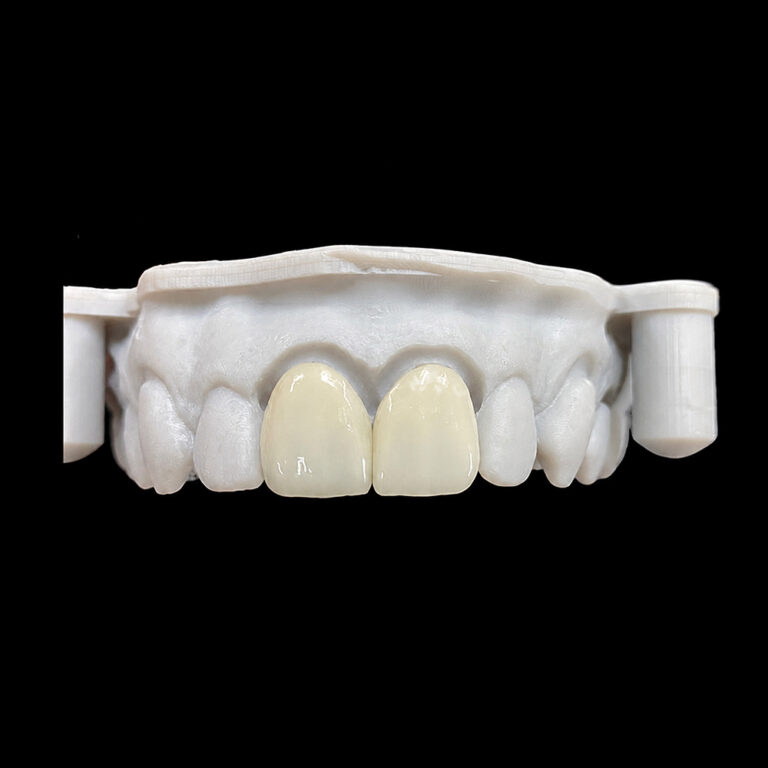
How Should Anterior and Posterior Materials Be Coordinated in Full-Mouth Rehabilitation?
Stop Treating the Full Mouth Like One Material Problem
Start here.
I do not coordinate anterior and posterior materials by brand family, and I definitely do not pick one ceramic and spray it across twenty-eight units just because the rep brought muffins, because the mouth is not one biomechanical neighborhood: the incisors sell the case, the canines police it, and the molars punish every lazy decision you made during planning. So why pretend one material logic should run all of it?
A 2025 retrospective cohort study in PMC came to the conclusion many experienced prosth teams already live by: zirconia trended better in posterior and implant-supported cases, while lithium disilicate was favored in anterior restorations where esthetics matter more; at five years, estimated survival was 94.0% for zirconia versus 89.0% for lithium disilicate, with technical complication rates of 14.0% and 21.0%, respectively.
Here is the hard truth.
Anterior material choice is usually an optics decision with functional limits, while posterior material choice is usually a function decision with esthetic limits, and the minute a clinician or lab forgets that split, the case starts drifting toward overbuilt centrals, underbuilt molars, and a remake conversation nobody wants.
Table of Contents
The split that actually matters: light in front, load in back
This is the rule.
In full mouth rehabilitation, the anterior zone should usually be selected around translucency, value control, surface texture, and guidance behavior, while the posterior zone should usually be selected around fracture tolerance, occlusal stability, contact durability, and lower sensitivity to layering variables, which is exactly why zirconia keeps earning posterior trust and lithium disilicate keeps owning the esthetic conversation.
And yes, there is a middle lane.
Canines and first premolars are the awkward teenagers of the case because they sit at the border of beauty and force, which means they often deserve the most honest discussion of all: if the patient has heavy function, worn envelope, or parafunction, I lean toward tougher, more repeatable materials there; if the case is highly visible and the guidance can be protected, I’ll spend more on optical quality. Who gets blamed when that transition zone is guessed instead of planned?
Zone
Main clinical job
Material bias I trust most
Why I trust it
What usually goes wrong
Central incisors to canines
Smile display, phonetics, anterior guidance
Lithium disilicate, layered E.max, or layered zirconia selectively
Better control of translucency, incisal effects, and facial texture
Overbulking for strength and killing light
Canines to first premolars
Transition between esthetics and function
Case-dependent mix: full E.max, E.max crowns, or stronger zirconia-based option
This area carries both guidance and visibility
Ignoring guidance and treating them like either pure anteriors or pure posteriors
Premolars to molars
Load, chewing efficiency, wear control, stability
Monolithic zirconia more often than not
Fewer interfaces, better chipping resistance, better tolerance for function-heavy cases
Chasing “beauty” in a grinding zone
That table is not brochure talk. It is the simplest honest synthesis of the 2025 cohort data, the long-running zirconia-versus-lithium-disilicate literature, and what serious labs are quietly building into their product stacks.
What Artist Dental Lab’s own catalog quietly tells you
The site gives it away.
If you read Artist Dental Lab like an investigator instead of a shopper, the material hierarchy is not subtle: full-contour multilayer zirconia crowns & bridges are positioned for posterior strength and reduced chipping risk, E.max crowns are positioned for anterior and select posterior esthetic use, layered zirconia crowns are pitched for premium anterior characterization, full E.max veneers are framed around predictable multi-unit consistency, and layered E.max veneers are reserved for high-end smile design where incisal effects actually matter. That is not random website organization. That is clinical triage disguised as navigation.
I agree with that architecture.
For most full mouth rehabilitation cases, I would coordinate the case like this: posterior units default toward monolithic zirconia unless there is a very specific reason not to, anterior units default toward lithium disilicate when enamel-like light behavior is the priority, and only the smile-zone units that truly need premium depth or texture get layered ceramics. Why buy more variability than the case can safely carry?
The anterior should not be over-engineered into looking fake
Three words matter.
Thin, bright, dead.
That is what happens when the anterior segment is forced into a posterior logic, especially when someone chooses a tougher-looking material and then tries to recover life with stain and glaze alone, which is why I prefer the site’s split between E.max crowns for esthetic zones and layered zirconia crowns for premium anterior detail rather than pretending every front tooth needs the same answer.
The posterior should not be handed a fragile beauty contest winner
This always happens.
Clinicians obsess over the centrals, then quietly hand the molars a material choice that depends on perfect reduction, perfect bonding, perfect cooling, perfect occlusion, and perfect patient behavior, and then they act shocked when the posterior segment becomes the place where function, not photography, writes the final review. I think that is backwards.
Artist Dental Lab’s own full-contour multilayer zirconia page emphasizes posterior strength, monolithic design, and lower chipping risk, and frankly that is where I’d start whenever the posterior is expected to do real labor instead of pose for intraoral glamour shots.
The data sales pages prefer not to lead with
Numbers first.
A 2024 full-mouth rehabilitation case report in PMC documented a 30-year-old patient treated with lithium disilicate ceramic crowns after crown lengthening and increased vertical dimension, with satisfactory performance at 52 months, which is a useful reminder that lithium disilicate is not some delicate anterior ornament; in the right hands and the right design, it can survive serious rehabilitation work.
But context matters.
The broader literature still leans the same way most experienced teams do: a 2019 narrative review in PMC described lithium disilicate as highly versatile, with strong esthetic potential and favorable bonding because of its silica content, and the newer 2025 cohort still supported zirconia when posterior or implant-supported mechanical reliability took center stage. That is not contradiction. That is case selection.
And here is the part too many people skip.
A 2024 PMC study on laminate veneers and cement shade found that IPS e.max Press groups showed mean ΔE values above the clinically acceptable threshold for all tested cement shades, while IPS e.max CAD laminate veneers stayed below that threshold, which is another way of saying shade stability is not just a ceramic problem; it is a thickness, translucency, cement, and workflow problem. That is why I get suspicious whenever someone says a material is “best” without talking about stump shade, prep space, or bonding protocol.
My blunt coordination model
Use the front to manage perception.
Use the back to manage punishment.
Then use the canine-premolar corridor to negotiate the peace treaty between those two priorities, because that corridor decides whether anterior guidance and posterior disclusion feel engineered or improvised.
Where the money, regulation, and remake risk collide
This part stings.
The cosmetic end of dentistry is crowded with people selling “beauty” while quietly ignoring diagnosis, occlusion, and biological cost, and that becomes even more dangerous when full-mouth cases get discussed like fashion packages instead of irreversible medical treatment plans. Who pays for that fantasy when it collapses?
According to an Associated Press report from October 2024, veneers usually cost about $1,000 to $2,000 per tooth, and they generally are not covered by insurance, which helps explain why cheap shortcuts keep attracting patients and why full-mouth cosmetic packages are so often marketed with more confidence than discipline.
That is why I care about operations, not just esthetics.
On Artist Dental Lab’s client cases and success stories page, the company says it serves partners in 20+ countries, cites a typical 7–14 day turnaround, and describes a 28-clinic North American DSO that cut standard turnaround from 15–20 days to 9–11 days after consolidating workflows, which is exactly the kind of operational signal I watch when I want to know whether a lab understands full-mouth rehab as a system instead of a collection of pretty units.
My hard-rule framework for coordinating anterior and posterior materials
Here it is.
I coordinate by job description, not by catalog romance.
If the anterior must carry the smile, phonetics, and visible guidance, I want a material plan that protects light behavior and lets the ceramist control value, incisal effects, and texture. If the posterior must survive force, chewing cycles, and messy real-world behavior, I want a material plan that removes weak interfaces and lowers the number of variables. And if the case cannot tolerate much variability, I get more conservative fast.
So my default playbook looks like this:
For heavy-function patients
Posterior monolithic zirconia. Anterior lithium disilicate only where function permits. Layered ceramics only for the units that absolutely need them.
For elite smile-zone esthetic cases
Layered anterior ceramics where the photos, reduction, stump shade, and patient expectations justify the extra complexity. But even then, I still keep the posterior boring on purpose, because boring posteriors usually keep fancy anteriors in business.
For multi-unit cosmetic rehabs
I like consistency.
That is why the internal logic behind Artist Dental Lab’s full E.max veneer page and its related article, Full E.max Veneers vs Layered E.max Veneers: What Is the Real Difference?, makes sense to me: full-contour lithium disilicate is presented as the lower-variance route for multi-unit consistency, while layering is treated as a premium option with more optical upside and more technique sensitivity. That is a mature way to frame risk.
FAQs
What is the best way to coordinate anterior and posterior materials in full-mouth rehabilitation?
The best coordination strategy in full-mouth rehabilitation is to assign materials by functional role: anterior restorations are usually selected for translucency, shade control, and guidance behavior, while posterior restorations are usually selected for fracture tolerance, wear management, and lower mechanical variability under load.
After that, the canines and premolars become the swing votes. I would never plan them blindly, because they decide whether the case transitions smoothly or fractures at the exact point where esthetics meets force.
Should zirconia always be used on posterior teeth in a full-mouth reconstruction?
Zirconia is not mandatory for every posterior restoration in a full-mouth reconstruction, but it is often the safer default when the case involves heavy occlusal demand, implant support, parafunction, or a need to reduce chipping risk through a monolithic design and simpler mechanical behavior.
That said, lithium disilicate still has a legitimate role in select posterior indications when span length, preparation form, bonding, and patient function are well controlled. The mistake is turning a trend into a religion.
Is lithium disilicate only an anterior material?
Lithium disilicate is not just an anterior material; it is a versatile silica-based ceramic used across veneers, inlays, onlays, overlays, and select crowns, but it is chosen most confidently in the anterior because its optical qualities and bonding behavior are especially valuable where esthetics are more demanding.
I think the industry often oversimplifies this. “Anterior only” is lazy shorthand, not planning.
When should layered ceramics be used in the anterior segment?
Layered ceramics should be used in the anterior segment when the case truly requires advanced incisal effects, internal characterization, nuanced value control, or lifelike surface texture that cannot be achieved as predictably with a monolithic restoration under the available prep space and photographic communication.
If the case does not need that extra optical ceiling, I would rather buy consistency than artistry for its own sake.
How do clinicians and labs reduce remakes in full-mouth rehabilitation cases?
The most reliable way to reduce remakes in full-mouth rehabilitation is to build a strict information chain that includes prep design, occlusal scheme, stump shade, high-quality photography, mock-up or wax-up references, and a material plan that respects where esthetics end and force begins.
Most remake stories start before fabrication. They start in the prescription.
Your Next Step
Do this next.
If you are planning a full mouth rehabilitation and want the anterior and posterior materials coordinated like a system instead of sold like separate products, start by matching the case to the right internal workflow: use full-contour multilayer zirconia for function-heavy posterior zones, review E.max crowns and layered zirconia crowns for anterior strategy, compare full E.max veneers against layered E.max veneers for smile-zone risk tolerance, and then move the case through the lab with actual documentation instead of hope.
And if you want the operational side to matter as much as the ceramic, study the client case benchmarks and then open a conversation through the OEM / ODM services page or Contact Us. I would send STL files, stump shades, retracted photos, occlusal scheme notes, and a brutally honest description of the patient’s functional habits on day one. That is how expensive full-mouth cases stop being glamorous gambles and start becoming controlled work.