Get a B2B Price List & Start a Trial Case
Leave your details on the left — we’ll contact you with pricing and next steps.
Dental Denture Manufacturer & B2B Partner
Predictable quality • Digital workflow support • Reliable turnaround
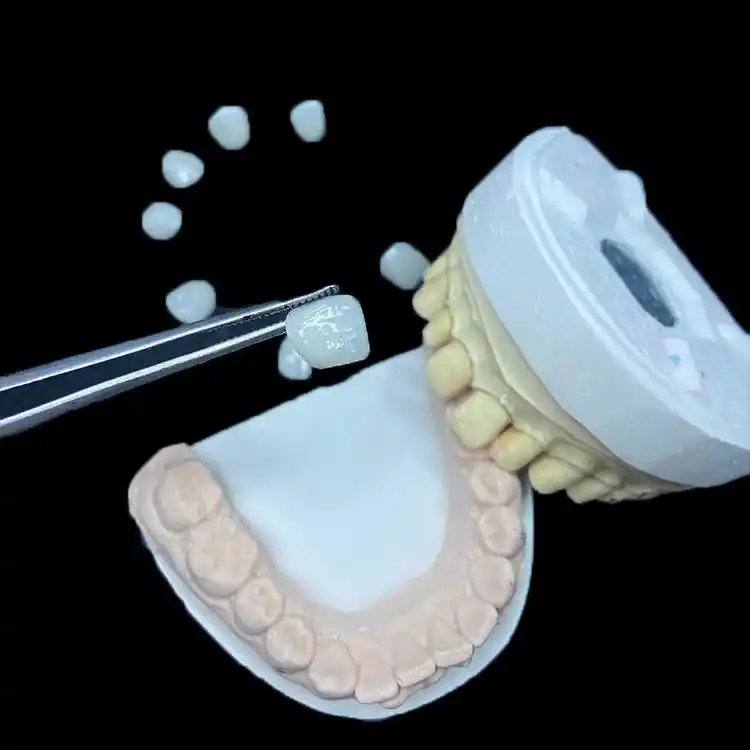
Monolithic E.max isn’t “less esthetic.” It’s less variable. This piece explains why consistency often beats layering, with 2024 veneer survival and color-shift data, plus lab-side workflow hard truths.
Consistency beats layering.
I’ve watched more “premium” layered cases fail at the boring stuff—repeatable value, controllable translucency, uniform contacts—than monolithic cases ever do, because layering multiplies variables (ceramist hands, porcelain thickness, firing cycles, surface texture) while the clinic still wants one outcome: the same shade, across units, across re-makes.
Why pretend that’s not the real job?
Here’s the hard truth I tell dentists (and sometimes other labs) when the photos start coming in: if your case success depends on a single artist’s mood that day, you don’t have a workflow—you have a gamble. And gambling is expensive.
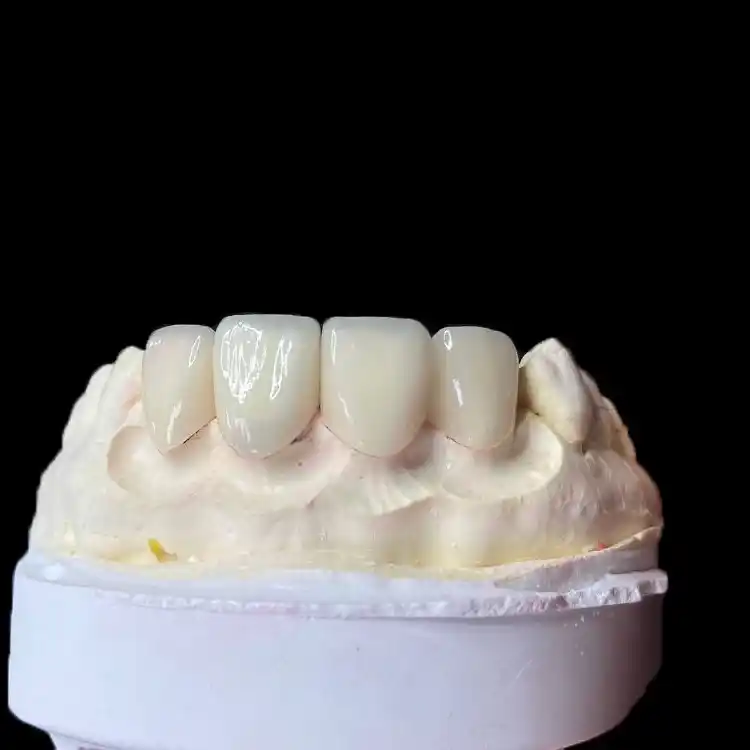
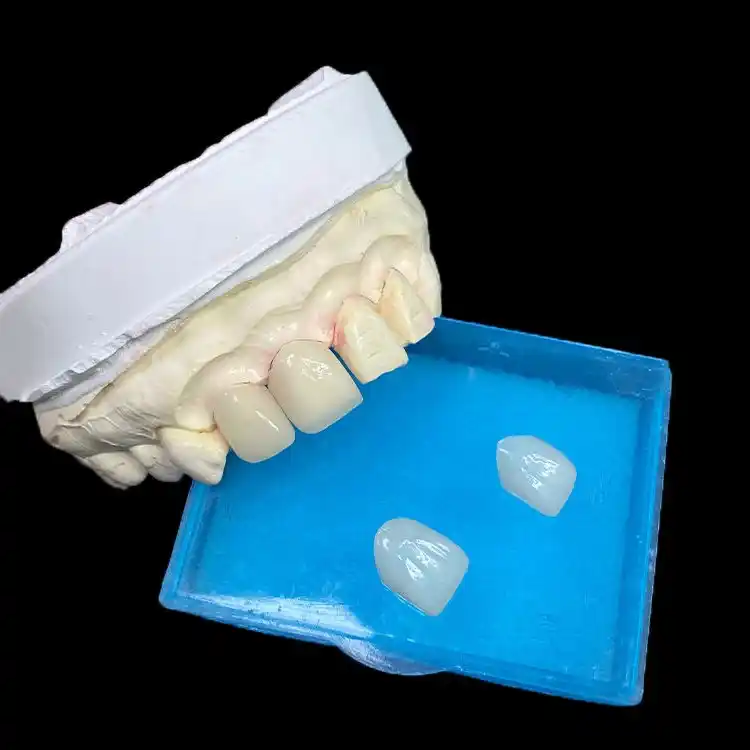
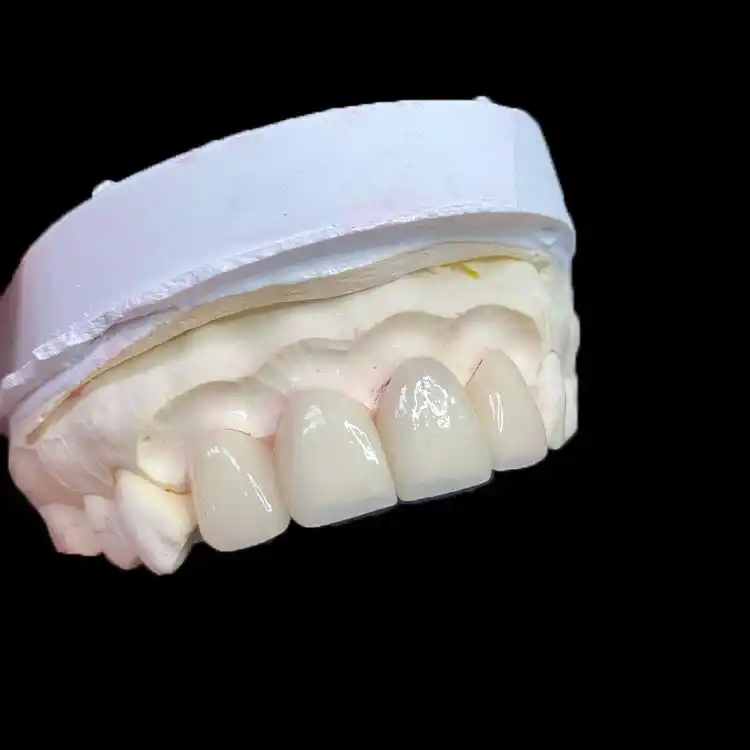
A full contour e.max veneer (monolithic lithium disilicate) is a one-piece solution. One material. One optical “system.” Less room for someone to accidentally create a value mismatch that no amount of chairside cement wizardry can hide.
Artist Dental Lab even frames it bluntly: full-contour (monolithic) E.max veneers are positioned for predictable fit, consistent strength, and controlled shade communication (shade + stump shade + photos). That’s not marketing fluff—it’s the shortest path to fewer surprises on multi-unit work. You can see how they spec it on their Full E.max Veneer (monolithic lithium disilicate) page.
Three words. Less drama.
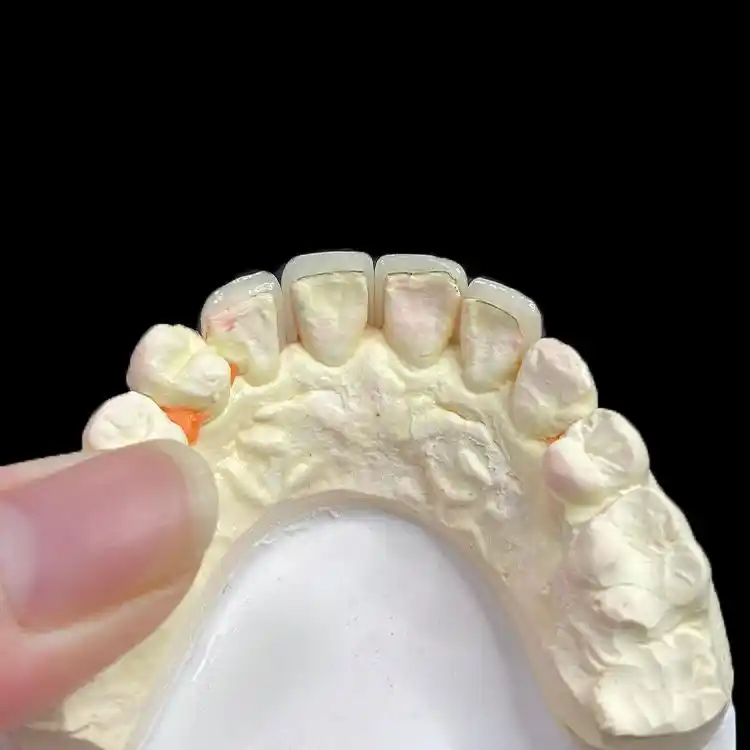
Now compare that to the Layered E.max Veneer: lithium disilicate core plus porcelain build-up, designed specifically to chase incisal effects, halo, characterization—aka, more “moving parts.”
Layering can look insane (in a good way). It can also drift. It’s both.
Most dentists talk about veneers like they’re a beauty product. They aren’t. They’re bonded ceramics living in a stress field, under habits you’ll never fully control.
A 2024 systematic review/meta-analysis reported pooled laminate veneer survival rates around 97.76% (1–3 years), 97.12% (~5 years), and 96.05% (~10.4 years)—and showed lithium disilicate subgroup survival in the short term at ~99.21%.
So yes: lithium disilicate veneers perform. The question becomes: where do your failures come from? And the answer is usually workflow—prep design, bonding, occlusion notes, photos, stump shade discipline—not whether a ceramist hand-layered a little extra “magic” at the incisal.
This is where I get opinionated. Most “shade misses” blamed on the lab are really ceramic + cement shade interactions plus thin areas where the stump shade is screaming through.
A 2024 in-vitro paper on lithium disilicate veneers measured color change (ΔE) after cementation and used clinical acceptability thresholds (values above ~3.3–3.5 are commonly considered unacceptable). In that study, IPS e.max CAD groups landed roughly 0.5–2.306 ΔE depending on cement shade, while IPS e.max Press groups landed ~5.272–8.848 ΔE—over the stated “unsatisfactory” range in their framework.
That is a giant, practical takeaway: your “material choice” is sometimes a proxy for “how sensitive this case will be to cement shade and thickness.” And if you want veneer shade consistency, you pick the path with fewer optical surprises.
If you’re building an internal standard, write this down: stump shade + cement shade are not “optional notes.” They’re your risk controls.
Small sentence.
Numbers matter.
A 2024 study on chairside CAD/CAM veneer restorations found fracture load values for maxillary central incisor veneers where IPS e.max CAD averaged ~640 ± 109 N, and even the lowest-tested lithium disilicate block in that set still exceeded reported occlusal force ranges cited in the paper (their referenced range peaking at ~320 N).
In other words: the material isn’t usually the weak link. The weak link is design + bonding + occlusion + expectations.
Also, the same paper gets nerdy in a way I respect: it describes e.max CAD’s microstructural transformation during crystallization (e.g., a partially crystallized state involving lithium metasilicate transforming toward lithium disilicate during firing around 850°C for 15–20 minutes, with associated property changes).
That’s why “CAD/CAM e.max veneers” aren’t just a convenience—they’re a controlled manufacturing route.
Layering wins when you actually need it:
That’s the real use case for Layered E.max Veneers for premium anterior characterization.
But if the case goal is “match these six units and don’t make me adjust contacts for an hour,” monolithic keeps you honest.
And if your doctor wants “the most natural translucency possible” above everything else? That’s where Feldspathic Veneers often enter the conversation—because translucency and surface nuance are the whole point of that category.
| Decision Factor | Monolithic E.max Veneer (Full-Contour) | Layered E.max Veneer | Feldspathic Veneer |
|---|---|---|---|
| Shade repeatability across 6–10 units | High (fewer variables) | Medium (more variables) | Medium (case-dependent) |
| Incisal effects / “vitality” | Good | Highest | Highest (when done well) |
| Risk of “value drift” between units | Lower | Higher | Medium |
| Workflow speed (B2B) | Fast / scalable | Slower / artisan-dependent | Slower / artisan-dependent |
| Best use case | Consistency-first smile cases | High-end anterior showpieces | Ultra-natural esthetics, selective cases |
| What I demand from the clinic | Stump shade + photos + clear priorities | Even more photos + space planning | Photos + expectations management |
If you want a practical template for what to send, Artist Dental Lab spells it out for monolithic (STLs, margin notes, shade/stump shade, photos, references) on their Full E.max Veneer workflow page.
Here’s the “insider” piece: multi-unit esthetics is a systems problem. Labs that stay sane standardize:
Artist Dental Lab’s Client Case section leans into the idea that consistency is an operational product (multi-site operators, standardized protocols, typical turnaround windows). That framing matters if you’re running volume.
How to choose monolithic vs layered veneers?
A monolithic vs layered veneer decision is a trade between predictability and customization: monolithic lithium disilicate prioritizes repeatable shade/fit/strength across units, while layered lithium disilicate adds porcelain build-up to maximize incisal effects and micro-characterization at the cost of more variables and more technician-dependent outcomes.
If the case is 4–10 units and the doctor wants “same shade, fast, no remakes,” I lean monolithic. If it’s two centrals in a high-value esthetic zone with demanding incisal effects, layering earns its keep.
What is a monolithic (full-contour) e.max veneer?
A monolithic (full-contour) e.max veneer is a single-piece lithium disilicate veneer—milled or pressed as one body—designed to reduce variability from porcelain layering, helping labs hold consistent value and contacts across multi-unit cases while still delivering natural translucency when shade, stump shade, and photo communication are disciplined.
Translation: fewer surprises.
How much can cement shade change the final color of lithium disilicate veneers?
Cement shade change is the measurable color shift (often expressed as ΔE) that occurs when a veneer’s translucency allows resin cement and stump shade to alter perceived value and hue, meaning the “same” ceramic can finish noticeably different depending on cement shade, thickness, and substrate.
In 2024 testing, some e.max CAD groups stayed roughly within ~0.5–2.3 ΔE across cement shades, while e.max Press groups in that setup ran much higher, highlighting how sensitive some workflows can be.
What’s the “best e.max veneer material” for consistency?
The best e.max veneer material for consistency is the one that minimizes shade and strength variability across your specific workflow—scanner, mill/press route, crystallization, finishing, and cement protocol—because clinical outcomes are driven by the system, not the brand name alone, especially in multi-unit cases where small value errors compound.
If you’re building a repeatable B2B pipeline, monolithic is often the safer default.
Want fewer remakes? Start with fewer variables.
If you’re running multi-unit cosmetic work and you want a lab workflow built around repeatable outcomes, look at Full E.max Veneer (monolithic) for consistency-first cases, and reserve Layered E.max Veneer for the true “showpiece” indications. If you’re ready to trial it, request a B2B price list and a first case via Artist Dental Lab Contact.