가격 및 샘플 지원 요청
지르코니아 크라운, 리튬 디실리케이트 크라운, 베니어, OEM 서비스 또는 도매 수복물 주문을 비교하고 있는 치과 기공소, 치과 진료소, 유통업체 및 조달 담당자분들을 위한 정보입니다.
귀사의 제품 유형, 소재, 월간 생산량, 수출 대상국 및 샘플 요청 사항을 알려주시면, 당사 영업팀이 적절한 후속 조치를 준비할 수 있습니다.

결정화 소성은 밀링 처리된 E.max 베니어를 부드러운 푸른색의 중간 단계 상태에서 완성된 이산화리튬으로 변화시키는 소성 공정입니다. 이 공정은 수복물의 최종 강도와 외관을 변화시키며, 치수에도 약간의 변화를 일으킵니다. 베니어를 조달하는 치과나 치과 기공소 입장에서는 소성 과정 자체가 어떤 문제를 일으킬 수 있는지, 그리고 어떤 문제는 단지 소성 과정에서 시작된 것처럼 보일 뿐인지를 파악하는 것이 실질적인 과제입니다. 발표된 크라운 연구에 따르면, 소성 후 마진 틈은 넓어지고 내부 틈은 좁아지지만, 측정된 값은 허용 범위 내에 머물렀습니다. 소성 후 발생하는 색상 변화는 대개 블록 선택, 두께, 치아 잔여부 색상, 시멘트, 추가 소성 주기뿐만 아니라 결정화 프로그램에서도 기인할 수 있습니다. 이 가이드에서는 이러한 원인을 구분하고, 케이스를 승인하기 전에 기공소에 문의해야 할 사항을 나열합니다.
IPS e.max CAD 블록은 부분적으로 결정화된 상태로 공급됩니다. Ivoclar는 이 블록의 초기 파란색 결정상을 다음과 같이 설명합니다. CAD/CAM 공구에 손상을 주지 않음, 그렇기 때문에 베니어를 먼저 밀링 가공한 뒤 소성 처리를 합니다. 이후 결정화 소성 처리를 통해 재료가 최종 미세구조로 변환됩니다. 같은 Ivoclar 페이지에 따르면, 완성된 재료의 굽힘 강도는 530 MPa, 파괴 인성은 2.11 MPa·m^1/2로 보고되어 있습니다.
구매자에게는 다음 세 가지 결과가 중요합니다:
아래 기사에서는 베니어에 대해 다루고 있지만, 문헌에 보고된 대부분의 측정 적합성 데이터는 크라운과 코핑에서 비롯된 것입니다. 연구 결과가 크라운에서 나온 경우에는 그 사실을 명시해 두었습니다.
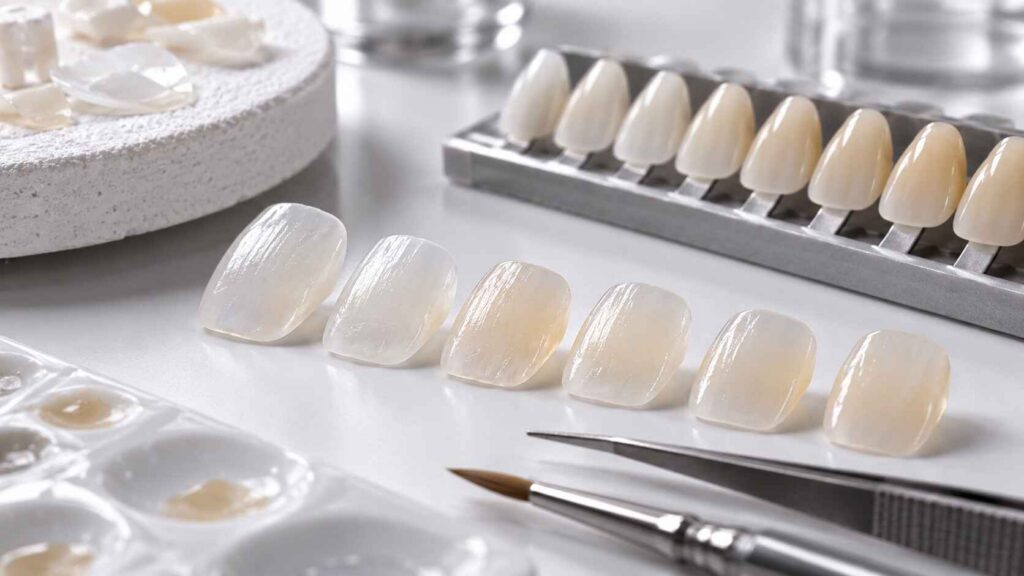
네, 약간은 그렇고, 그 변화는 예상 가능한 방향으로 나타납니다. 또한 공정상의 오류로 인해 이러한 변화가 더 커질 수 있습니다. 크라운 연구에서 나타나는 내재적 변화는 미미합니다. 공정과 관련된 변위는 용광로 상태, 지지대, 취급 방식에 따라 달라집니다.
CAD/CAM 리튬 디실리케이트 크라운에 대한 체외 연구, 결정화 전후의 적합도 측정, 15개의 작업 모형과 실리콘 복제 기법을 사용했다. 결정화 후 가장자리 부위의 틈은 넓어지고 내부 부위의 틈은 좁아졌으며, 측정된 모든 부위에서 이러한 차이는 통계적으로 유의미했다. 결정화 후 측정된 값 중 어느 것도 저자들이 임상적으로 허용 가능한 기준치로 간주하는 120 µm를 초과하지 않았다. 이 논문의 서론에서는 또한 결정화 과정에서 약 0.2–0.3%의 수축이 보고된 바 있음을 언급하고 있다.
이 내용을 해석할 때는 한계를 염두에 두시기 바랍니다. 지대치는 어금니였고, 수복물은 크라운이었으며, 표본 규모도 작았습니다. 베니어는 세라믹 부피가 훨씬 적고 형상도 매우 다르기 때문에, 크라운 수치는 대략적인 경향을 보여줄 뿐 베니어의 허용 오차를 나타내는 것은 아닙니다. 이 논문에서는 베니어에 특화된 측정값이 제시되지 않았습니다.
실제적으로 볼 때, 청색 상태에서 완벽하게 밀착된 것처럼 보였던 이음매가 소성 후 약간 벌어질 수 있는 반면, 오목한 표면은 더 단단해질 수 있습니다. 따라서 구매자는 실험실에서 적합도를 측정할 시점을 반드시 확인해야 합니다. 즉, 청색 상태의 복원물에서 측정하는지, 소성 후 측정하는지, 아니면 두 경우 모두에서 측정하는지 물어봐야 합니다.
제조업체의 사용 설명서에는 여러 가지 조작 방법이 명시되어 있습니다. 이보클라(Ivoclar)의 IPS e.max CAD 체어사이드 사용 설명서, ManualsDir에 게시된 내용에 따르면 다음과 같이 명시되어 있습니다:
이 지침들은 진료실 사용을 위해 작성된 것이므로, 각 실험실에서는 자사가 사용하는 소성로의 실험실용 사용 설명서(IFU)에 명시된 해당 요구 사항을 확인해야 합니다. 어떤 지침에도 베니어 전용 허용 오차가 명시되어 있지 않으며, 허용 오차를 무시할 경우 적합도가 얼마나 변할지 예측한 내용도 없습니다. 그럼에도 불구하고, 각 지침은 특정 응력이나 온도 변수를 대상으로 하고 있습니다. 얇은 베니어는 열의 불균형이나 지지력의 불균형을 상쇄할 만한 질량이 거의 없습니다.
블루 스테이트에서 가장자리가 깨지거나 미세 균열이 생긴 부분은 소성 과정에서 회복되지 않으며, 소성 전에는 잘 보이지 않던 결함도 소성 후에는 더 쉽게 눈에 띌 수 있습니다. 이 가이드에 소개된 진단 체계는 밀링 과정에서 E.max 베니어 마진이 깨지는 이유 이 문서는 “결정화 소성 후”를 칩이 처음 발견될 수 있는 단계 중 하나로 꼽고 있다. 여러 부품에서 동일한 패턴이 반복적으로 나타나는 것은 스캔 데이터나 설계 데이터의 문제를 시사한다. 무작위 위치에서 나타나는 경우, 공구 상태, 취급 과정 또는 공정상의 문제를 시사한다.
반드시 보철물 자체에 문제가 있다고 단정하지 마십시오. 접합부가 꽉 조여져 있거나 잔여 이물질이 남아 있거나, 다이(die)의 불일치로 인해 베니어가 치아에 제대로 밀착되지 않을 수도 있습니다. 다음 가이드에서 E.max 베니어의 내부 조정 피팅 표면을 연마하여 강제로 장착할 경우 파손 및 접착 박리 위험이 발생하는 이유와, 여러 치아에 걸쳐 체계적인 피팅 문제가 발생할 경우 기록을 첨부하여 이를 실험실로 돌려보내야 하는 이유를 설명합니다.
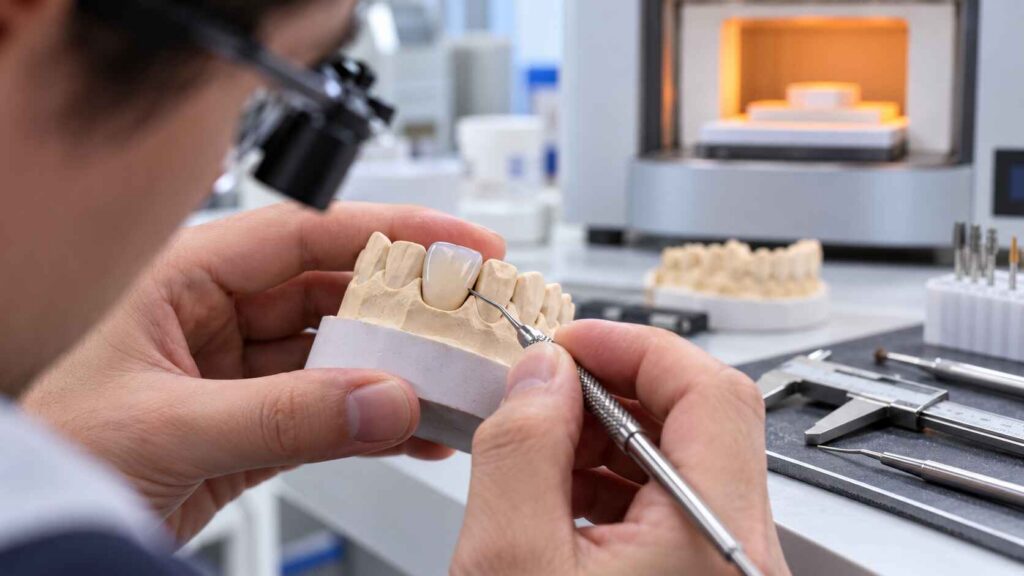
소성 과정이 영향을 미칠 수는 있지만, 결코 유일한 변수는 아닙니다. 베니어가 가마에 들어가기 전에 원목의 선택과 두께는 이미 정해져 있으며, 가마에서 나온 후에는 그루터기 색상과 시멘트가 베니어에 영향을 미칩니다.
시작 시 블록의 반투명도가 선택됩니다. Ivoclar는 다음과 같이 나열합니다. 4가지 반투명도 단계와 A–D, Bleach, Impulse 색상 IPS e.max CAD의 경우, HT, MT, LT, MO 중 실험실에서 선택한 옵션에 따라 치아 잔여부와 시멘트가 결과에 미치는 영향의 정도가 결정되며, 두께에 따라 광학적 결과도 달라집니다. 형광에 관한 논문에서는 다음과 같이 밝히고 있습니다. E.max 베니어의 세라믹 두께, 시멘트, 그리고 층 쌓기 방식은 모두 형광 현상에 영향을 미칩니다., 따라서 시멘테이션 후 색상이 이상해 보이는 경우, 애초에 소성 과정의 문제가 아니었을 수도 있습니다.
치근 그늘 현상도 같은 범주에 속합니다. 어두운 색상이나 혼합된 치아 표면 위에 얇고 투명도가 높은 베니어를 씌우면, 소성 프로그램을 어떻게 설정하든 주변의 밝은 부분과 색상이 일치하지 않습니다. 소성 로드가 아닌 치아 표면 처리 과정에서 발생하는 이러한 색상 불일치는 기질과 마스킹 처리 방식의 문제임을 시사합니다.
Temperature accuracy, hold time, and program choice are the furnace variables. The lab-side IPS e.max CAD laboratory instructions for use list program durations of approximately 25 minutes for crystallization without staining and glazing in some workflows, and approximately 35 minutes for MO and Impulse blocks in others. The edition reviewed here is an older one, so confirm current parameters, but the principle holds: a program built for one block family is not interchangeable with another.
Surface contamination is a second route. The same IFU says restorations should be cleaned with ultrasound in a water bath or with a steam jet before crystallization, and must not be blasted with aluminum oxide or glass polishing beads. Residue on the visible surface is a plausible cause of a localized discoloration after firing. That link is an inference from process logic, not a quantified finding.
Evidence that temperature and hold time can move color and translucency exists, but for a different material. A BMC Oral Health study on Amber Mill nano lithium disilicate tested a manufacturer-recommended 825 °C against 800 °C with several holding times. The authors report that the temperature and holding times they suggested altered color reproduction and translucency relative to the manufacturer’s settings, without a significant effect on flexural strength. This was a different ceramic with different parameters. It does not show that E.max reacts the same way. It does support asking a lab for its calibration record and for confirmation that it uses the manufacturer’s program for the specific block.
Many E.max veneers are fired more than once. The lab-side IFU lays out workflows in which crystallization is followed by wash, dentin, incisal, and stain or glaze firings, depending on the construction. A monolithic veneer typically passes through fewer steps. The comparison of monolithic and layered E.max veneers for multi-unit smiles explains why added layering adds technique-dependent variation between units, and extra firings are part of that variation. For finish, the polished-versus-glazed article covers how polished and glazed finishes change light reflection, which matters because gloss differences are often read as shade differences.
This table is a qualitative framework built from manufacturer instructions and the studies above. It does not rank causes by measured frequency.
| 변수 | Can it shift fit? | Can it shift shade? | What to verify with the lab |
|---|---|---|---|
| Inherent transformation shrinkage | Yes, direction shown in crown studies (margin gap up, internal gap down) | No direct evidence | Where fit is checked: blue state, post-firing, or both |
| Furnace calibration and type | Plausible | Plausible | Furnace model, controlled cooling and vacuum capability, last calibration date |
| Tray, pins, and firing paste | Plausible (support and cooling stress) | Not established | Whether the dedicated tray and Object Fix are used for every load |
| Cooling and handling | Plausible stress risk | Not established | Draft protection, no quenching, no blasting after firing |
| Program choice (standard vs speed) | Not established for veneers | Not established | Whether the program matches block type and tray |
| Block translucency (HT/MT/LT/MO/Impulse) | 아니요 | Yes, set before firing | Block type written on the work order |
| 세라믹 두께 | Design-dependent | 네 | Design thickness by zone, not one average |
| Stump shade and cement | 아니요 | Yes, after firing | Stump shade photographs, planned cement |
| Number of firings | Cumulative effect not quantified here | Plausible | Firing count for the chosen construction |
Possibly, and the answer depends on whether the program is validated for the block, furnace, and tray. Ivoclar’s lab-side IFU says speed crystallization must be performed on a dedicated Speed Crystallization Tray, with a stated maximum of two units on that tray. A 2024 paper on fast crystallization and simultaneous glazing of lithium disilicate CAD/CAM ceramic reports that abbreviated crystallization and simultaneous glazing with non-recommended systems adversely affected the final properties, with microstructural features suggesting incomplete crystallization. The abstract-level evidence available here does not break results down by veneer thickness.
The distinction is between a manufacturer-validated fast program and an improvised shortcut. A lab using a fast program should be able to say which one, on which furnace, with which tray.
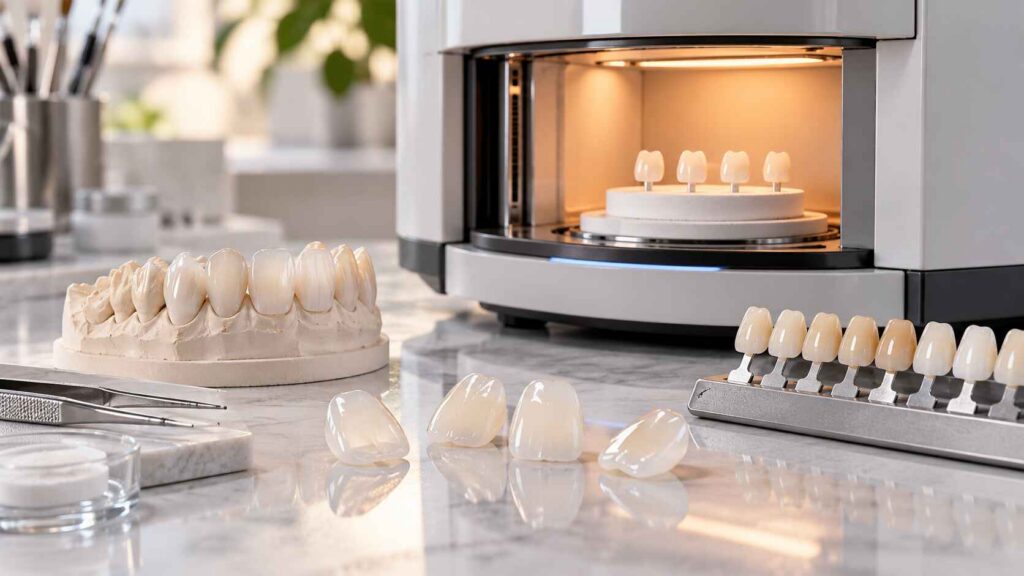
A common assumption holds that if a veneer fit the die in the blue state and the shade tab matched, the firing is a formality. That is partly wrong. The crown data show a measurable, directional dimensional change, so a pre-firing check is not a final check. The opposite assumption is also too simple: that every post-firing shade complaint is a furnace error. Block choice, thickness, stump, cement, and added firings all sit between the firing and the clinical result.
An illustrative scenario, not a client case: a lab delivers eight veneers where #7 and #10 read slightly lighter in value than the rest. A furnace error would be one explanation. A different block translucency on those two units, a thinner cervical design, or a lighter stump on those teeth would be others. Which explanation is correct determines whether the fix is a remake of two units, a cement change, or a calibration check. Documentation, not assumption, resolves it.
Buyers do not need to audit a furnace, but a few questions separate a controlled process from an unexamined one. Ask for:
On your side, send the preparation and opposing scans, bite registration, shade and stump-shade photographs, planned cement, and the intended construction. The E.max veneer product page lists the case files the lab expects for new orders. A veneer that fails after firing is far easier to diagnose when those inputs were recorded before production began.
Slightly. In a study of lithium disilicate crowns, marginal gaps increased and internal gaps decreased after crystallization, with all values below 120 µm. No veneer-specific measurement was identified, so ask the lab where it checks fit.
Yes, the block changes from its blue state to the final tooth-colored material, which is why shade cannot be judged before firing. Block translucency, thickness, stump shade, cement, and added firings then shape what the clinician sees.
Ivoclar’s chairside IFU calls for calibration before the first crystallization and every six months after that, with more frequent calibration possible depending on use. A lab should be able to state its last calibration date.
Re-firing is not a fit correction, and extra firings add exposure. Stain and glaze corrections follow the manufacturer’s corrective-firing parameters. A fit problem should be traced to its cause and usually returned to the lab, not solved with another cycle.
Not by default. A manufacturer-validated speed program on the specified tray is a documented workflow. A 2024 study found adverse effects when abbreviated crystallization or simultaneous glazing used non-recommended systems.
Resin cement, stump shade, and ceramic thickness all change the bonded result, and a study cited in the lab’s fluorescence guide found that fluorescence varied with both ceramic and cement. A lab shade check cannot fully predict the post-cementation appearance.