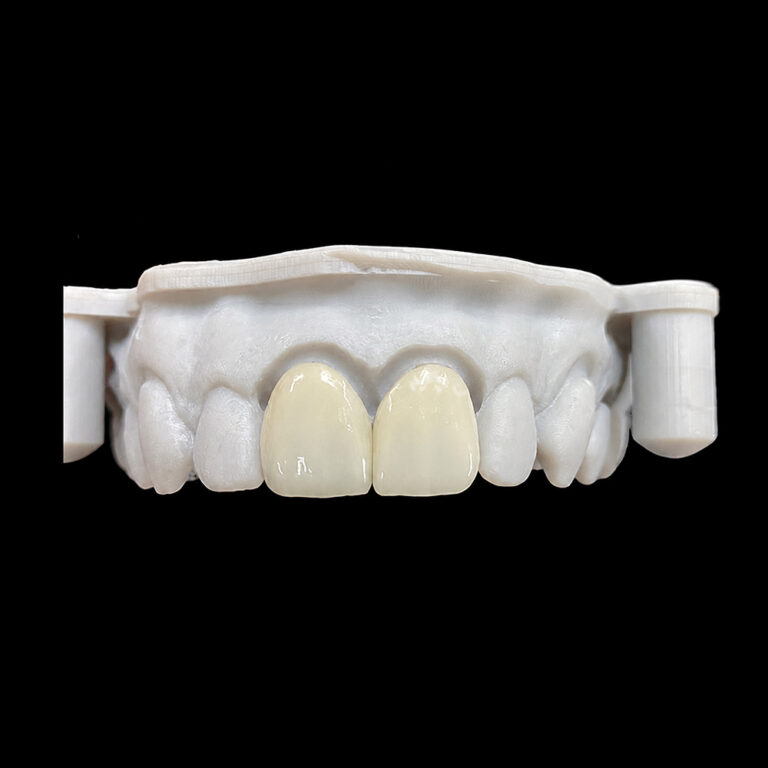
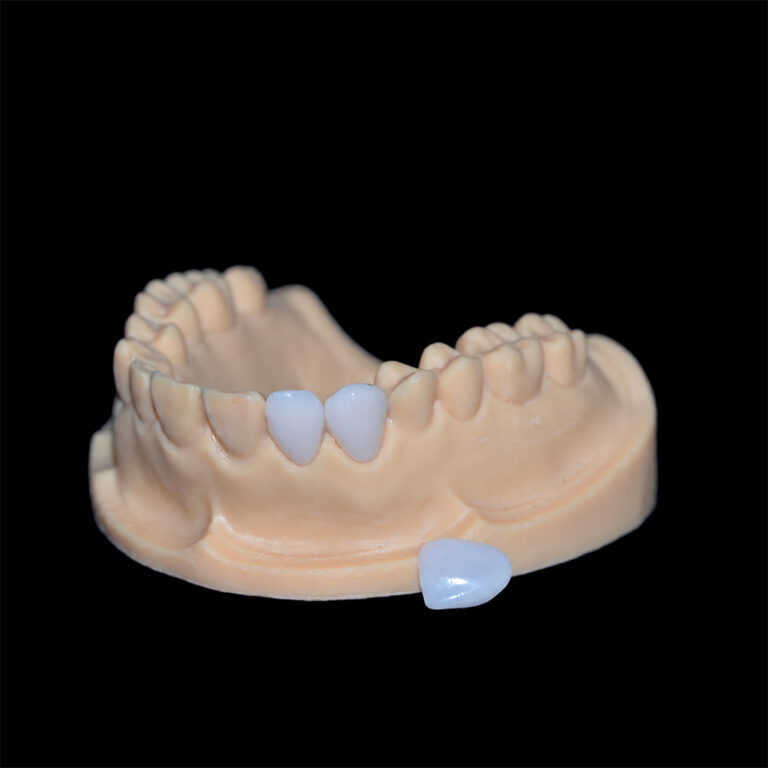
E.max Crystallization Firing: What Can Shift Veneer Fit and Shade?
Crystallization firing is the furnace step that turns a milled E.max veneer from a softer, blue intermediate into finished lithium disilicate. It changes the restoration’s final strength and appearance, and it changes its dimensions slightly. For a clinic or dental lab sourcing veneers, the practical question is which problems the firing itself can cause and which ones only appear to start there. In published crown studies, marginal gaps widen and internal gaps narrow after firing, though the measured values stayed within accepted limits. Shade changes after firing can usually be traced to block selection, thickness, stump color, cement, or extra firing cycles as well as to the crystallization program. This guide separates those causes and lists what to ask a lab before approving a case.
What Happens to an E.max Veneer During Crystallization Firing?
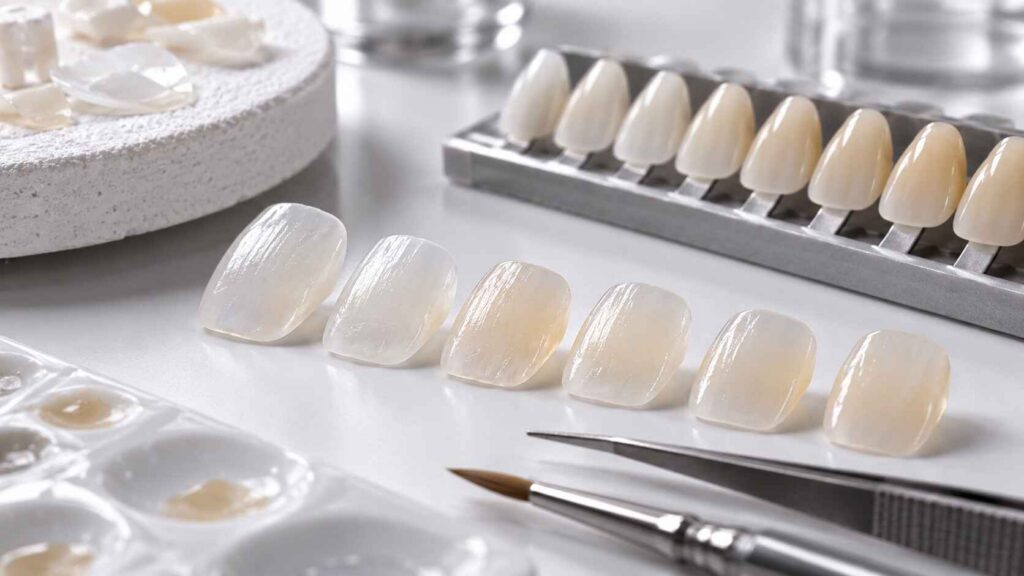
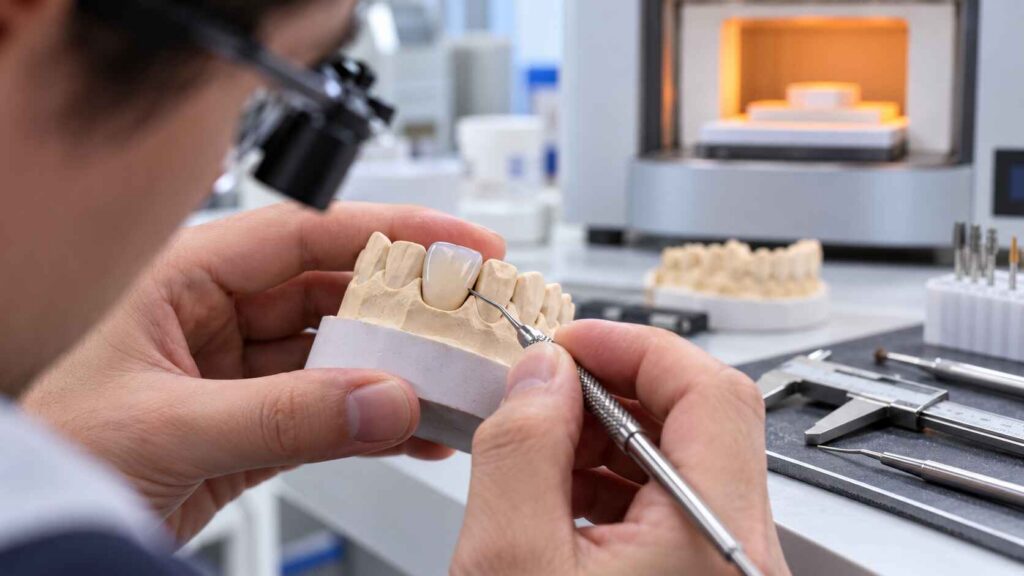
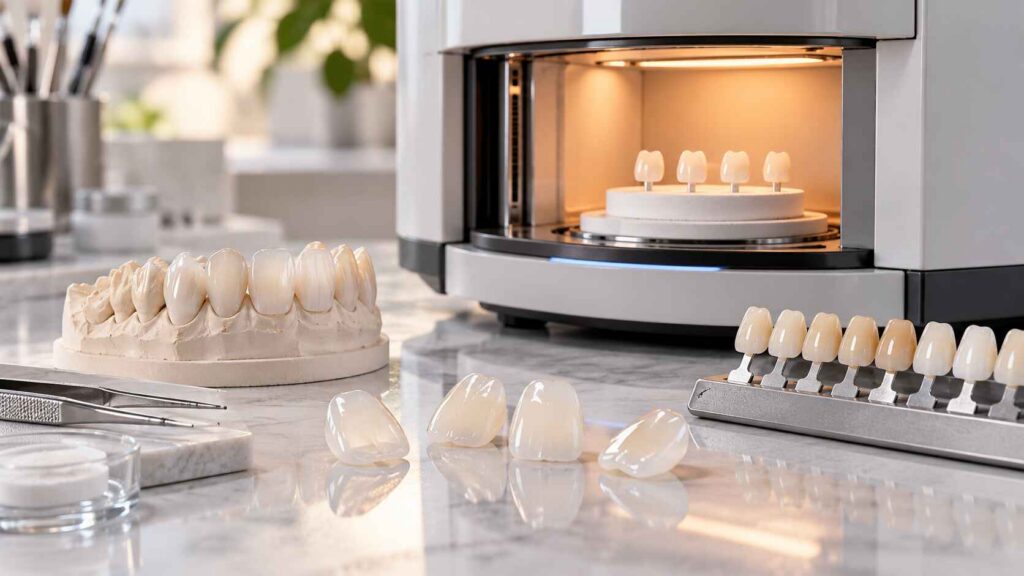
IPS e.max CAD blocks are supplied in a partially crystallized state. Ivoclar describes the block’s initial blue crystalline phase as gentle on CAD/CAM tools, which is why the veneer is milled first and fired afterward. Crystallization firing then converts the material to its final microstructure. The same Ivoclar page reports a flexural strength of 530 MPa and a fracture toughness of 2.11 MPa·m^1/2 for the finished material.
Three consequences matter to a buyer:
The milled restoration is not the final restoration. Fit and shade checked in the blue state are provisional.
The furnace is a controlled process, not a heater. Atmosphere, temperature accuracy, support, and cooling are all specified by the manufacturer.
Each additional firing is another exposure. Stain, glaze, wash, and incisal firings come after or alongside crystallization, depending on the workflow.
The article below covers veneers, but most measured fit data in the literature comes from crowns and copings. Where a finding comes from crowns, it is labeled as such.
Can Crystallization Firing Change E.max Veneer Fit?
Yes, slightly and in a predictable direction, and process errors can add to it. The built-in change is small in crown studies. Process-related shifts depend on furnace condition, support, and handling.
The built-in dimensional change
An in-vitro study of CAD/CAM lithium disilicate crowns, measuring fit before and after crystallization, used 15 working models and the silicone replica technique. Gaps increased at the margin and decreased in the internal areas after crystallization, and the differences were statistically significant in every area measured. None of the post-crystallization values exceeded 120 µm, the threshold the authors treat as clinically acceptable. The paper’s introduction also cites a reported shrinkage of roughly 0.2–0.3% during crystallization.
Read this with its limits. The abutment was a molar, the restorations were crowns, and the sample was small. A veneer has far less ceramic volume and a very different geometry, so the crown numbers show direction, not a veneer tolerance. No veneer-specific measurement was identified for this article.
The practical reading is that a margin which looked perfectly closed in the blue state can open slightly after firing, while the intaglio surface can tighten. Buyers should therefore ask where a lab measures fit: on the blue-state restoration, after firing, or both.
Furnaces without controlled long-term cooling or a vacuum function cannot be used.
The furnace must be calibrated before the first crystallization and every six months after that, with more frequent calibration possible depending on use.
Only the IPS e.max CAD Crystallization Tray and matching pins should be used, because they store heat for slow, tension-free cooling.
Restorations should not sit directly on the tray and pins without Object Fix firing paste.
Objects should cool to room temperature protected from drafts, should not be touched with metal tongs, and should not be blasted or quenched.
These are written for chairside use, so a lab should confirm the equivalent requirements in the lab-side IFU for its own furnace. None of the instructions states a veneer-specific tolerance, and none of them predicts how much fit will shift if one is ignored. Still, each one targets a stress or temperature variable. A thin veneer has little mass to buffer uneven heat or uneven support.
Damage that firing reveals but does not cause
A margin that is chipped or micro-cracked in the blue state will not heal in the furnace, and a defect that was hard to see before firing can be easier to see afterward. The diagnostic framework in this guide on why E.max veneer margins chip during milling lists “after the crystallization firing” as one stage at which a chip can first be noticed. The same pattern recurring across units points to scan or design data. Random locations point to tool condition, handling, or process.
When a veneer does not seat after firing
Do not assume the furnace is at fault. A tight contact, residual debris, or a die discrepancy can hold a veneer off the tooth just as well. The guide on internal adjustment of E.max veneers explains why grinding the fitting surface to force a seat risks fracture and debonding, and why a systematic fit problem across several units should go back to the lab with records instead.
Can Crystallization Firing Change E.max Veneer Shade?
The firing can contribute, but it is never the only variable. Block choice and thickness are fixed before the veneer enters the furnace, and stump shade and cement act on it after it leaves.
Stump shade belongs to the same category. A thin, highly translucent veneer over a darker or mixed preparation will not match a lighter neighbor, whatever the firing program does. A mismatch that follows the preparation, not the furnace load, points to substrate and masking decisions.
What the furnace and protocol can influence
Temperature accuracy, hold time, and program choice are the furnace variables. The lab-side IPS e.max CAD laboratory instructions for use list program durations of approximately 25 minutes for crystallization without staining and glazing in some workflows, and approximately 35 minutes for MO and Impulse blocks in others. The edition reviewed here is an older one, so confirm current parameters, but the principle holds: a program built for one block family is not interchangeable with another.
Surface contamination is a second route. The same IFU says restorations should be cleaned with ultrasound in a water bath or with a steam jet before crystallization, and must not be blasted with aluminum oxide or glass polishing beads. Residue on the visible surface is a plausible cause of a localized discoloration after firing. That link is an inference from process logic, not a quantified finding.
Evidence that temperature and hold time can move color and translucency exists, but for a different material. A BMC Oral Health study on Amber Mill nano lithium disilicate tested a manufacturer-recommended 825 °C against 800 °C with several holding times. The authors report that the temperature and holding times they suggested altered color reproduction and translucency relative to the manufacturer’s settings, without a significant effect on flexural strength. This was a different ceramic with different parameters. It does not show that E.max reacts the same way. It does support asking a lab for its calibration record and for confirmation that it uses the manufacturer’s program for the specific block.
Additional firings
Many E.max veneers are fired more than once. The lab-side IFU lays out workflows in which crystallization is followed by wash, dentin, incisal, and stain or glaze firings, depending on the construction. A monolithic veneer typically passes through fewer steps. The comparison of monolithic and layered E.max veneers for multi-unit smiles explains why added layering adds technique-dependent variation between units, and extra firings are part of that variation. For finish, the polished-versus-glazed article covers how polished and glazed finishes change light reflection, which matters because gloss differences are often read as shade differences.
E.max Crystallization Variables: Effect on Fit, Shade, and What to Verify
This table is a qualitative framework built from manufacturer instructions and the studies above. It does not rank causes by measured frequency.
Variable
Can it shift fit?
Can it shift shade?
What to verify with the lab
Inherent transformation shrinkage
Yes, direction shown in crown studies (margin gap up, internal gap down)
No direct evidence
Where fit is checked: blue state, post-firing, or both
Furnace calibration and type
Plausible
Plausible
Furnace model, controlled cooling and vacuum capability, last calibration date
Tray, pins, and firing paste
Plausible (support and cooling stress)
Not established
Whether the dedicated tray and Object Fix are used for every load
Cooling and handling
Plausible stress risk
Not established
Draft protection, no quenching, no blasting after firing
Program choice (standard vs speed)
Not established for veneers
Not established
Whether the program matches block type and tray
Block translucency (HT/MT/LT/MO/Impulse)
No
Yes, set before firing
Block type written on the work order
Ceramic thickness
Design-dependent
Yes
Design thickness by zone, not one average
Stump shade and cement
No
Yes, after firing
Stump shade photographs, planned cement
Number of firings
Cumulative effect not quantified here
Plausible
Firing count for the chosen construction
Does a Faster Crystallization Program Change the Result?
Possibly, and the answer depends on whether the program is validated for the block, furnace, and tray. Ivoclar’s lab-side IFU says speed crystallization must be performed on a dedicated Speed Crystallization Tray, with a stated maximum of two units on that tray. A 2024 paper on fast crystallization and simultaneous glazing of lithium disilicate CAD/CAM ceramic reports that abbreviated crystallization and simultaneous glazing with non-recommended systems adversely affected the final properties, with microstructural features suggesting incomplete crystallization. The abstract-level evidence available here does not break results down by veneer thickness.
The distinction is between a manufacturer-validated fast program and an improvised shortcut. A lab using a fast program should be able to say which one, on which furnace, with which tray.
Where Is the Conventional Assumption Too Simple?
A common assumption holds that if a veneer fit the die in the blue state and the shade tab matched, the firing is a formality. That is partly wrong. The crown data show a measurable, directional dimensional change, so a pre-firing check is not a final check. The opposite assumption is also too simple: that every post-firing shade complaint is a furnace error. Block choice, thickness, stump, cement, and added firings all sit between the firing and the clinical result.
An illustrative scenario, not a client case: a lab delivers eight veneers where #7 and #10 read slightly lighter in value than the rest. A furnace error would be one explanation. A different block translucency on those two units, a thinner cervical design, or a lighter stump on those teeth would be others. Which explanation is correct determines whether the fix is a remake of two units, a cement change, or a calibration check. Documentation, not assumption, resolves it.
What Should Buyers Ask a Lab About Crystallization Firing?
Buyers do not need to audit a furnace, but a few questions separate a controlled process from an unexamined one. Ask for:
Furnace type and calibration date. The IFU sets a six-month calibration interval as a minimum.
Program and tray per block type. Standard or speed, and the matching tray.
Fit check stage. Whether fit is verified after firing on a model, with magnified margin inspection before and after.
Firing count. How many firings the chosen construction involves, and whether stain and glaze are integrated with crystallization or separate.
Block documentation. Translucency and shade recorded on the work order so a remake can reproduce it.
Remake terms. Who investigates a post-firing fit or shade problem and what records are reviewed.
On your side, send the preparation and opposing scans, bite registration, shade and stump-shade photographs, planned cement, and the intended construction. The E.max veneer product page lists the case files the lab expects for new orders. A veneer that fails after firing is far easier to diagnose when those inputs were recorded before production began.
Frequently Asked Questions
Does crystallization firing change the fit of an E.max veneer?
Slightly. In a study of lithium disilicate crowns, marginal gaps increased and internal gaps decreased after crystallization, with all values below 120 µm. No veneer-specific measurement was identified, so ask the lab where it checks fit.
Does E.max change color during crystallization?
Yes, the block changes from its blue state to the final tooth-colored material, which is why shade cannot be judged before firing. Block translucency, thickness, stump shade, cement, and added firings then shape what the clinician sees.
How often should a crystallization furnace be calibrated?
Ivoclar’s chairside IFU calls for calibration before the first crystallization and every six months after that, with more frequent calibration possible depending on use. A lab should be able to state its last calibration date.
Can a veneer be re-fired to fix shade or fit?
Re-firing is not a fit correction, and extra firings add exposure. Stain and glaze corrections follow the manufacturer’s corrective-firing parameters. A fit problem should be traced to its cause and usually returned to the lab, not solved with another cycle.
Is speed crystallization worse than the standard program?
Not by default. A manufacturer-validated speed program on the specified tray is a documented workflow. A 2024 study found adverse effects when abbreviated crystallization or simultaneous glazing used non-recommended systems.
Why does my E.max veneer look different after cementation?
Resin cement, stump shade, and ceramic thickness all change the bonded result, and a study cited in the lab’s fluorescence guide found that fluorescence varied with both ceramic and cement. A lab shade check cannot fully predict the post-cementation appearance.