Monolithic vs Layered E.max Veneers for Uniform Multi-Unit Smiles
Consistency beats theater.
When six, eight, or ten anterior units are being designed together, the laboratory is not solving one veneer problem several times; it is controlling a connected optical system in which value, translucency, ceramic thickness, stump shade, cement color, line angles, incisal position, and surface texture must remain coherent from tooth to tooth.
So why add complexity unless the smile actually needs it?
That is how I approach the monolithic vs layered E.max veneers argument. I do not automatically consider layered ceramic more premium, and I do not automatically consider monolithic ceramic less esthetic. Those are sales-floor simplifications.
For a uniform multi-unit smile, the real question is this:
How much handcrafted optical variation improves the case before that variation starts reducing cross-unit consistency?
That distinction matters because E.max veneers are not merely white shells. Lithium disilicate interacts with the prepared tooth, resin cement, neighboring restorations, surface geometry, and incident light. Once multiple units enter the smile, every small error can repeat.
Artist Dental Lab’s discussion of single veneers versus multi-unit veneers makes the same underlying point: a larger case gives the technician more control over the overall visual system, but repeated errors in value, contour, or texture can become more obvious across the smile.
The Real Multi-Unit Problem Is Variance, Not Beauty
A single central incisor can justify obsessive individual characterization because the restoration must disappear beside natural enamel.
Eight veneers are different.
Now we are controlling a group.
The centrals still need dominance. Laterals should not look like shortened copies of the centrals. Canines need their own transition in chroma, facial convexity, and line-angle position. But the entire group must still appear to belong to one mouth.
That is why I think the phrase uniform smile is often misunderstood.
Uniform does not mean identical.
It means controlled.
A successful multi-unit smile should maintain a disciplined relationship between:
overall value and brightness;
cervical-to-incisal chroma progression;
incisal translucency;
central, lateral, and canine morphology;
facial line angles;
contact and embrasure progression;
surface texture;
gloss;
visible ceramic thickness;
stump-shade influence.
If one veneer is noticeably more translucent, one lateral is noticeably warmer, or one central reflects a much broader band of light, the patient may not know the technical reason.
They simply see that something is off.
What Monolithic and Layered E.max Actually Mean
Both approaches can use lithium disilicate, commonly associated with Ivoclar’s IPS e.max system. The difference is how the restoration’s anatomy and optical character are constructed.
Monolithic E.max Veneers Use One Main Ceramic Body
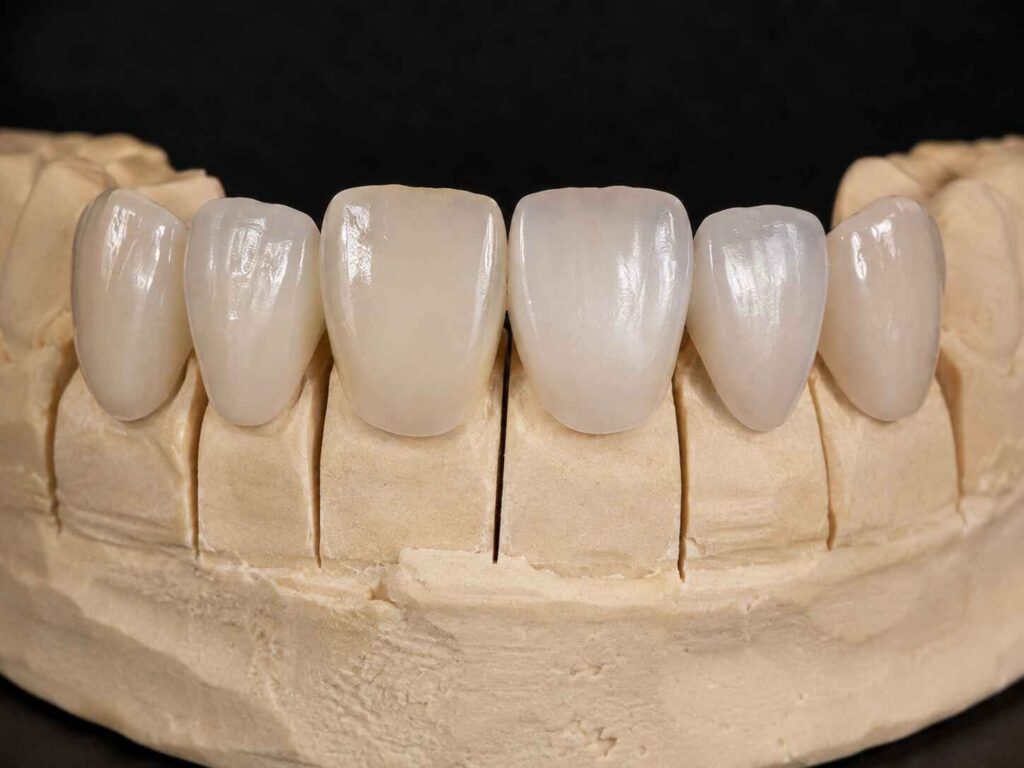
A monolithic E.max veneer is fabricated primarily as a full-contour lithium disilicate restoration. Shape, surface anatomy, staining, glazing, polish, and texture are used to create the final appearance without building substantial veneering porcelain over the facial surface.
Artist Dental Lab positions its Full E.max Veneer specifically around predictable fit, controlled strength, translucency, and consistent results in single- and multi-unit cosmetic cases.
That manufacturing logic makes sense to me.
Fewer material transitions mean fewer artistic variables.
And when the target is eight coordinated veneers rather than one highly individualized tooth, reducing unnecessary variables can be an advantage.
Monolithic does not mean featureless.
A competent ceramist can manipulate contour, developmental anatomy, line angles, incisal edge shape, external stain, surface texture, polish, and gloss while keeping the main ceramic body consistent from unit to unit.
Layered E.max Veneers Add an Esthetic Build-Up
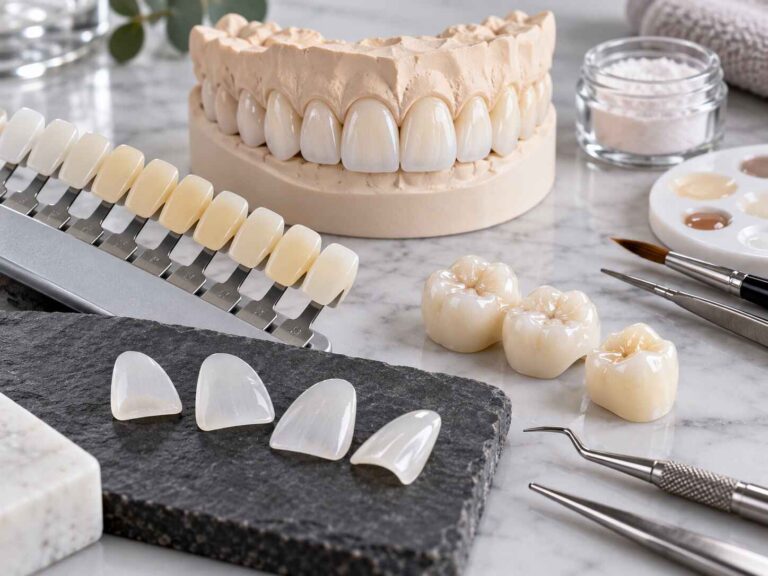
A layered E.max veneer typically uses a lithium disilicate foundation with additional veneering ceramic applied to create internal depth, incisal translucency, halo effects, localized opacity, mamelon effects, and more individualized optical behavior.
Artist Dental Lab describes its Layered E.max Veneer as a lithium disilicate core with porcelain layering intended for detailed anterior characterization and more nuanced translucency.
There is more artistic freedom.
There is also more technician-dependent interpretation.
That tradeoff gets ignored far too often.
A highly skilled ceramist can make layered E.max extraordinary. But hand-built character is not automatically the same thing as accuracy, and a technician who slightly changes porcelain thickness, internal effects, firing behavior, or surface anatomy from unit to unit can create variation the clinician never requested.
The Clinical Data Makes the Argument More Interesting
Lithium disilicate itself has a strong clinical record. What the literature does not support is the lazy conclusion that every lithium disilicate fabrication technique produces exactly the same risk profile.
One of the more useful real-world datasets came from a 2015 retrospective study published in The Journal of Prosthetic Dentistry. Researchers evaluated 21,340 IPS e.max restorations over 45 months, including 15,802 monolithic restorations and 5,538 layered restorations.
For E.max veneers specifically, 1.30% of monolithic veneers fractured versus 1.53% of layered veneers. The numerical difference is small, and the retrospective design does not justify pretending that monolithic veneers are universally superior. Still, the dataset is valuable because it shows that added layering certainly did not create an obvious durability advantage.
That is one reality check.
Another comes from longer-term veneer data. A 2019 study followed 364 pressable lithium disilicate laminate veneers placed in 41 patients for 10 years. Reported survival was 97.4%, while complications occurred in 1.64% of restorations: 0.55% fractures and 1.09% debonding. The 10-year lithium disilicate veneer study on PubMed is worth reading because it reinforces something less glamorous than material marketing: disciplined clinical protocol matters.
A newer systematic review and meta-analysis published in 2025 reported a pooled 96.81% survival rate for lithium disilicate veneers at approximately 10.4 years. That does not settle the monolithic-versus-layered question because the included evidence was not designed as one clean head-to-head trial of these two techniques. It does, however, strengthen the broader case for lithium disilicate as a predictable veneer material when indication, preparation, fabrication, and bonding are controlled.
So the evidence does not tell me, “Always choose monolithic.”
It tells me something more useful:
Do not spend complexity unless that complexity buys an optical result the case actually needs.
Monolithic vs Layered E.max Veneers: The Practical Comparison
Decision Factor
Monolithic E.max Veneers
Layered E.max Veneers
My Practical Read
Main construction
Full-contour lithium disilicate
Lithium disilicate foundation + veneering ceramic
Monolithic has fewer fabrication variables
Multi-unit shade consistency
Highly controllable
More technician-dependent
Monolithic usually has the edge
Incisal characterization
Good with anatomy, stain, texture and material selection
Excellent potential for internal effects
Layered wins when real optical complexity is required
Value control
Predictable when substrate and translucency are documented
Highly adjustable but more technique-sensitive
Depends heavily on stump shade and available space
Unit-to-unit repeatability
Strong
Can be excellent with disciplined layering
Monolithic reduces avoidable variation
Surface texture
Externally developed
Externally developed plus layered optical depth
Either can succeed
Repair/remake matching
Generally easier to reproduce from documented design
Additional layering variables must be reproduced
Documentation becomes more important with layering
Fabrication complexity
Lower
Higher
Complexity should have a clinical reason
Best multi-unit use
Controlled, uniform smile transformations
Premium cases needing individual optical effects
Do not equate “more layers” with “better”
Primary risk
Looking overly uniform if characterization is weak
Looking inconsistent if characterization varies
Skill matters more than the label
This is also where material specifications matter.
Ivoclar currently reports 530 MPa biaxial flexural strength and fracture toughness of approximately 2.11 MPa·m¹ᐟ² for IPS e.max CAD lithium disilicate. Its IPS e.max Press portfolio includes multiple translucency and opacity families—including HT, MT, LT, MO, HO, Impulse, and Multi—giving technicians different ways to control transmission, masking, and characterization. Ivoclar’s current IPS e.max CAD specifications and its IPS e.max Press documentation describe those material options directly.
That matters because “E.max” alone is not a complete prescription.
Not even close.
Where Monolithic E.max Usually Wins for Multi-Unit Smiles
If a patient wants six to ten veneers with a polished, coherent, controlled smile, my default conversation starts with monolithic—not because layered work cannot perform, but because I want someone to prove why the extra layering is necessary.
Consider a relatively even underlying substrate, a controlled final value, and an approved digital smile design covering teeth #6 through #11 or #5 through #12.
What are we trying to achieve?
Usually:
stable tooth proportions, repeatable brightness, predictable incisal positions, controlled line angles, harmonious translucency, clean surface reflection, and enough individual variation to prevent the case from looking manufactured.
A well-designed monolithic lithium disilicate workflow handles that surprisingly well.
And there is another advantage.
Digital design geometry can be preserved through fabrication with less dependence on how much hand-applied ceramic is subsequently added or removed. That does not eliminate human artistry—the final contour, texture, stain, glaze, and polish still matter—but it constrains where uncontrolled variation can enter.
For multi-unit cases, I like constraints.
Good constraints create repeatability.
Where Layered E.max Still Deserves the Extra Work
Layered E.max earns its place when the optical objective cannot be produced convincingly through material selection, contour, surface treatment, and restrained characterization alone.
This is especially relevant when the patient has highly translucent adjacent teeth, visible incisal opalescence, pronounced halo effects, complex dentin-to-enamel transitions, or natural teeth that must remain inside the esthetic zone.
A layered restoration gives the ceramist more control over depth.
That is real.
Imagine six veneers from canine to canine while the premolars remain untreated. If those natural teeth show sophisticated enamel behavior, a completely uniform high-value monolithic result may transition poorly into the untreated dentition.
Now layering can earn its cost.
But I would still ask a hard question:
Does every square millimeter of every veneer need to be layered?
Often, no.
A selective cut-back or restrained layering strategy may preserve much of the repeatability of lithium disilicate while concentrating handcrafted ceramic where it generates visible value—commonly in the facial-incisal region rather than across the entire restoration.
More ceramic artistry should be targeted, not ceremonial.
Uniform Does Not Mean Making Eight Identical Veneers
This is where bad cosmetic dentistry becomes obvious.
Eight equal-width, equal-texture, equal-translucency, equal-value teeth may be technically consistent and still look unnatural.
Natural dentitions have hierarchy.
Central incisors generally carry visual dominance. Lateral incisors interrupt that dominance. Canines transition toward the posterior segment. Line angles shift. Incisal embrasures change. Chroma distribution changes. Facial reflection changes.
That difference is controlled irregularity.
The problem with poorly executed layered E.max is uncontrolled irregularity.
The problem with poorly executed monolithic E.max is controlled sameness.
Neither is desirable.
I would therefore specify morphology independently from material. Ceramic choice should decide how the restoration manages light and fabrication risk; it should not become an excuse to stop designing the teeth.
This is also why reviewing veneer case photos for genuine esthetic skill is more useful than staring at distant before-and-after photographs. Close-up cases expose value, incisal behavior, texture, gloss, line-angle control, and whether multiple restorations actually behave as one coherent smile.
Stump Shade Can Destroy a Perfect Material Decision
Dentists sometimes debate monolithic versus layered E.max before documenting the preparation shade.
Change one element and the visible result changes.
A thin, high-translucency lithium disilicate veneer over a light enamel substrate behaves very differently from the same nominal shade over a dark preparation, composite foundation, tetracycline discoloration, or mixed stump shades across several teeth.
That becomes especially dangerous in multi-unit cases.
Suppose teeth #7 through #10 have relatively light preparations while #6 and #11 are darker.
If the laboratory treats all six restorations as identical ceramic recipes, the final value may not be identical at all.
The canines can visually drop.
Or the laboratory overcompensates with opacity and creates two dead-looking end units.
This is why the material selection question should come after stump-shade analysis.
The Lab Prescription Matters More Than the Marketing Name
If a prescription says:
“A1 E.max, natural, 8 units.”
I consider that insufficient.
The technician still has to guess the final value, stump compensation, cervical chroma, incisal translucency, degree of central dominance, surface texture, line angles, facial reflection, halo intensity, gloss, and whether the dentist wants youthful enamel or restrained adult characterization.
For a multi-unit E.max case, I would document at minimum the final shade and value target, stump shade of every prepared tooth, intended ceramic thickness, target translucency, areas requiring masking, incisal characterization, surface-texture reference, approved tooth lengths and proportions, line-angle preferences, photographs with shade references, and whether uniformity or individualized characterization takes priority.
That last instruction matters.
A technician cannot optimize two conflicting goals without knowing which one wins.
The Best E.max Veneer Is the One That Solves the Actual Optical Problem
Here is where I disagree with a lot of cosmetic-restoration marketing.
“Layered” is often positioned as premium.
That framing is too convenient.
Premium dentistry is not the technique with the greatest number of fabrication steps. Premium dentistry is the technique that produces the intended result with the lowest unnecessary uncertainty.
For an eight-unit high-value smile in which the patient wants clean, bright, highly uniform teeth, aggressive hand layering may add variables without adding visible benefit.
I would lean monolithic.
For a four- or six-unit anterior case surrounded by natural teeth with strong incisal translucency, opalescence, internal character, and complex light behavior, layering may be worth every extra step.
I would lean layered.
And for many cases, the smartest answer lives between the extremes: monolithic lithium disilicate with carefully selected translucency, controlled staining, sophisticated texture, or limited cut-back characterization only where the eye can actually perceive the difference.
That is not compromise.
That is case selection.
FAQs
What are monolithic E.max veneers?
Monolithic E.max veneers are full-contour lithium disilicate restorations fabricated primarily as one ceramic body and finished through contouring, staining, glazing, texture, and polishing, making them particularly useful when a multi-unit case requires repeatable value, thickness, morphology, translucency, and surface behavior across several anterior teeth.
They can still be highly characterized. The misconception is that monolithic means plain; in reality, much of the visual result can be controlled through ceramic translucency, external morphology, facial reflection, surface texture, stain, and polish.
What are layered E.max veneers?
Layered E.max veneers are anterior restorations that combine a lithium disilicate foundation with additional veneering ceramic so the technician can build more complex internal color, translucency, halo, opalescent effects, mamelon-like features, and optical depth than would normally be created through a full-contour ceramic and external characterization alone.
Their main advantage is optical flexibility. Their main disadvantage is that added handcrafted steps also make consistency more dependent on ceramic thickness, technician control, firing, records, available preparation space, and the quality of communication from the clinic.
Which is better for a uniform multi-unit smile: monolithic or layered E.max?
Monolithic E.max is often the better starting point for a highly uniform multi-unit smile because full-contour lithium disilicate reduces fabrication variables while preserving control over shape, value, translucency, texture, and polish; layered E.max becomes more attractive when the clinical target requires individualized internal effects that monolithic characterization cannot reproduce convincingly.
That is not a universal rule. A highly skilled laboratory can produce exceptionally consistent layered cases, while a poorly designed monolithic case can look flat or excessively uniform.
Are monolithic E.max veneers stronger than layered E.max veneers?
Monolithic E.max veneers eliminate the additional veneering-ceramic layer used in layered restorations, which simplifies the material structure, although clinical durability depends on preparation, remaining enamel, ceramic thickness, occlusion, bonding, material processing, and case selection rather than on the words “monolithic” or “layered” alone.
In the 2015 retrospective dataset of 21,340 lithium disilicate restorations, reported veneer fracture rates were 1.30% for monolithic veneers and 1.53% for layered veneers over 45 months. The absolute difference was modest and should not be treated as proof that one technique always survives longer.
How should a dentist choose between monolithic and layered E.max veneers?
A dentist should choose between monolithic and layered E.max by evaluating the number of units, stump shades, preparation space, remaining natural teeth, target value, masking requirements, incisal translucency, desired characterization, occlusal conditions, photographic records, patient-approved smile design, and how much unit-to-unit optical variation is actually needed.
If cross-unit repeatability is the dominant objective, I would usually begin with monolithic E.max. If matching sophisticated natural optical characteristics is the dominant objective, layered or selectively cut-back E.max deserves stronger consideration.
Can monolithic and layered techniques be combined in the same veneer case?
Monolithic and layered techniques can be combined selectively when a veneer case needs the repeatability of full-contour lithium disilicate in most regions but additional ceramic characterization in specific visible zones, provided the laboratory plans thickness, optical transitions, contours, firing, surface texture, and cross-unit shade behavior as one coordinated restorative system.
That hybrid logic can be useful in premium multi-unit cases because the dentist does not have to choose between maximum standardization and maximum characterization everywhere. The extra ceramic can be concentrated where it contributes visible esthetic value.
Your Next Step: Specify the Smile Before You Specify the Ceramic
Do not send the laboratory “8 units E.max, B1, natural” and expect the material to solve the missing information.
Define the smile first.
Document the stump shades. Establish the desired value. Decide how much cervical warmth and incisal translucency should remain. Approve tooth length and facial position. Specify whether consistency or individual characterization has priority. Then decide where monolithic E.max veneers are sufficient and where layered E.max veneers genuinely add something the patient can see.
For clinics and dental laboratories planning a multi-unit veneer case, contact Artist Dental Lab with your STL files, shade and stump-shade records, clinical photographs, approved mock-up or smile design, and esthetic objectives to discuss the most appropriate E.max fabrication strategy for the case.