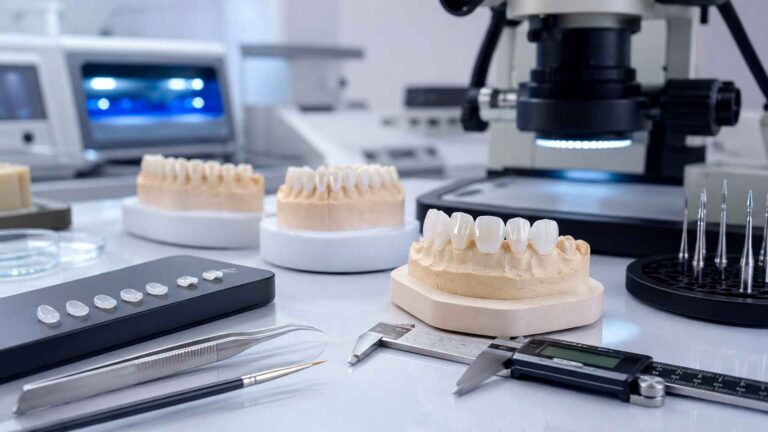
Two dental restorations can carry exactly the same shade designation yet look noticeably different in the mouth, because an existing ceramic crown and a newly bonded E.max veneer may transmit, scatter, and reflect light differently—and the underlying tooth color can amplify that difference.
So why do we still see complex anterior cases prescribed with little more than a Vita shade code?
Matching E.max veneers to existing ceramic crowns means reproducing the crown’s actual optical appearance—not simply selecting the same nominal porcelain shade.
Consider a common restorative situation: a patient has two existing ceramic central-incisor crowns and wants E.max veneers on the adjacent lateral incisors.
The existing crowns are A1. The veneers are prescribed A1.
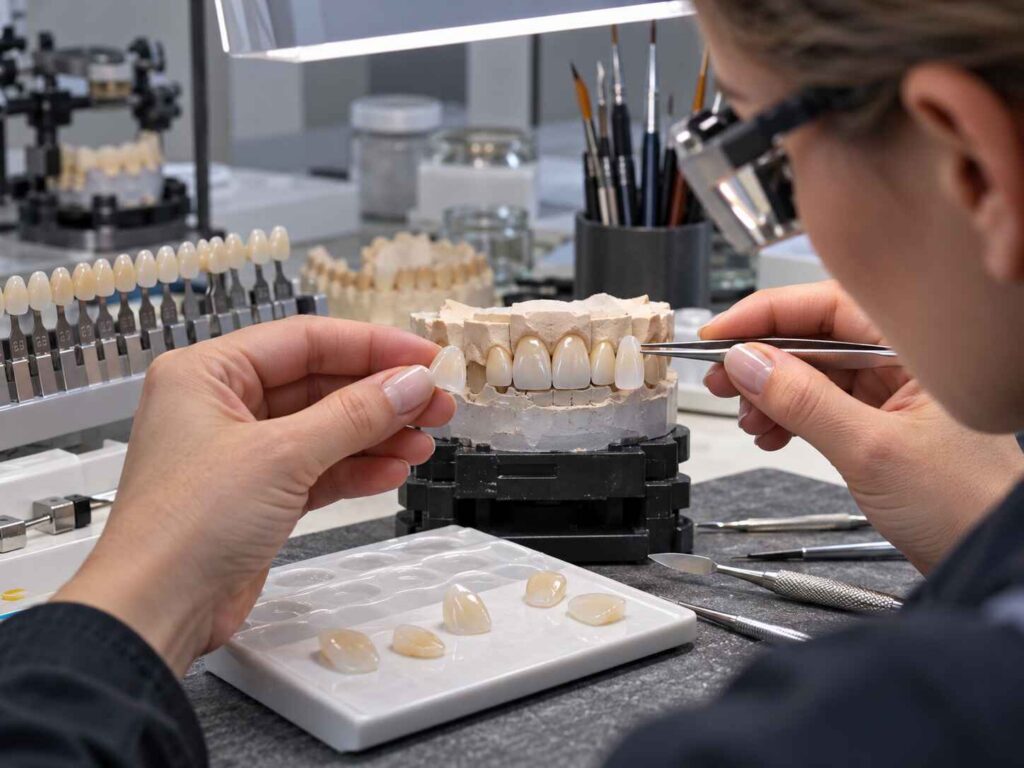
On the laboratory bench, everything appears consistent.
After bonding, however, the veneers look slightly darker, the cervical areas appear warmer, and the incisal edges transmit more light than the neighboring crowns.
The shade code was correct.
The optical strategy wasn’t.
I would argue that this is where many expensive esthetic cases go wrong. The problem is not necessarily poor ceramic craftsmanship. It is often the assumption that different restorative systems will produce identical results when given identical shade instructions.
They won’t.
And published research explains why.
Why E.max Veneers and Ceramic Crowns Can Look Different
Lithium Disilicate and Crown Materials Do Not Handle Light Identically
IPS e.max is a lithium disilicate glass-ceramic system. Its principal crystalline phase is represented by the chemical formula Li₂Si₂O₅.
The material offers useful mechanical properties alongside the translucency required for many anterior restorations.
But an existing ceramic crown may be manufactured from an entirely different restorative system.
It could be monolithic zirconia, layered zirconia, feldspathic porcelain, porcelain-fused-to-metal, or lithium disilicate itself.
Each material interacts with light differently.
For instance, a relatively translucent lithium disilicate veneer may allow the underlying preparation to influence its final appearance more strongly than a comparatively opaque zirconia crown.
The result?
Two restorations can share the same shade designation but display different brightness, depth, and translucency.
Even lithium disilicate crowns and veneers can differ because of restoration thickness, layering, characterization, and cementation.
That is why identifying the existing crown material should be one of the first steps when planning E.max veneer restorations beside existing ceramic work.
Shade Matching Involves More Than Hue and Chroma
The technician must reproduce several interconnected optical properties:
Value: The perceived brightness or darkness of the restoration.
Hue: The basic color family.
Chroma: The intensity or saturation of the color.
Translucency: How much light passes through the ceramic.
Opalescence: Wavelength-dependent optical effects, particularly relevant near incisal edges.
Surface texture and gloss: How light reflects from the facial surface.
Value deserves particular attention.
A veneer that is slightly different in hue but similar in value may integrate better than one that has the correct hue but is obviously brighter than the adjacent crown.
However, value alone is not enough.
A highly translucent veneer beside an opaque crown can still appear inconsistent, especially when the patient moves between different lighting environments.
The laboratory needs to match the entire visual effect.
What Clinical Research Reveals About E.max Veneer Shade Matching
Three published investigations help explain why these cases are difficult.
They also challenge the assumption that ceramic shade and resin cement can be selected independently.
1. Ceramic Design Influences the Match Between Adjacent Crowns
A study published in the March 2024 issue of the Journal of Prosthodontics examined how different CAD/CAM ceramic crowns matched a neighboring bilayered lithium disilicate crown.
Researchers from the University at Buffalo and Augusta University evaluated 40 crowns divided into four groups:
Monolithic lithium disilicate
Bilayered lithium disilicate
Bilayered zirconia
Monolithic zirconia
Each group contained 10 crowns.
The researchers compared color differences across the cervical, middle, and incisal thirds.
At the middle third, bilayered lithium disilicate demonstrated a significantly higher shade-match frequency than monolithic zirconia (p < 0.05).
Monolithic zirconia also demonstrated significantly greater color differences than bilayered lithium disilicate and bilayered zirconia in the middle and incisal regions.
The authors concluded that bilayered lithium disilicate and bilayered zirconia most closely matched the reference crown.
There is an important limitation: this was a controlled crown experiment using a dental model, not a clinical study of bonded veneers.
Nevertheless, the findings support a practical principle.
When an existing crown has layered optical characteristics, material selection and restoration architecture affect the likelihood of achieving a convincing match.
A monolithic restoration should not automatically be expected to reproduce the appearance of a layered crown.
2. Underlying Tooth Color Can Overpower the Veneer Shade
This is the finding I would pay the most attention to.
A 2025 study published in the Journal of Dentistry investigated how ceramic translucency, resin cement shade, and substrate color influenced the masking ability of IPS e.max CAD veneers.
Researchers tested high-, medium-, and low-translucency ceramics alongside Variolink Esthetic LC resin cements and simulated dentin substrates.
The statistical analysis produced a striking result.
Variable
Contribution to explained color variation
Underlying substrate shade
87.82%
Ceramic translucency
9.15%
Resin cement shade
3.03%
These percentages describe contributions within the study’s experimental regression model. They are not universal percentages applicable to every clinical veneer.
Still, the underlying message is significant.
The substrate exerted a far greater influence on the measured final color than either ceramic translucency or cement shade under the tested conditions.
More importantly, none of the tested combinations successfully masked severe substrate discoloration within the study’s clinical acceptability threshold.
Now consider a patient whose existing crowns are bright and opaque while the adjacent prepared natural teeth are darker.
Using highly translucent E.max veneers may allow those darker substrates to influence the final color.
Selecting a brighter cement may not be enough to correct the mismatch.
In my view, prescribing highly translucent veneers without recording the prepared-tooth shade is an avoidable risk.
3. Resin Cement Affects Final Color, but Its Correction Range Is Limited
A 2023 study in The Journal of Advanced Prosthodontics examined 90 lithium disilicate crowns with different cement shades and film thicknesses.
The tested cement thicknesses were 40, 80, and 120 µm.
The cement shades were clear, yellow, and white.
Researchers measured color differences before cementation, after cementation, and following 10,000 thermocycling cycles.
They used the CIEDE2000 formula, with ΔE00 thresholds of 0.8 for perceptibility and 1.8 for acceptability.
After cementation, the 40 µm clear-cement group produced an average color difference below the study’s perceptibility threshold. The remaining groups demonstrated color differences between the perceptibility and acceptability thresholds.
After thermocycling, every experimental group showed a perceptible color change.
The 2023 resin cement color study demonstrates that cement shade and thickness can influence restorative appearance.
Because the specimens were crowns rather than thin veneers, the exact results cannot be applied directly to every veneer case.
But the broader point remains useful.
Resin cement is an optical variable.
It is not a guaranteed solution for correcting the wrong ceramic shade.
How to Match E.max Veneers to Existing Porcelain Crowns
I would approach a demanding anterior shade-matching case as a sequence of controlled decisions, with the existing crowns serving as the primary visual reference.
Step 1: Identify the Existing Ceramic Crown
Determine whether the crown is lithium disilicate, zirconia, feldspathic porcelain, or porcelain-fused-to-metal.
Review the original laboratory documentation if it is available.
When assessing existing lithium disilicate crowns, useful information may include their translucency, layering technique, characterization, and original shade.
If the material cannot be identified reliably, do not guess.
Document the crown’s observable characteristics instead.
Pay particular attention to its current appearance. A crown that has been in service for several years may have different surface gloss or staining from when it was originally delivered.
The new veneer must match what exists today.
Step 2: Photograph the Existing Crowns Before Tooth Dehydration
Good shade records reduce unnecessary interpretation.
Capture the existing crowns before prolonged isolation or preparation changes the hydration of neighboring natural teeth.
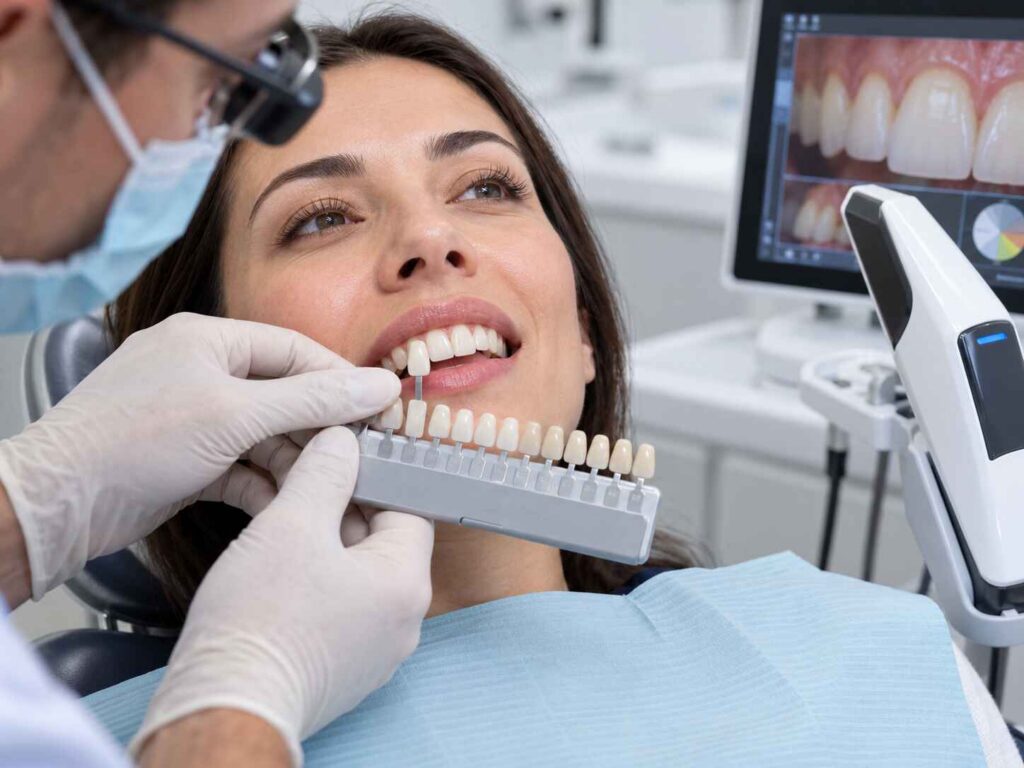
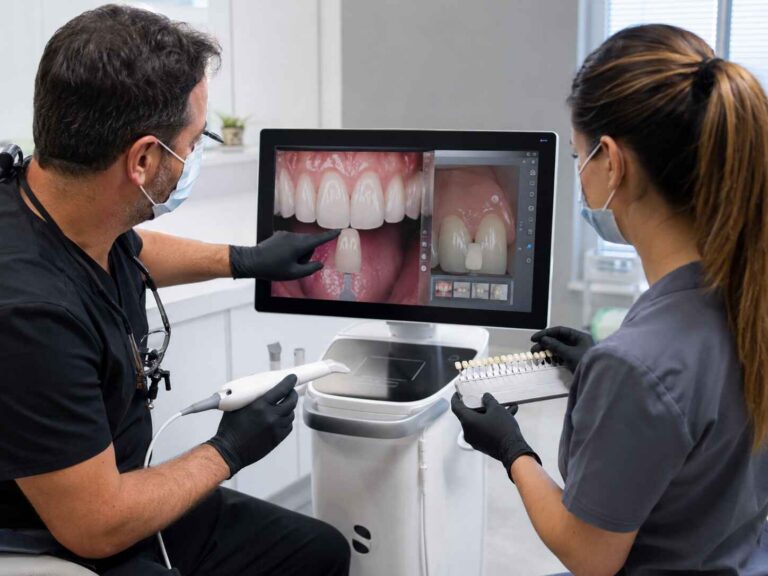
Recommended records include frontal smile photographs, retracted close-ups, shade-tab photographs, and cross-polarized images where available.
A dental spectrophotometer, such as the VITA Easyshade V, can supplement visual assessment.
But a single instrument reading should never replace direct observation.
The technician needs to see the cervical, middle, and incisal regions separately.
For example, a crown may have an A1-like body, a warmer cervical third, and localized incisal translucency.
Simply prescribing A1 ignores those differences.
Step 3: Record the Stump Shade and Available Ceramic Thickness
The prepared-tooth shade is not optional information in a difficult veneer case.
A relatively thin lithium disilicate veneer over a light substrate may behave differently from the same ceramic over a dark preparation.
The laboratory should receive the stump shade, available reduction, preparation design, and any information about existing composite restorations or localized discoloration.
Ceramic thickness also matters.
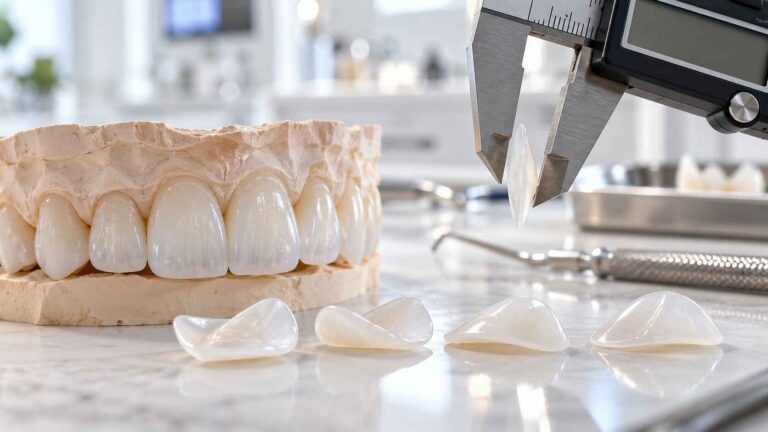
A change from approximately 0.4 mm to 0.8 mm can alter the amount of underlying color visible through the restoration, although the actual optical effect depends on the specific ceramic and substrate.
Increasing thickness is not automatically a solution because additional tooth reduction may compromise conservative treatment objectives.
The correct material must work within the available preparation.
Step 4: Select the Appropriate IPS e.max Translucency
Not every E.max veneer should be manufactured from the same translucency.
May integrate well over favorable substrates but offers less masking
MT — Medium Translucency
Intermediate translucency and brightness
Useful to evaluate when balancing natural appearance and value
LT — Low Translucency
Greater shade stability and reduced translucency
May help limit substrate influence
MO — Medium Opacity
Increased opacity
Intended for discolored preparations and framework applications; suitability depends on restoration design
Impulse
Pronounced opalescent characteristics
May be considered for specialized veneer esthetics
These options are not interchangeable.
I would reject any blanket recommendation that high-translucency E.max is always the best material for anterior veneers.
Sometimes greater translucency helps.
Sometimes it exposes the problem.
The objective is to select a material that matches the existing crown while maintaining appropriate structural and clinical requirements.
Step 5: Consider Layered E.max When the Crown Has Complex Characterization
Some existing crowns have optical details that are difficult to reproduce using monolithic ceramic and surface stains alone.
These might include subtle internal mamelons, incisal halos, localized opacity, or complex translucency patterns.
In such cases, layered E.max veneers may offer more control over internal characterization and surface appearance.
However, layering adds fabrication variables and requires sufficient ceramic space.
It should be selected because the case benefits from individualized optical effects, not because layering is automatically superior.
For relatively uniform crowns, a carefully selected monolithic veneer may offer a more straightforward route to consistency.
Step 6: Evaluate the Veneers With Try-In Paste Before Bonding
The definitive shade judgment should not occur solely on the laboratory model.
Use the compatible try-in paste system associated with the intended resin cement.
Compare the veneers with the existing crowns under appropriate lighting.
Assess brightness first, followed by cervical chroma, translucency, incisal characterization, and surface reflection.
Remember that try-in paste approximates the optical effect of the cementation system; it does not guarantee an identical final appearance after curing.
If the veneers are visibly unacceptable during try-in, the solution may require ceramic modification or remake.
Proceeding with permanent bonding in the hope that cement will conceal a substantial mismatch is a poor risk-management strategy.
Why Mixed-Material Cases Need More Than a Shade Prescription
Matching a veneer to a ceramic crown becomes particularly demanding when the two restorations use different materials.
Zirconia and lithium disilicate are not optically identical.
Zirconia is based primarily on zirconium dioxide (ZrO₂), while IPS e.max uses lithium disilicate glass-ceramic.
Their relative translucency depends on formulation, thickness, and manufacturing conditions.
This creates a potential problem when one restoration is designed primarily for masking while the neighboring restoration transmits more light.
The same shade designation cannot eliminate that physical difference.
The direction of the material combination changes, but the underlying concern remains the same: two different ceramics must be made to appear consistent within one smile.
The laboratory should focus on the finished appearance rather than assuming that identical shade codes represent identical restorations.
FAQs
Can E.max Veneers Match Existing Ceramic Crowns?
Yes, E.max veneers can be matched to existing ceramic crowns when the laboratory uses the installed restorations as optical references and carefully coordinates ceramic translucency, stump shade, restoration thickness, internal characterization, surface texture, and resin cement. The objective is a visually consistent result rather than an identical shade designation.
A convincing match is often possible, but exact optical equivalence under every lighting condition cannot be guaranteed, particularly when the existing crowns are made from different ceramic systems.
How Do You Match E.max Veneers to Porcelain Crowns?
Matching E.max veneers to porcelain crowns involves identifying the existing crown material, recording its cervical-to-incisal color characteristics, documenting the prepared-tooth shade, selecting an appropriate lithium disilicate translucency, and evaluating the proposed ceramic and cement combination before permanent bonding. Accurate clinical photography and laboratory communication improve the reliability of this process.
The technician should also evaluate surface texture and gloss because reflection differences can make restorations appear mismatched even when their underlying shades are similar.
What Is the Best Shade-Matching Technique for E.max Veneers?
The best shade-matching technique for E.max veneers combines standardized clinical photography, visual shade assessment, stump shade documentation, spectrophotometric measurements when available, and controlled evaluation with compatible try-in materials. This approach helps dentists and technicians assess brightness, hue, chroma, translucency, ceramic thickness, and substrate influence together rather than treating shade as a single variable.
For difficult anterior cases, direct communication with the ceramic technician can help establish realistic optical targets before fabrication.
Can Resin Cement Fix an E.max Veneer That Does Not Match an Existing Crown?
Resin cement can influence the final color of an E.max veneer, but it cannot reliably correct a substantial mismatch between the ceramic and an existing crown. The final appearance depends on the combined effects of ceramic composition, translucency, thickness, underlying tooth color, and the optical properties of the selected cementation system.
Minor adjustments may be achievable, but a visibly unsuitable veneer should be reassessed before definitive bonding.
Your Next Steps: Get Better E.max Veneer Shade Matching Before Fabrication
The most expensive shade-matching mistakes often begin before the laboratory touches the ceramic.
A prescription that simply reads “E.max veneers, A1, match existing crowns” leaves too many decisions unresolved.
What ceramic are the existing crowns made from?
How translucent are they?
What is the prepared-tooth shade?
And how much room does the technician actually have to reproduce their optical characteristics?
I believe the most reliable approach is straightforward: communicate the existing crown’s appearance, document the substrate, select the appropriate material, and verify the result before bonding.
For clinics and dental laboratories planning anterior restorations, Artist Dental Lab offers custom E.max veneer fabrication and case-specific production support.
Before submitting a case, prepare your STL files, existing-crown photographs, shade-tab references, stump shade records, preparation details, and desired esthetic characteristics.