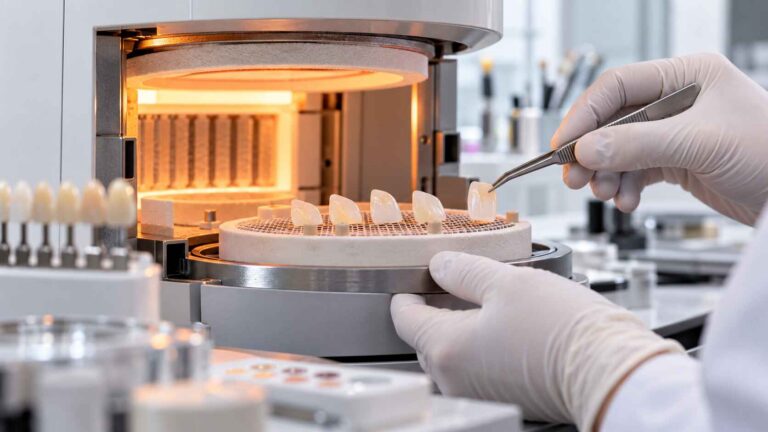
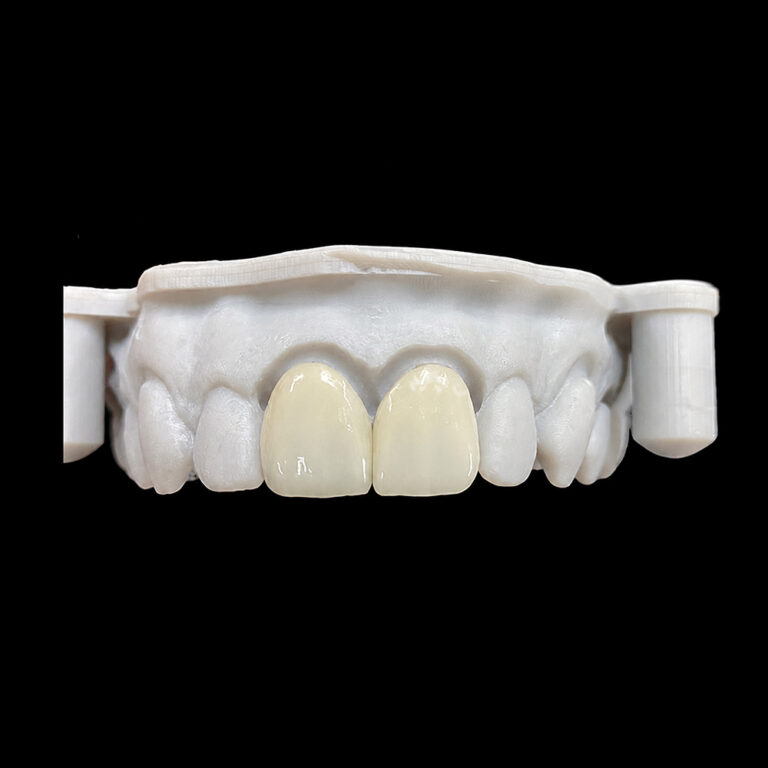
When an IPS e.max Press restoration emerges from the pressing process, its shape may be complete, but its surface is not necessarily ready for finishing, layering, or adhesive preparation because the heated ceramic has interacted with the investment surrounding it.
So why do some laboratories still treat reaction layer removal as little more than cleanup?
I see a serious quality-control issue hiding inside an ordinary manufacturing step.
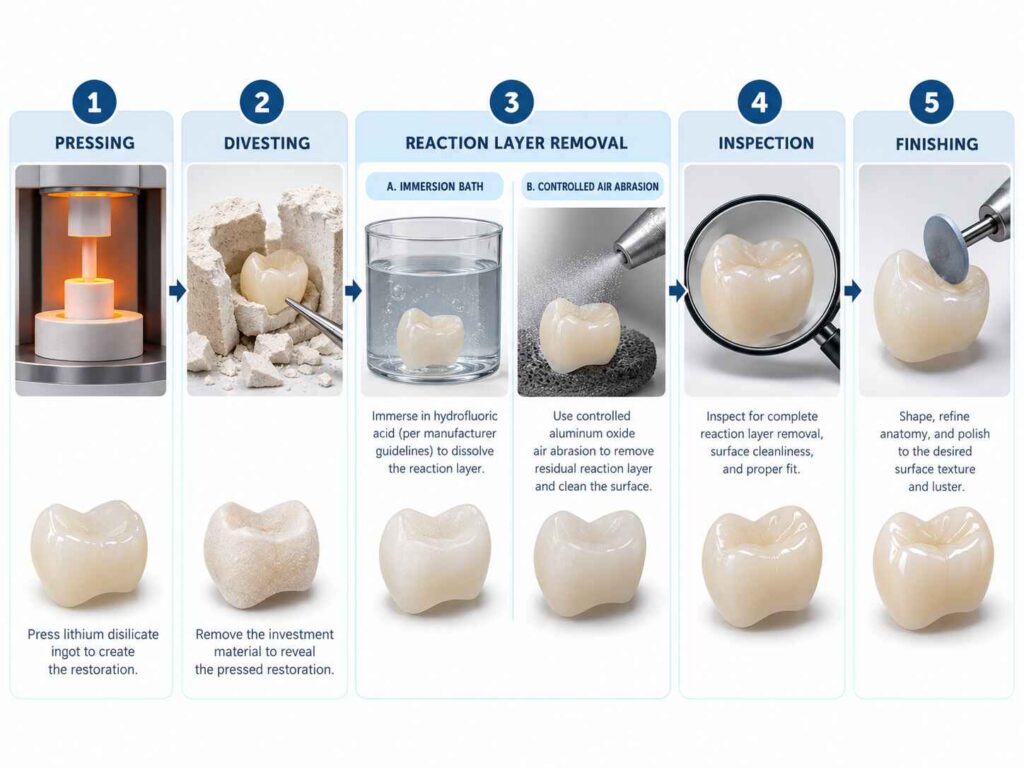
E.max Press reaction layer removal is the controlled elimination of a surface layer formed during heat pressing, when lithium disilicate ceramic interacts with the investment material. Proper removal prepares the restoration for subsequent laboratory procedures while avoiding unnecessary damage to its surface and margins.
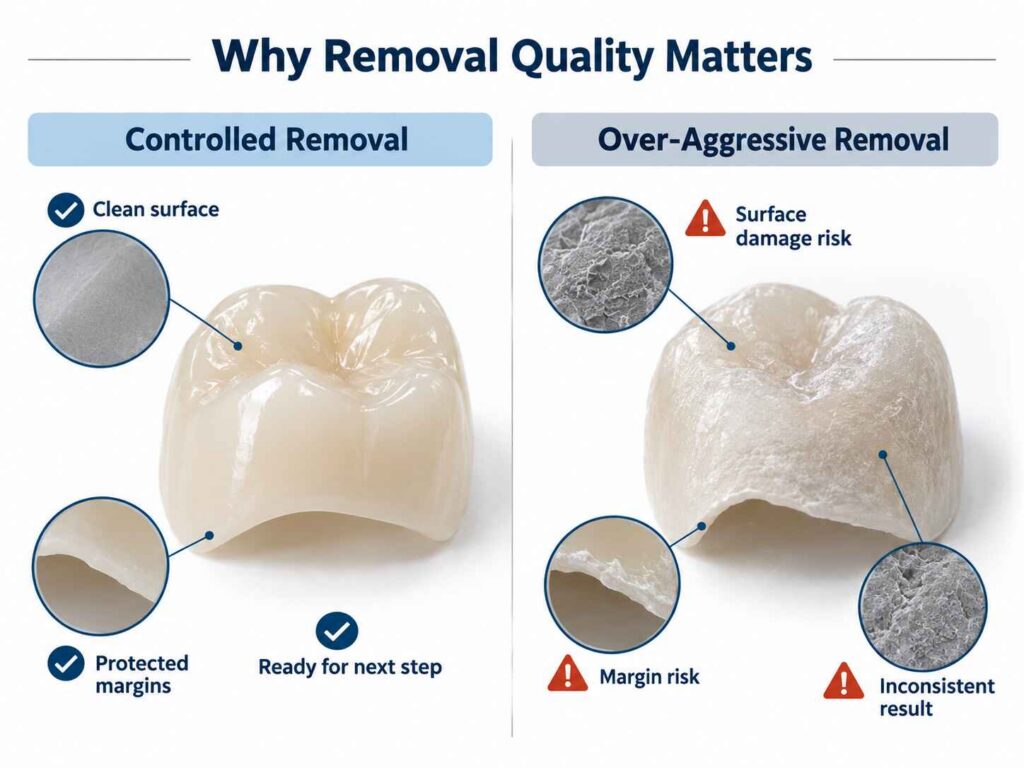
The real challenge is not making the restoration look clean. It is removing the unwanted material without creating new defects.
A 2025 laboratory study offers a particularly interesting finding: adding a low-concentration acid treatment to grit-blasting did not automatically improve resin-cement bond strength compared with grit-blasting alone.
That challenges the assumption that more chemical treatment always means better quality.
And it gives dental laboratories a good reason to examine what they actually measure after divesting.
What Is the IPS e.max Press Reaction Layer?
IPS e.max Press is a lithium disilicate glass-ceramic used to fabricate dental restorations through heat pressing.
Its primary crystalline phase is lithium disilicate (Li₂Si₂O₅), embedded in a glassy matrix. That microstructure contributes to the material’s mechanical and optical properties.
During pressing, the heated ceramic contacts a phosphate-bonded investment material.
At this interface, interactions between the investment and ceramic form a modified surface region commonly called the IPS e.max Press reaction layer.
It is not simply loose dust.
The reaction layer may remain after the bulk investment has been removed, which is why divesting and reaction layer removal are treated as separate manufacturing operations.
Why Incomplete Removal Is a Problem
The most immediate concern is the condition of the surface before the next processing step.
Older IPS e.max Press manufacturing guidance warns that incomplete reaction layer removal can interfere with subsequent layering or glazing procedures.
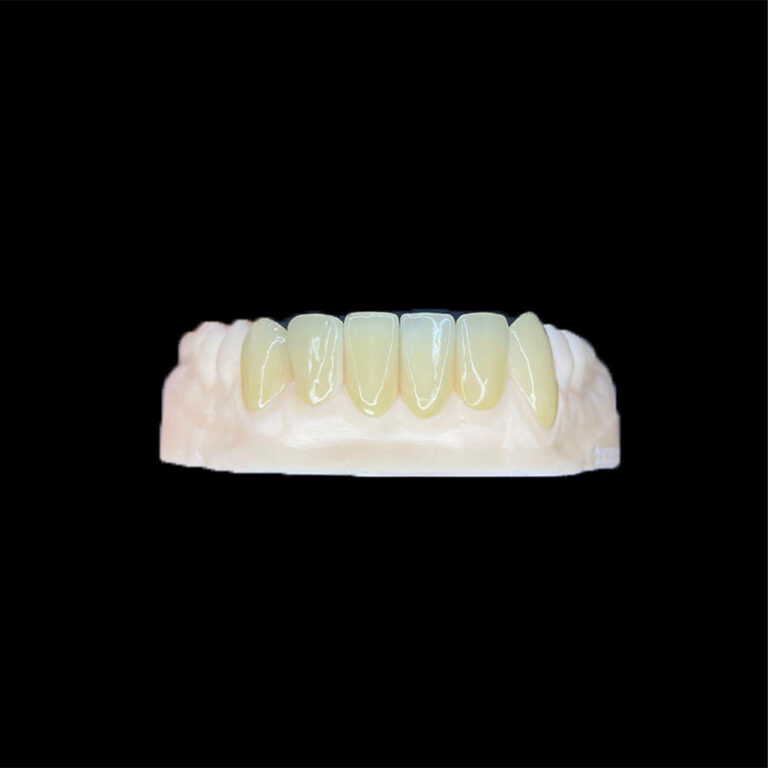
That matters particularly for layered E.max veneers, where the lithium disilicate structure supports additional esthetic ceramic characterization.
However, we should distinguish an established processing risk from a proven clinical failure.
There is insufficient evidence to assign a reliable percentage of crown fractures, debonding incidents, or remakes specifically to incomplete reaction layer removal.
And I would question any supplier making that claim without traceable production and clinical data.
The defensible conclusion is more precise: reaction layer removal determines the starting condition of the pressed ceramic surface, and inappropriate treatment can compromise subsequent processing.
What Published Research Actually Reveals
Three studies help explain why removal quality matters—and why some conventional assumptions deserve scrutiny.
2025: Chemical Cleaning Was Not Automatically Better
The researchers tested 60 pressed lithium disilicate discs across six experimental groups.
They compared polishing, grit-blasting, and grit-blasting combined with a low-concentration acid solution, with or without additional 5% hydrofluoric acid (HF) etching.
Bond strength was evaluated after 24 hours and again following 90 days of aging, including 10,000 thermal cycles.
The findings were revealing:
Initial resin-cement bond strength did not differ significantly between groups (p > 0.05).
After aging, the polishing-only group showed the lowest bond strength.
Groups receiving appropriate HF conditioning generally showed better long-term bond stability.
Grit-blasting alone and grit-blasting combined with low-concentration acid treatment both proved effective for reaction layer removal under the experimental conditions.
The researchers also associated higher magnesium (Mg) and phosphorus (P) levels with reaction layer presence.
Here is the uncomfortable part for anyone selling one cleaning method as unquestionably superior: the study did not establish a bonding advantage for adding the low-concentration acid immersion step to grit-blasting.
It also did not prove that laboratories should abandon manufacturer instructions.
These were in vitro findings, not clinical survival data.
My conclusion is that laboratories should prioritize a validated, material-specific process instead of assuming that an additional chemical stage automatically improves the finished restoration.
2013: Invex Liquid Did Not Improve Veneering Bond Strength in One Study
Scanning electron microscopy also showed no notable morphological differences between the treated and untreated lithium disilicate surfaces.
This does not mean reaction layer removal is unnecessary. It means that applying the acid solution did not independently improve the measured veneering bond strength under that study’s conditions.
That distinction is important.
Removing an unwanted surface layer and increasing bond strength are not the same scientific claim.
2024: Surface Treatment Can Remove More Than Intended
Researchers evaluated 5% and 10% hydrofluoric acid concentrations across 20-, 40-, and 60-second etching periods.
They found that ceramic composition and etching duration influenced surface roughness and material removal.
LiSi Press demonstrated greater resistance to HF etching than the other tested materials.
This study investigated adhesive surface conditioning, not press reaction layer removal directly.
Nevertheless, it reveals a broader manufacturing concern: materials within the same ceramic category do not necessarily respond identically to chemical treatment.
A process that works for one lithium disilicate product should not automatically be transferred to another.
Which E.max Press Reaction Layer Removal Method Makes Sense?
There are two central approaches to consider: the manufacturer-described Invex Liquid procedure followed by controlled abrasion, and mechanical removal methods investigated in laboratory studies.
Neither should be evaluated solely by whether the surface looks clean.
Comparing Removal and Surface-Treatment Methods
Method
Purpose
Evidence or advantage
Main consideration
Controlled divesting
Remove bulk investment
Necessary initial manufacturing step
May leave reaction layer material behind
IPS e.max Press Invex Liquid
Soften the surface reaction layer
Specifically identified by Ivoclar for reaction layer removal
Requires chemical safety controls and correct processing
Controlled Al₂O₃ grit-blasting
Mechanically remove remaining material
Effective in the 2025 laboratory comparison
Excessive abrasion can create surface defects
Invex Liquid plus controlled blasting
Combine chemical and mechanical removal
Manufacturer-described workflow
Must follow material-specific instructions
Hydrofluoric acid etching for bonding
Condition cleaned glass-ceramic for adhesive procedures
Supported by bonding research
Not a substitute for divesting or reaction layer removal
IPS e.max Press Invex Liquid: What the Manufacturer Describes
In an Ivoclar technical article on crafting customized restorations, a documented IPS e.max Press Multi workflow describes ultrasonic treatment in Invex Liquid for 10–30 minutes, followed by rinsing and controlled blasting using 50 µm aluminum oxide at 2 bar.
Those figures describe a specific published procedure, not a universal instruction for every restoration or investment system.
Technicians should follow the current instructions for the exact materials and equipment in use.
I would also avoid treating additional blasting as a harmless corrective step.
Repeated abrasive exposure may remove unwanted material, but it can also change the underlying ceramic surface.
A clean-looking crown is not proof that its margins and surface integrity remain unaffected.
How Dental Labs Should Judge Reaction Layer Removal Quality
For a professional laboratory, removal quality should be assessed as part of the complete manufacturing process rather than as an isolated cleaning operation.
I would focus on five practical controls.
1. Confirm the Exact Material
IPS e.max Press and IPS e.max CAD are both lithium disilicate materials, but they follow different manufacturing routes.
Pressing creates direct contact between the ceramic and investment. Milling and crystallization follow a different process.
When sourcing E.max crown restorations, buyers should establish which manufacturing route and material are specified rather than assuming all restorations described as E.max are processed identically.
2. Control the Divesting and Cleaning Sequence
The laboratory should use a documented procedure appropriate to its ceramic and investment systems.
That procedure should distinguish bulk divesting, reaction layer removal, finishing, and preparation for subsequent treatment.
Combining these operations under one vague instruction such as “sandblast until clean” makes process consistency harder to evaluate.
3. Protect Margins and Thin Ceramic Areas
Excessive abrasion is particularly concerning where ceramic geometry is delicate.
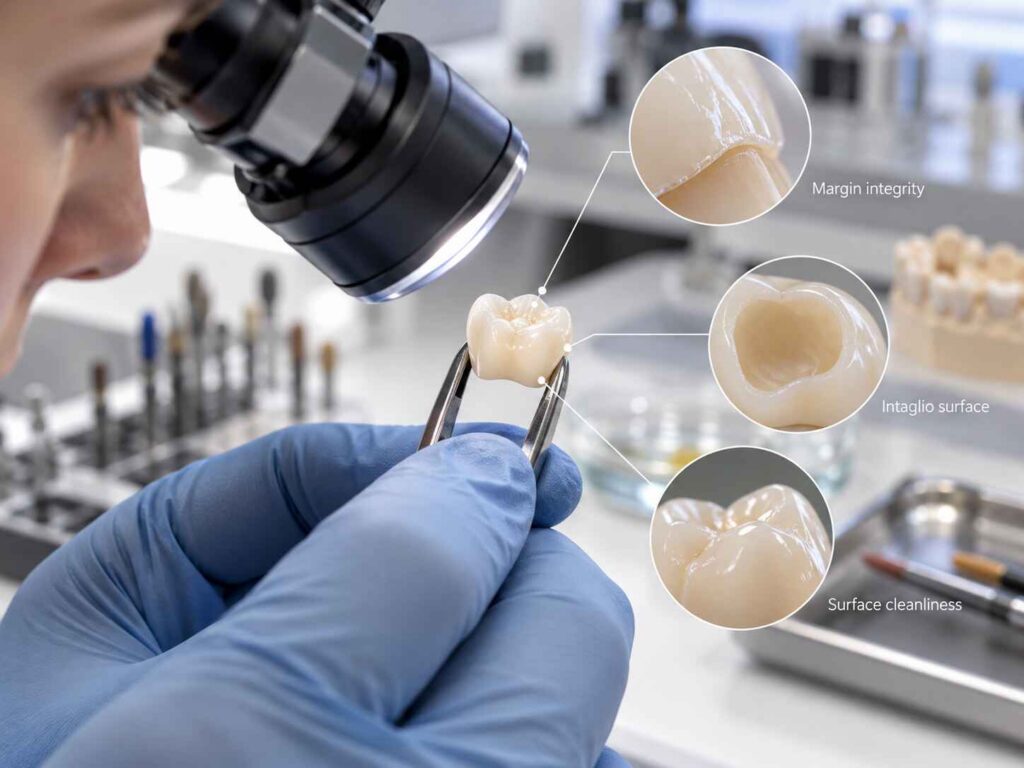
Thin margins and detailed anatomy deserve careful inspection after cleaning.
If additional mechanical treatment is necessary, technicians should determine whether it is appropriate or whether the restoration needs further evaluation.
4. Inspect More Than the Visible Facial Surface
The intaglio surface, proximal regions, margins, and other difficult-to-access areas should be included in the inspection process.
Visible cleanliness matters, but it is not a complete measure of surface chemistry or microscopic defects.
Research tools such as scanning electron microscopy and energy-dispersive X-ray spectroscopy can reveal characteristics that ordinary visual inspection cannot.
Routine production does not require these instruments for every restoration. It does require well-defined acceptance criteria and consistent process controls.
For buyers evaluating a supplier, dental laboratory quality control should include documented inspection checkpoints and clear procedures for handling restorations that do not meet specifications.
5. Keep Reaction Layer Removal Separate From Adhesive Conditioning
This distinction deserves emphasis.
Reaction layer removal addresses a manufacturing-related surface condition.
Adhesive conditioning prepares the appropriate ceramic surface for the selected cementation system.
The 2025 study showed why these steps should not be confused: the methods used to remove the reaction layer did not create the same long-term bonding outcomes as subsequent adhesive surface treatment.
For E.max veneer restorations, clear communication between laboratory and clinician about surface preparation is especially important.
A laboratory should be able to state what surface treatment has already been performed and what preparation remains the clinician’s responsibility.
FAQs
What is the reaction layer on IPS e.max Press?
The IPS e.max Press reaction layer is a modified ceramic surface formed when heated lithium disilicate interacts with phosphate-bonded investment during the pressing process, leaving reaction products that must be appropriately removed before further laboratory processing to obtain the intended ceramic surface condition.
It differs from ordinary loose investment residue. A restoration can appear divested while still requiring reaction layer removal.
How do you remove the reaction layer from E.max Press?
E.max Press reaction layer removal is a controlled post-divesting procedure that uses manufacturer-compatible chemical and mechanical cleaning methods to eliminate the press-related surface layer while protecting the underlying lithium disilicate, followed by careful inspection of the restoration’s internal and external surfaces.
Ivoclar describes an Invex Liquid and controlled abrasion workflow, while experimental studies have also evaluated grit-blasting without the acid immersion step.
Is sandblasting alone enough to remove the E.max Press reaction layer?
Sandblasting-only reaction layer removal is a mechanical technique in which controlled abrasive particles eliminate the modified surface material from pressed lithium disilicate, potentially achieving effective cleaning without an additional low-concentration acid immersion step when performed under the specific conditions evaluated in laboratory research.
The 2025 study supports its effectiveness under tested conditions. It does not establish that every blasting-only workflow is suitable or that manufacturer instructions can be disregarded.
Does better reaction layer removal improve the lifespan of E.max crowns?
Reaction layer removal quality is a manufacturing factor that affects the condition of the pressed ceramic surface before finishing and further preparation, but its independent contribution to the clinical lifespan of E.max crowns has not been quantified reliably through direct long-term clinical comparisons of removal methods.
Published laboratory evidence supports careful surface processing. It does not justify claiming a specific increase in restoration lifespan or reduction in remake rates from reaction layer removal alone.
Final Thoughts: Demand Better Surface Quality, Not Just Better-Looking Ceramics
The reaction layer is small. The manufacturing decisions surrounding it are not.
Research shows that effective E.max Press reaction layer removal depends on the method and conditions used, while subsequent surface treatment introduces separate considerations for bonding and ceramic integrity.
I would not judge a laboratory by whether it uses the most elaborate cleaning procedure.
I would judge it by whether technicians understand the material, follow appropriate processing instructions, inspect the finished surface, and can explain how they maintain consistency.
That is the standard professional buyers should expect.
Looking for a lithium disilicate restoration supplier with clear technical communication and defined quality-control requirements?
Contact Artist Dental Lab to discuss your E.max restoration requirements, request a quotation, or arrange a trial case.
Ask about material selection, fabrication methods, surface-processing documentation, inspection checkpoints, and the quality criteria applied before shipment.
Because premium lithium disilicate deserves more than a convincing final photograph. It deserves a process that can stand up to scrutiny.