للمختبرات السنية والعيادات والموزعين وفرق التوريد التي تقارن بين تيجان الزركونيا وتيجان ثاني أكسيد الليثيوم والقشور وخدمات التصنيع حسب الطلب (OEM) أو طلبات الترميم بالجملة.
يرجى إطلاعنا على نوع المنتج، والمواد المستخدمة، وحجم المبيعات الشهري، وبلد المقصد، وطلب العينات، حتى يتمكن فريق المبيعات لدينا من تحديد الخطوة التالية المناسبة.
It is an instruction missing half the information that actually determines what happens to the intaglio surface.
الضغط يغير كل شيء.
A zirconia veneer exposed to 50 μm aluminum oxide at 0.2 MPa is not receiving the same treatment as one blasted at 0.4 or 0.5 MPa, even though both procedures may be casually documented as “Al₂O₃ air abrasion” on a laboratory ticket or clinical note.
So why do we still discuss zirconia air abrasion as though the machine has only an ON switch?
I do not trust generic zirconia bonding instructions that omit particle size, pressure, distance, treatment duration, material generation, and whether the restoration is already fully sintered. Those variables are not laboratory trivia. They can alter roughness, micromechanical retention, phase behavior, microcracking, flexural properties, and eventually how much confidence we should place in the resin-zirconia interface.
And veneers make the problem less forgiving because there is less ceramic bulk available to absorb unnecessary abuse.
The useful question is therefore not, “Should I sandblast zirconia?”
It is this:
How aggressively can we air abrade a specific zirconia veneer while improving bonding without creating unnecessary surface damage?
Zirconia Air Abrasion Is a Balance, Not a Roughness Contest
Zirconia, or zirconium dioxide (ZrO₂), is a polycrystalline oxide ceramic. Unlike lithium disilicate, it does not contain the silica-rich glass phase that makes conventional hydrofluoric-acid etching and silanization so effective for glass ceramics.
That chemistry is why surface treatment differs between E.max and zirconia. Lithium disilicate follows an etch-and-silane pathway; zirconia bonding usually depends much more heavily on controlled micromechanical surface modification and phosphate-monomer chemistry such as 10-MDP.
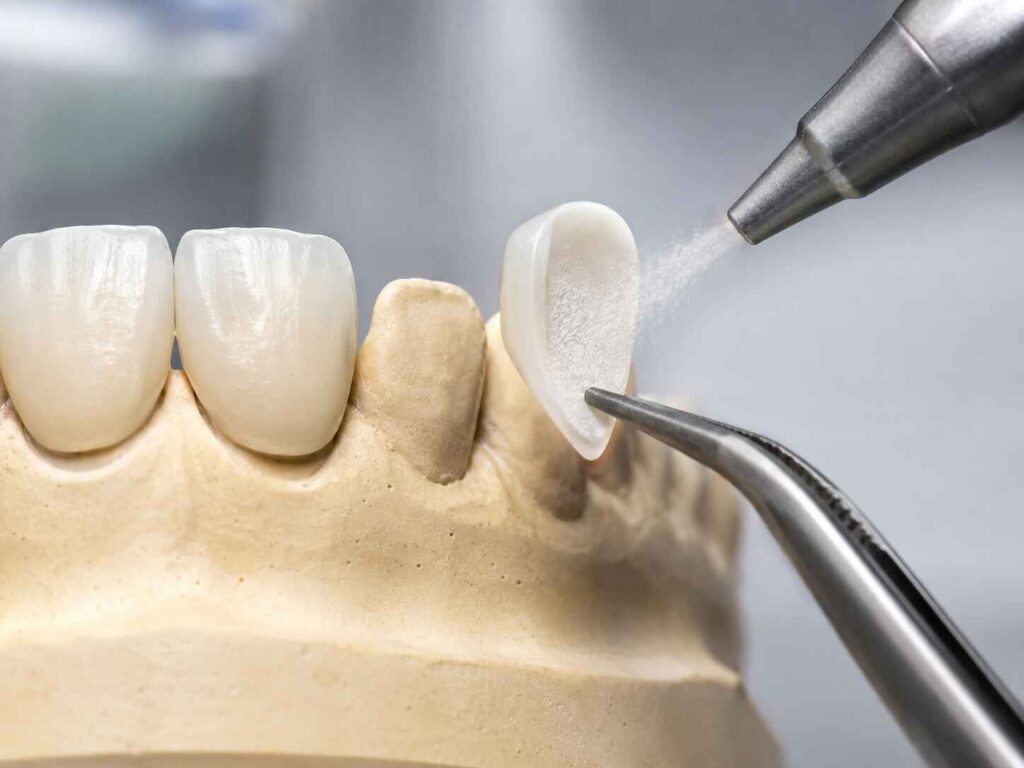
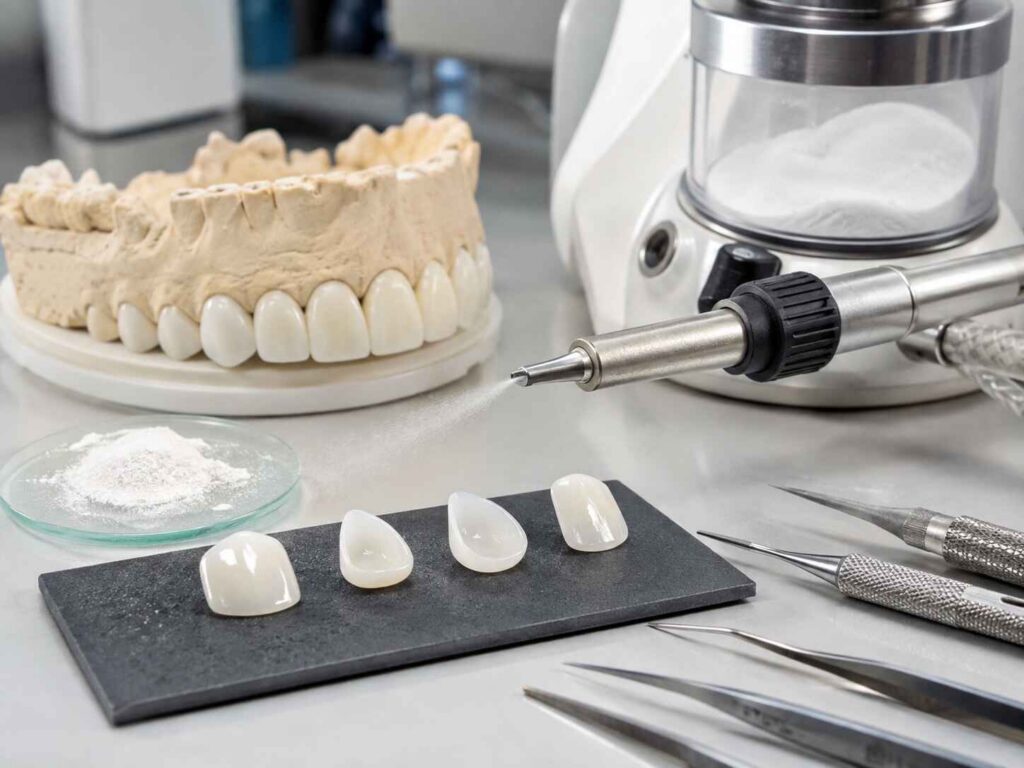
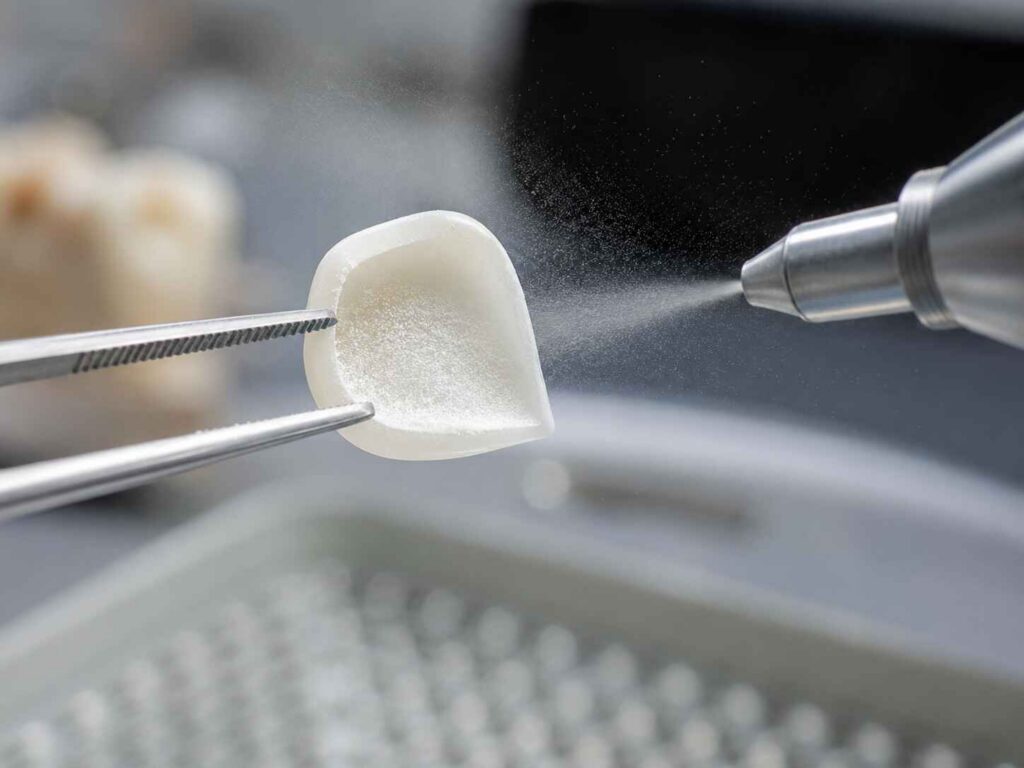
Airborne particle abrasion helps because aluminum oxide particles strike the zirconia surface and increase microscopic irregularity available for resin cement interaction.
But that explanation is incomplete.
The impact also introduces surface stress.
Push hard enough and the same treatment intended to improve adhesion can produce deeper defects, microcracks, or unfavorable changes in mechanical behavior.
That is why I dislike the phrase “rougher is better.”
It is lazy.
A 2021 study indexed by the U.S. National Library of Medicine tested translucent zirconia with 50 μm Al₂O₃ at 0.1, 0.2, 0.3, 0.4, and 0.5 MPa. The researchers reported their highest shear bond strengths at 0.2 MPa, 15.88 ± 2.70 MPa, و 0.3 MPa, 14.32 ± 1.12 MPa. Yet pressures of 0.3, 0.4, and 0.5 MPa reduced flexural strength, and the 0.5 MPa specimens showed greater surface damage and microcracking. The authors recommended 0.2 MPa with 50 μm alumina as the better compromise for that translucent zirconia.
That result should change how we talk about zirconia sandblasting.
More pressure created more roughness.
It did not create an unlimited mechanical advantage.
Best Air-Abrasion Parameters for Zirconia Veneers: The Evidence-Based Starting Point
There is no defensible universal setting for every zirconia veneer.
Anyone promising one is ignoring the difference between 3Y-TZP, 4Y-PSZ, 5Y-PSZ, manufacturer-specific formulations, restoration thickness, and laboratory processing.
Still, the published evidence gives us a useful working zone.
For many conventional and translucent zirconias, 30–50 μm or approximately 50 μm Al₂O₃ at around 0.2 MPa / 2 bar appears repeatedly in the literature as a conservative air-abrasion condition worth evaluating against the manufacturer’s instructions for use. A 2024 review of air-particle abrasion and MDP-based bonding similarly described roughly 0.2 MPa with 30–50 μm particles as a useful balance between bond improvement and mechanical preservation.
Here is the parameter table I would actually want beside the blasting unit.
Air-Abrasion Variable
Evidence-Informed Starting Point
لماذا هذا مهم؟
What Excess Can Do
Abrasive
Al₂O₃
Produces micromechanical surface modification
Aggressive abrasion may damage thin ceramic
Particle size
About 30–50 μm; 50 μm widely studied
Creates surface roughness without automatically requiring large particles
Larger particles can create more severe surface defects
Pressure
Around 0.2 MPa / 2 bar for many studied zirconias
Repeatedly associated with useful bonding and manageable mechanical effects
Higher pressure may increase microcracking and reduce flexural strength
Distance
Around 10 mm in many laboratory protocols
Controls particle impact energy and distribution
Short distance increases impact intensity
Duration
Often 10–20 seconds in published experimental protocols
Abrasion alone may provide inadequate durable adhesion
Final decision
Manufacturer-specific IFU
Different zirconias behave differently
Generic settings may be inappropriate for a specific material
The distance and time figures deserve context. Studies frequently standardize air abrasion at roughly 10 mm, with protocols ranging around 10–20 seconds. For example, a 2023 study used 50 μm Al₂O₃, 0.2 MPa, 10 mm, and 20 seconds, while other published investigations have used 10-second exposures. Those conditions show how research protocols are standardized; they should not be interpreted as permission to ignore the restoration manufacturer’s instructions.
هذا التمييز مهم.
Research gives us boundaries.
The IFU gives us the material-specific operating instructions.
3Y, 4Y, and 5Y Zirconia Do Not Deserve the Same Sandblasting Assumptions
This is where the conversation gets more uncomfortable.
الكلمة زركونيا hides several materially different ceramics.
Traditional 3Y-TZP contains roughly 3 mol% yttria stabilization and has a high tetragonal phase fraction. Increasing yttria content toward 4Y and 5Y formulations increases the amount of optically favorable cubic or partially stabilized structures, improving translucency but changing transformation toughening and mechanical behavior.
That tradeoff matters intensely in anterior restorations.
The same reason a highly translucent zirconia veneer may look better can make us more cautious about treating its internal surface like an old-school posterior 3Y crown.
A study comparing air-particle abrasion protocols across translucent zirconias concluded that 50 μm Al₂O₃ at 2 bar was recommended for the tested 3Y-TZP material, while the researchers did not recommend abrasion for the tested 5Y-ZP material under their experimental conditions.
اقرأ ذلك مرة أخرى.
Same broad material family.
Different conclusion.
That is precisely why a universal “50 microns, 2 bar, done” rule still makes me nervous.
More recent investigations do show that carefully controlled airborne-particle abrasion can work with both 3Y and 5Y zirconias when paired with appropriate primers. A 2025 study involving 160 zirconia specimens evaluated 3Y and 5Y zirconia and used an air-abrasion protocol of 50 μm Al₂O₃, 2 bar, 10 mm, and 20 seconds; the authors reported that air-particle abrasion combined with primer was effective for improving bond strength in their experimental systems.
Contradictory?
Not really.
إنه يخبرنا بشيء أكثر فائدة: zirconia formulation, treatment protocol, adhesive chemistry, and test design interact.
That is exactly how materials science behaves outside marketing brochures.
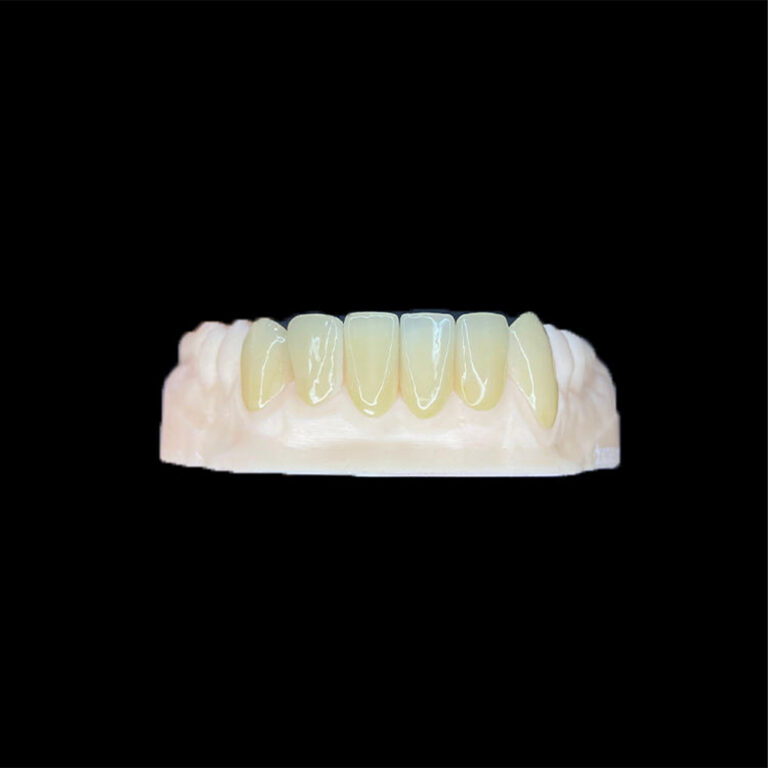
For case planning, Artist Dental Lab already separates قشرة الزركونيا from more traditional glass-ceramic veneer workflows and positions them for cases where durability, function, masking, and preparation strategy justify using zirconia.
Material choice comes first.
Blasting parameters come second.
Why I Would Start Around 0.2 MPa Before I Would Reach for More Pressure
If I were evaluating the best air abrasion parameters for zirconia veneers, I would start my risk analysis around 0.2 MPa / 2 bar with fine 30–50 μm Al₂O₃, assuming that condition is allowed by the specific zirconia manufacturer.
Not because 0.2 MPa is magical.
Because the evidence repeatedly shows what happens when we become greedy.
The 2021 translucent-zirconia investigation found that moving from 0.2 MPa toward 0.3–0.5 MPa increased roughness, but the higher-pressure groups also experienced declining flexural strength, with visible microcracking at 0.5 MPa.
Another study on highly translucent Y-PSZ found a similar direction of travel: surface roughness increased as air-abrasion pressure increased, while flexural strength decreased.
That should kill the instinct to “give it another blast.”
A veneer is not a rusty machine part.
We are conditioning a thin ceramic restoration expected to survive years of tensile, shear, thermal, moisture, and occlusal stress.
The goal is not maximum crater depth.
The goal is an interface.
Alumina Air Abrasion Is Only Half the Zirconia Bonding Protocol
This is where some articles stop too early.
They tell you how to sandblast zirconia and call the job finished.
ليس كذلك.
Air abrasion primarily addresses the micromechanical side of zirconia bonding. Durable adhesive protocols generally also need a chemical strategy compatible with zirconium oxide.
That is where 10-MDP — 10-methacryloyloxydecyl dihydrogen phosphate — enters the conversation.
The phosphate end of the molecule can interact with metal oxides such as ZrO₂, while its methacrylate component participates in polymerization with the resin system.
Plain English?
Abrasion creates the terrain.
MDP helps create the chemistry.
A 2025 study found that combining sandblasting and MDP-based primer produced substantially better shear bond performance than relying on either strategy alone in the tested zirconia system.
Earlier evidence points the same way. Studies and reviews have repeatedly reported improved zirconia-resin bonding when micromechanical conditioning is combined with phosphate-monomer primers or resin cements.
That is also why the site’s detailed guide to the biggest bonding challenges with zirconia veneers focuses not only on air abrasion but also on MDP chemistry, contamination, preparation design, cement selection, and occlusion.
One step fails.
The whole interface pays.
Saliva Contamination Can Undo a Beautiful Air-Abraded Surface
Now we get to the part that makes carefully calibrated laboratory treatment almost meaningless if the chairside workflow is sloppy.
Try-in contamination.
Zirconia surfaces can interact with phosphate-containing contaminants from saliva. A restoration can arrive from the laboratory with a controlled internal surface, be tried intraorally, rinsed casually, and then move into cementation with chemistry that is no longer behaving like the clean laboratory specimen described in a research paper.
Water alone should not automatically be assumed to restore the original bonding condition after saliva contamination. Recent experimental work continues to show meaningful differences between contaminated, water-rinsed, and specifically cleaned zirconia surfaces.
That means the protocol needs ownership.
Who performs the final air abrasion?
The laboratory?
The clinician?
Is the surface blasted before shipment?
Will there be an intraoral try-in afterward?
What cleaning system is being used?
Will the surface be re-abraded?
And does the manufacturer actually allow that?
Those questions belong in the workflow before the veneer enters the mouth.
A useful veneer purchase specification already communicates material, substrate, optical targets, dimensions, finishing expectations, and clinical information. For zirconia veneers, I would extend the same discipline to the intaglio treatment and intended cementation system.
How to Air Abrade Zirconia Veneers Without Turning It Into Guesswork
I would document the procedure like this.
1. Identify the Exact Zirconia
Do not write only “zirconia.”
Record the manufacturer, product family, and—when available—the zirconia generation or yttria classification.
3Y-TZP and highly translucent 5Y zirconia should not automatically inherit identical assumptions.
If the team has not yet decided whether zirconia is the right veneer material, review the E.max, zirconia, and feldspathic veneer selection guide first. The material decision should reflect enamel remaining, stump shade, preparation design, occlusion, esthetic demand, and bonding risk.
2. Check the Manufacturer’s Air-Abrasion Limits
The manufacturer’s current instructions for use should override an internet recipe.
Look specifically for:
Permitted abrasive material
Particle-size range
Maximum blasting pressure
Whether treatment is performed before or after sintering
Recommended distance
Recommended duration
Whether re-abrasion after try-in is permitted
If the IFU says not to blast a particular highly translucent zirconia, a paper using a different zirconia does not give us permission to improvise.
3. Use Fine Alumina Rather Than Brute Force
Where the material permits airborne-particle abrasion, approximately 30–50 μm Al₂O₃ provides a rational evidence-based starting range.
And I would rather standardize the pressure than tell an operator to “blast lightly.”
“Lightly” cannot be audited.
0.2 MPa can.
4. Standardize Distance and Time
Do not let the nozzle drift from 20 mm to 3 mm depending on who happens to be holding it.
Many controlled studies use roughly 10 mm stand-off distances and 10–20 second treatment periods.
Again, those figures are research reference points, not universal prescriptions.
5. Keep the Nozzle Moving
The goal is even surface conditioning rather than digging one heavily damaged zone into a thin veneer.
Localized over-treatment makes little sense when the adhesive interface is spread across the full intaglio surface.
6. Control Post-Abrasion Cleaning
Remove residual abrasive and contamination according to the chosen zirconia and bonding-system instructions.
Do not invent a cleaning sequence because it “usually works.”
7. Use Compatible MDP Chemistry
When the selected bonding system calls for it, apply a zirconia-compatible 10-MDP primer or use an appropriately designed MDP-containing system.
Randomly combining primer, adhesive, and resin cement from unrelated systems is not sophistication.
It is uncontrolled chemistry.
8. Record the Parameters
This may be the least glamorous step and one of the most useful.
السجل:
Al₂O₃ 50 μm / 0.2 MPa / 10 mm / 15 s / post-sintering / MDP system X
Now the clinic and lab actually know what happened.
“Sandblasted zirconia” tells them almost nothing.
The Parameters I Would Question Immediately
Some settings should trigger a conversation before they become routine.
High Pressure on Thin, High-Translucency Zirconia
When pressure climbs toward 0.3, 0.4, or 0.5 MPa, I want to know why.
There may be a manufacturer-approved reason.
But “more retention” is not enough.
The literature already gives us evidence that increasing pressure can produce rougher surfaces while simultaneously reducing flexural performance in translucent zirconia.
Large Alumina Particles Without Material-Specific Justification
Bigger particles deliver greater impact energy.
That does not automatically translate into a clinically superior interface.
Particle-size studies show that alumina size affects surface morphology and mechanical behavior, reinforcing the need to treat particle selection as a parameter rather than a disposable detail.
Repeated Sandblasting After Every Try-In
I am especially skeptical of the “blast it again just to be safe” habit.
Safety is not created by repeating an aggressive procedure without knowing the cumulative effect.
Cleaning and reconditioning should follow the restoration and bonding-system instructions, particularly after contamination.
Treating 5Y Like Old 3Y-TZP
This may be the biggest conceptual mistake.
High-translucency zirconia exists because its composition and phase structure differ.
If we celebrate those differences for esthetics and then pretend they disappear during surface treatment, we are contradicting ourselves.
What the Research Still Cannot Tell Us
Here is the part SEO articles usually hide.
Most of the highly specific numbers we have discussed come from in vitro testing.
Discs are not veneers.
Shear bond specimens are not upper central incisors.
Five thousand thermocycles are not a human patient with bruxism, acidic beverages, variable hygiene, a deep bite, repeated occlusal contacts, and ten years of unpredictable behavior.
Laboratory studies are useful because they isolate variables.
They do not remove clinical judgment.
That matters particularly for zirconia veneers, where long-term clinical evidence remains less mature than it is for established glass-ceramic veneer systems. Artist Dental Lab’s material-selection review cites a recent meta-analysis showing long-term evidence for feldspathic and lithium-disilicate veneers extending beyond a decade, while zirconia veneer follow-up remains comparatively shorter.
So I would not market a particular blasting setting as “proven for life.”
That is nonsense.
What the evidence does support is a more disciplined statement:
Fine-particle, moderate-pressure airborne abrasion can improve zirconia-resin bonding, but excessive abrasion can sacrifice mechanical integrity, and the optimal protocol depends on the zirconia formulation and adhesive system.
That sentence is less exciting.
It is also far more useful.
الأسئلة الشائعة
ما هي أفضل معلمات الكشط الهوائي لقشور الزركونيا؟
The best air-abrasion parameters for zirconia veneers are material-specific settings that create sufficient micromechanical retention without unnecessarily damaging the ceramic; published studies frequently investigate approximately 30–50 μm Al₂O₃ at around 0.2 MPa or 2 bar, often from roughly 10 mm, but the zirconia manufacturer’s current instructions should control the final protocol.
For many zirconias, that moderate-pressure zone is a more defensible starting point than aggressive sandblasting. But 3Y, 4Y, and 5Y materials can respond differently, so the same parameters should never be copied blindly between products.
ما هو حجم الجسيمات الذي ينبغي استخدامه في عملية الكشط الهوائي بالزركونيا؟
A zirconia air-abrasion particle size of approximately 30–50 μm aluminum oxide is a commonly studied range for producing controlled micromechanical surface modification while limiting unnecessary impact damage, with 50 μm Al₂O₃ appearing frequently in studies of translucent zirconia bonding and mechanical performance.
Particle size is only one variable. Pressure, distance, exposure time, zirconia composition, sintering stage, cleaning method, and adhesive chemistry all influence the final result.
هل ضغط 2 بار آمن لقشور الزركونيا؟
Two bar, equivalent to approximately 0.2 MPa, is a commonly investigated moderate air-abrasion pressure that has produced favorable bonding results with 50 μm Al₂O₃ in several zirconia studies, but it cannot be declared universally safe for every zirconia veneer because highly translucent formulations and manufacturer-specific ceramics can respond differently.
For thin 4Y or 5Y zirconia veneers, I would check the exact IFU before using even a widely cited 2-bar protocol.
هل يمكن أن يؤدي الضغط العالي في عملية السفع الرملي إلى إتلاف الزركونيا؟
High sandblasting pressure can damage zirconia by increasing the severity of surface defects, microcracks, roughness, and phase-related changes, and studies on translucent zirconia have reported declining flexural strength as alumina air-abrasion pressure increased beyond moderate levels such as 0.2 MPa.
This is why maximum surface roughness should not be the objective. The objective is a surface capable of predictable bonding while retaining sufficient ceramic integrity.
هل يجب إجراء عملية الكشط الهوائي للزركونيا قبل تطبيق طبقة التمهيدي MDP؟
Zirconia is often air abraded before an MDP-containing primer when the restoration manufacturer’s protocol permits it, because airborne-particle abrasion can improve micromechanical retention while 10-MDP contributes chemical interaction with zirconium oxide, producing a combined mechanical-and-chemical bonding strategy rather than relying on either mechanism alone.
But the sequence must also include appropriate cleaning and contamination control. MDP does not rescue a damaged, saliva-contaminated, or improperly prepared surface.
هل يمكن معالجة قشور الزركونيا 5Y بالرمل مثل قشور الزركونيا 3Y؟
Five-mol-percent yttria zirconia should not automatically be sandblasted exactly like conventional 3Y-TZP because its higher-translucency phase composition changes its mechanical behavior, and published experiments have produced material-dependent recommendations ranging from cautious abrasion protocols to avoiding abrasion in particular tested 5Y systems.
That disagreement is not evidence that research is useless. It is evidence that the material name on the box matters.
ما هي المدة التي ينبغي أن يستمر فيها تلميع الزركونيا بالهواء؟
Zirconia air-abrasion duration is usually a short, controlled exposure rather than prolonged blasting, with published experimental protocols commonly using approximately 10–20 seconds alongside standardized particle size, pressure, distance, and nozzle orientation; however, those research settings should be treated as reference conditions rather than universal clinical instructions.
A thin veneer does not benefit from an operator continuing until the surface “looks rough enough.” Standardization is safer than visual guessing.
Your Next Step: Stop Writing “Sandblast Zirconia” on the Protocol
If your zirconia veneer workflow currently says only “air abrade, prime, cement,” rewrite it.
Document the zirconia system.
Document Al₂O₃ particle size.
Document pressure.
Document distance.
Document time.
Document who performs the treatment.
Document what happens after try-in contamination.
And document the MDP-compatible bonding system.
For cases being outsourced, send the laboratory the restoration material, stump shade, scans, preparation design, occlusion, desired translucency, cementation strategy, and any requested intaglio treatment before fabrication starts. Artist Dental Lab’s سير عمل قشرة الزركونيا و zirconia bonding-risk guide provide useful starting points for aligning the laboratory and clinic before the case reaches the cementation appointment.
If you are planning a zirconia veneer trial case or need the laboratory to confirm material, surface treatment, and esthetic requirements before production, اتصل بمختبر «أرتيست دنتال» with your STL files, stump shade, clinical photographs, occlusal records, and intended bonding protocol.