Why Full-Mouth Cases Require More Try-In Stages Than Standard Anterior Cases
The Uncomfortable Truth: Anterior Cases Are Smile Problems; Full-Mouth Cases Are System Problems
I’ll say the quiet part first: many anterior cases are cosmetically difficult, but full-mouth reconstruction is biologically unforgiving.
Big difference.
A standard anterior case may demand obsessive attention to value, incisal translucency, mamelon effects, midline, embrasures, and lip dynamics, but a full-mouth rehabilitation forces the dentist and the lab to rebuild a working machine where every posterior stop, excursive pathway, implant interface, vertical dimension decision, and patient habit can expose a mistake weeks later.
So why do some teams still try to run full-mouth cases like “bigger veneer cases”?
Because speed sells. Precision does not always sell as loudly.
But chairside reality punishes shortcuts. When a case involves full-arch restorative cases, implant-supported prosthetics, worn dentition, altered vertical dimension of occlusion, or a new occlusal scheme, the try-in stage stops being a courtesy check. It becomes risk control.
That is why the workflow behind full-contour multilayer zirconia crowns and bridges cannot be treated the same way as a simple anterior veneer workflow. Zirconia, ZrO₂, can be strong and efficient, yes. But strength does not forgive poor bite records, vague occlusal instructions, unstable centric relation records, or a patient who has not adapted to the new vertical dimension.
Table of Contents
The Data Behind the Demand: More Teeth, More Disease, More Variables
Full mouth reconstruction is not a boutique vanity category. It is often the endpoint of years of caries, periodontal breakdown, tooth wear, missing posterior support, bruxism, failed crowns, or unmanaged occlusion.
According to the CDC’s 2024 Oral Health Surveillance Report selected findings, adults aged 65 or older had an average of 9.3 filled teeth and 6.4 missing teeth due to disease, while edentulism reached 11.4% among adults aged 65–74 and 19.7% among adults aged 75 or older.
That matters.
The NIDCR’s periodontal disease statistics report that 42.2% of U.S. adults aged 30 or older had total periodontitis, including 7.8% with severe periodontitis and 34.4% with nonsevere periodontitis. Periodontitis also increased with missing teeth, which is exactly the kind of clinical background that turns “restore the smile” into “rebuild the stomatognathic system.”
And implant dentistry keeps pushing these cases into larger restorative plans. A 2024 JADA study indexed on PubMed found that the prevalence of at least one dental implant among adults aged 50 or older rose from 1.3% in 1999–2004 to 8.4% in 2015–2020 in the United States, based on NHANES data: implant and implant restoration trends among adults 50 years or older.
What does that mean for the lab bench?
It means more titanium Ti-bases. More scan bodies. More emergence profile decisions. More prosthetic space questions. More chances for one bad assumption to contaminate the entire case.
Standard Anterior Cases Have Fewer Failure Points
A six-unit anterior case can absolutely fail. I have seen gorgeous ceramics die because someone ignored stump shade, under-reduced a dark canine, or sent two blurry smile photos and called it a prescription.
But the failure zone is narrower.
With anterior dental cases, especially veneers, the main battleground is usually esthetic integration. The lab needs shade, stump shade, photos, margin clarity, incisal edge position, smile-line notes, and texture direction. That is why an E.max veneer workflow asks for STL scans, prep/opposing/bite records, shade information, stump shade, retracted photos, smile photos, margin notes, and esthetic reference goals.
For more demanding cosmetic cases, layered E.max veneers add porcelain layering over lithium disilicate, Li₂Si₂O₅, to create depth, incisal vitality, halo effects, and surface texture. Beautiful work. Fragile assumptions.
But still, the case is usually confined to the esthetic zone.
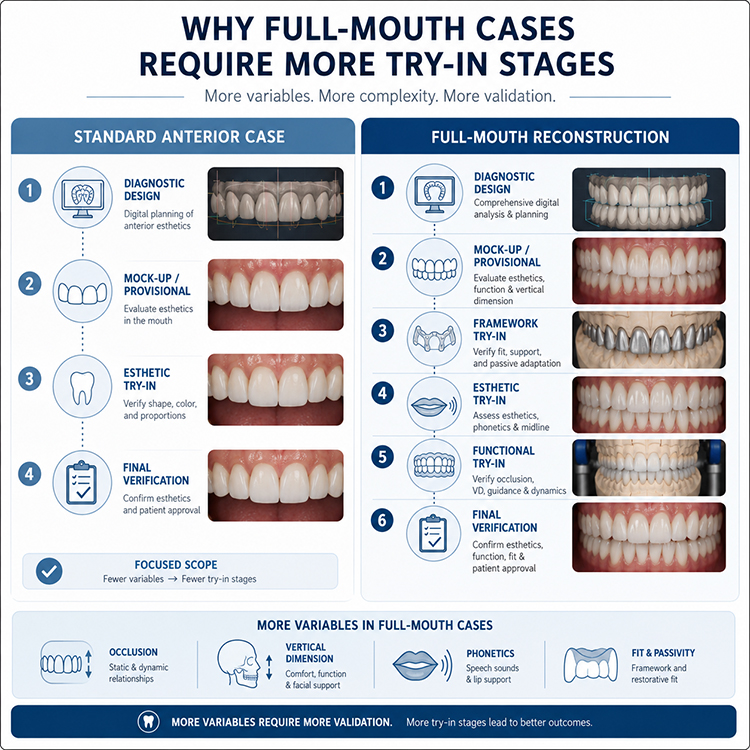
A full-mouth restoration workflow is different. It may include 24 to 28 units, posterior support, canine guidance or group function, altered vertical dimension, implant bridges, long-span zirconia, lithium disilicate crowns, PMMA provisionals, and muscle-memory adaptation. The mouth does not judge those pieces separately. It judges them as one system.
Why the First Try-In Is Usually Not About Beauty
The first full-mouth try-in is often a lie detector.
Not poetic. Practical.
A proper diagnostic or PMMA try-in reveals whether the records make sense when they leave the software and enter the patient’s actual mouth, where the condyles, tongue, lips, cheeks, muscles, speech patterns, and parafunction all start voting against the plan.
In the literature, full-mouth rehabilitation case reports repeatedly show staged validation rather than instant finalization. One published case report on full-mouth rehabilitation of reduced vertical dimension describes monitoring adaptation to an occlusal splint before definitive restorative steps. Another report on severely worn dentition and reduced vertical dimension centers treatment around restoring vertical dimension and anterior guidance — not simply placing prettier crowns.
That is the part sales brochures often soften.
If you increase VDO by 2 mm, 3 mm, or 4 mm, you are not just opening space for ceramic. You are asking muscles, joints, speech, swallowing, and proprioception to accept a new operating height. Sometimes they do. Sometimes they complain.
And when they complain, the lab hears about it.
The Try-In Ladder: What Each Stage Actually Catches
Try-In Stage
Standard Anterior Case
Full-Mouth Reconstruction Case
What It Prevents
Digital/wax-up review
Smile design, tooth length, midline, incisal edge
Occlusal plane, VDO, arch form, posterior support, esthetic plan
Wrong blueprint before production
Mock-up or PMMA provisional
Esthetic preview and patient approval
Functional test-drive of vertical dimension, speech, bite, guidance
Finalizing an untested system
Framework/structure try-in
Sometimes skipped in simple cases
Often needed for long-span bridges, implants, zirconia frameworks
Every row represents money, patient patience, schedule pressure, and clinical judgment. But compared with a failed full-arch delivery, an extra try-in is cheap. I know that sounds blunt, but most labs learn this through pain, not theory.
Full-Arch Cases Are Not “More Units”; They Are More Consequences
A single anterior crown can be slightly high and get adjusted. A full-arch implant bridge that is high on one distal cantilever can overload an implant, distort chewing patterns, or create soreness that the patient describes as “the whole bite feels wrong.”
That sentence ruins mornings.
This is why full-arch restorative cases need a different verification mindset. On the lab side, the key questions are not only “Does it fit the die?” or “Does the shade match?” The questions become:
Does the prosthesis seat passively?
Does the occlusion match the prescribed scheme?
Is there enough restorative space for material thickness?
Are screw channels acceptable?
Can the patient clean under the prosthesis?
Is the midline right when the bite is right?
Does the phonetic test expose bulky lingual contours?
Will the opposing arch destroy this material?
Artist Dental Lab’s client case examples mention full-arch workflows, implant-supported prosthetics, associated provisional restorations, standardized scanning protocols, and reduced chairside adjustment time. That is exactly the territory where extra try-in stages earn their keep.
Material Choice Changes the Try-In Strategy
Ceramic does not care about your optimism.
For anterior lithium disilicate crowns, the question may be whether the restoration has enough translucency and value control over the prep. The E.max crowns workflow specifically calls for stump shade, photos, occlusal/contact guidance, margin notes, and clear esthetic targets because even one dark stump can shift the final result.
With multilayer zirconia, the conversation changes. The material is stronger and often better for posterior load, implant-supported restorations, and functional occlusion cases, but the monolithic design also means contour, contacts, polish quality, occlusal scheme, and clearance must be nailed before final delivery. Adjusting sintered zirconia aggressively after the fact is not strategy. It is cleanup.
And with layered ceramics, including porcelain-layered zirconia or layered E.max, the lab gains optical depth but adds a chipping-risk conversation. That does not make layered ceramics bad. It makes case selection honest.
Hard truth: many “material failures” are planning failures wearing a lab invoice.
Why Occlusal Adjustment Is Not a Final-Appointment Detail
Occlusal adjustment in full mouth cases should not be saved like dessert.
It belongs early.
When the vertical dimension changes, when posterior support is rebuilt, when anterior guidance is re-established, or when a patient moves from a collapsed bite into a reorganized occlusion, you need staged checks. Centric relation, maximum intercuspation, protrusive movement, laterotrusion, working contacts, non-working interferences, and envelope of function all matter.
Can you see all of that from a static STL file?
No. You can design intelligently from digital records, but the patient still has to prove the plan in motion.
This is where PMMA provisionals are underrated. They give the clinician a living prototype. Speech can be checked. Chewing comfort can be observed. Soreness can be traced. Esthetics can be revised. The patient can discover what they hate before the final zirconia or lithium disilicate is finished.
That is not inefficiency. That is insurance.
The Lab’s Suspicion List: Records That Make Full-Mouth Cases Dangerous
I get suspicious when a full-mouth case arrives with perfect confidence and imperfect records.
The dangerous signs are familiar: one bite scan for a 28-unit reconstruction, no face photos, no retracted photos, no midline note, no VDO rationale, no provisional phase, no implant library confirmation, no material thickness discussion, no parafunction history, and a prescription that says “make natural.”
Make natural?
That is not a prescription. That is a wish.
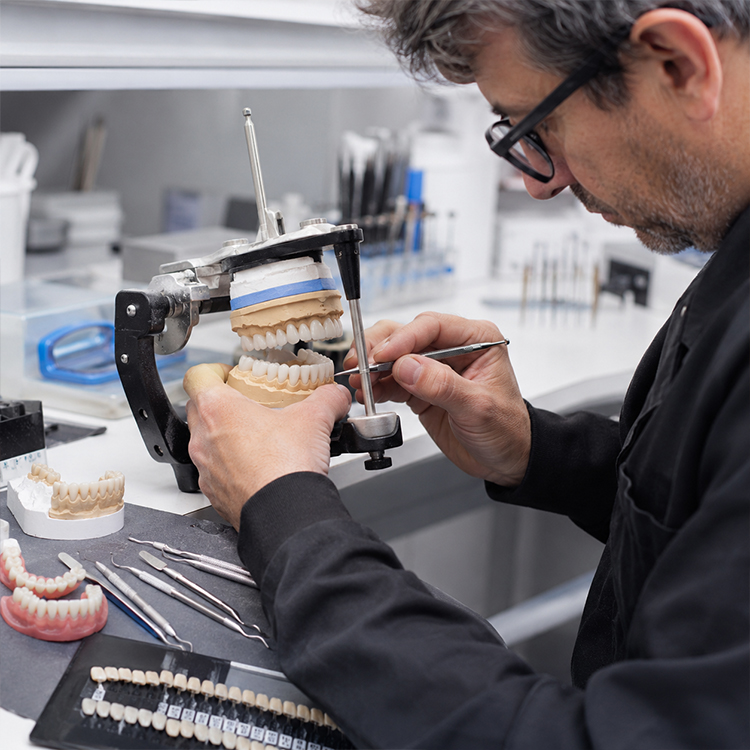
For a serious full mouth reconstruction, the lab needs a disciplined packet: upper and lower scans, bite records at the intended VDO, prep scans, opposing scans, tissue scans where relevant, scan body verification, implant system details, shade tabs in the photo, stump shade, full-face smile images, occlusal scheme instructions, desired incisal edge position, material preferences, and provisional feedback.
This is why a detailed case intake and quote request is not just an admin form. It is the first quality-control filter.
The Real Reason More Try-Ins Save Money
Clinics sometimes frame extra try-ins as lost time. I disagree.
Remakes are lost time. Chairside grinding is lost time. Patient distrust is lost time. A full-arch zirconia bridge that needs major adjustment at delivery is lost time with a soundtrack.
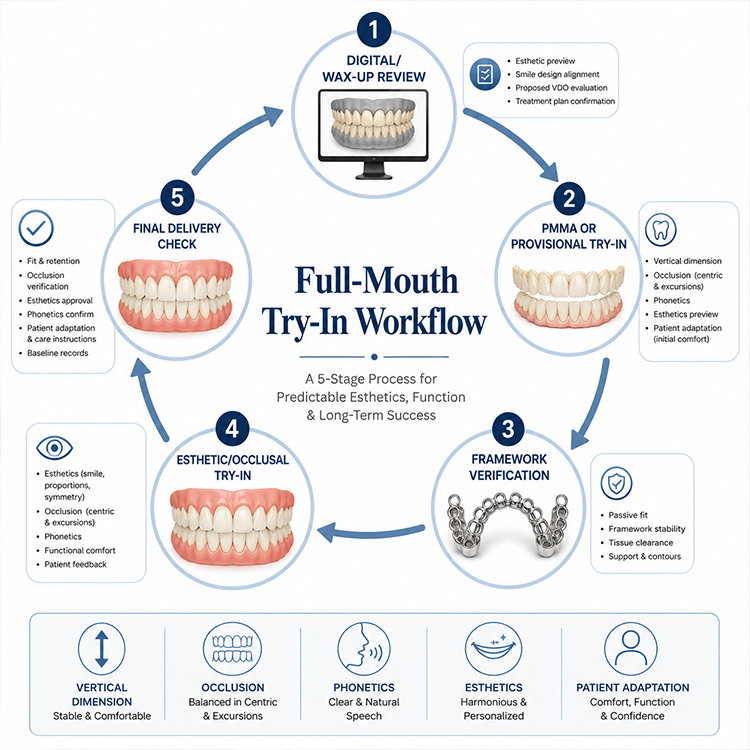
In full-mouth rehabilitation, each try-in answers a different question:
The Diagnostic Try-In Answers: “Is the Plan Clinically Coherent?”
This stage tests VDO, tooth position, occlusal plane, facial support, and esthetic direction before expensive final materials enter the story.
The Provisional Try-In Answers: “Can the Patient Live With This?”
This stage exposes phonetic issues, muscle adaptation problems, cheek biting, lip support complaints, and functional discomfort.
The Framework Try-In Answers: “Does the Structure Fit Passively?”
This matters most in implant bridges, long-span frameworks, titanium bars, and zirconia substructures where passive fit is not optional.
The Bisque or Pre-Final Try-In Answers: “Are We Ready to Finish?”
This stage checks shade, contour, contacts, smile line, embrasures, occlusion, hygiene access, and final patient approval before glaze, stain, polish, or bonding.
Skipping one stage can work. Sometimes.
But when it fails, it fails expensively.
FAQs
Why do full-mouth cases need more dental try-in stages?
Full-mouth cases need more dental try-in stages because they change the entire oral system, not just the visible smile; each appointment verifies vertical dimension, occlusion, function, phonetics, esthetics, framework fit, implant relationships, and patient adaptation before the final restorations are fabricated or delivered.
In a standard anterior case, the main risk is usually esthetic mismatch. In full mouth reconstruction, the risk includes soreness, unstable bite, ceramic fracture, implant overload, speech changes, poor hygiene access, and complete case remake. That is why staged verification is not excessive. It is sane.
What is the difference between full mouth reconstruction and anterior dental cases?
Full mouth reconstruction restores or reorganizes most or all teeth in both arches, often involving vertical dimension, posterior support, implants, occlusal design, and multiple materials, while anterior dental cases usually focus on the visible front teeth, smile esthetics, incisal position, shade, translucency, and facial harmony.
Anterior cases can be artistically demanding, especially with layered ceramics or feldspathic-style esthetics. But full-mouth rehabilitation adds mechanical and biological load. The clinician must manage how the patient bites, speaks, chews, adapts, and maintains the restorations long after the mirror test is over.
How many try-ins are normal for full-mouth rehabilitation?
A full-mouth rehabilitation may require three to five verification stages, commonly including diagnostic wax-up or digital design review, mock-up or PMMA provisional try-in, framework try-in, bisque or pre-final ceramic try-in, and final delivery verification with occlusal adjustment and patient approval.
The exact number depends on implants, material selection, vertical dimension changes, parafunction, esthetic complexity, and whether the case is tooth-supported, implant-supported, or mixed. A simple tooth-supported rehabilitation may need fewer stages than a full-arch implant reconstruction with long-span zirconia and altered VDO.
Can digital dentistry reduce the number of try-ins?
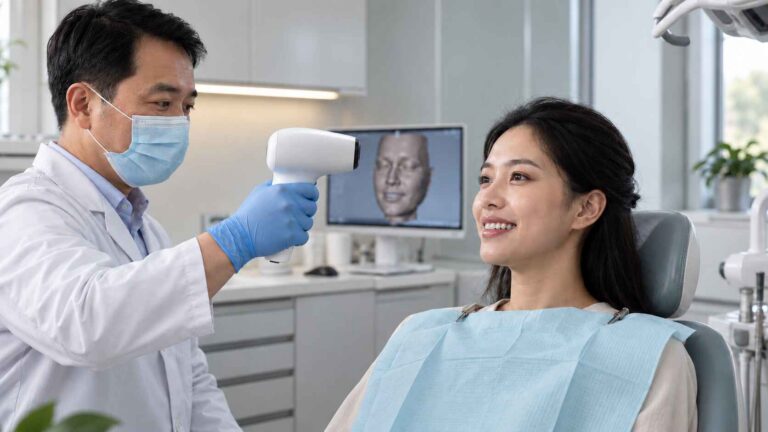
Digital dentistry can reduce some errors and improve repeatability, but it cannot fully replace biological testing; scans, CAD design, printed models, and milled PMMA provisionals help the team verify fit and design earlier, yet patient adaptation, speech, occlusion, and muscle response still require clinical try-in stages.
Digital workflows are strongest when paired with disciplined records. Poor bite records, weak photos, vague shade notes, and missing implant details do not become accurate just because they enter software. Garbage in, expensive garbage out.
Is PMMA provisionalization necessary in full-mouth cases?
PMMA provisionalization is often necessary in full-mouth cases because it gives the dentist and patient a functional prototype to test vertical dimension, esthetics, phonetics, occlusion, comfort, and hygiene access before committing to final zirconia, lithium disilicate, layered ceramic, or implant-supported restorations.
Not every case needs a long provisional phase, but high-risk cases usually do. Severe wear, bruxism, changed VDO, implant full arches, unstable occlusion, and demanding esthetics all make PMMA provisionals valuable. They reveal problems while the case is still editable.
Final Thoughts: Stop Treating Full-Mouth Cases Like Larger Smile Makeovers
Full mouth reconstruction is not a bigger anterior case. It is a different category of risk.
If you are planning full-mouth rehabilitation, do not rush the try-in sequence to make the schedule look cleaner. Build the case in layers: diagnosis, provisional validation, framework verification, esthetic approval, functional adjustment, final delivery. The patient may not understand every step, but they will understand the result.
And if you want a lab partner that understands full-arch restorations, implant-supported prosthetics, zirconia, lithium disilicate, PMMA provisionals, and staged B2B workflows, start with a real case discussion through Artist Dental Lab’s quote and consultation page. Send the records. Send the doubts too. The doubts are usually where the remake is hiding.