How Clinics Can Communicate “Naturalness” Instead of Just “Whiteness” to Labs
The Whitening Trap Clinics Keep Walking Into
Whiter sells fast.
But “whiter” is not a lab instruction; it is a mood, a marketing word, a patient’s anxious shortcut, and sometimes a clinician’s way of avoiding the harder conversation about value, chroma, translucency, surface texture, stump shade, incisal behavior, and whether the final smile should look alive in daylight or merely bright under operatory LEDs.
So why are so many prescriptions still written like the technician owns a mind-reading device?
Here is the hard truth: most shade failures are not failures of ceramic. They are failures of language. A clinic writes “B1, natural,” the patient expects camera-ready teeth, the lab receives one shade photo with saliva glare, and everyone acts shocked when the restoration comes back too flat, too opaque, too chalky, or too “bathroom-tile white.”
The American Dental Association makes one point that clinics should tattoo onto every cosmetic case plan: whitening works on natural teeth, but not on tooth-colored restorations; it also identifies hydrogen peroxide and carbamide peroxide as common whitening agents. In plain English, if you place the restoration at the wrong value, the patient cannot bleach it into harmony later. Read the ADA whitening overview.
That matters because dental lab communication is not clerical work. It is risk control.
Table of Contents
Naturalness Is a Specification, Not a Vibe
I am going to be blunt: “make it natural” is only slightly better than “make it nice.” The lab needs usable evidence. Not poetry.
Natural-looking dental restorations are built from several separate optical decisions: base shade, value, chroma, hue, translucency, opacity, fluorescence, surface gloss, incisal effects, mamelon visibility, halo strength, and the way the restoration behaves against gingiva, lips, skin tone, and adjacent teeth.
The mouth is not Photoshop.
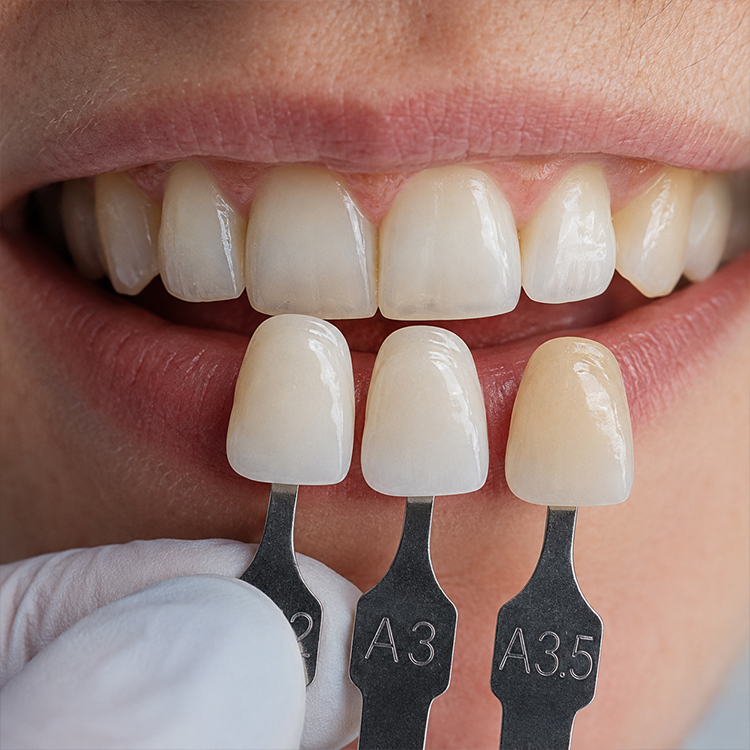
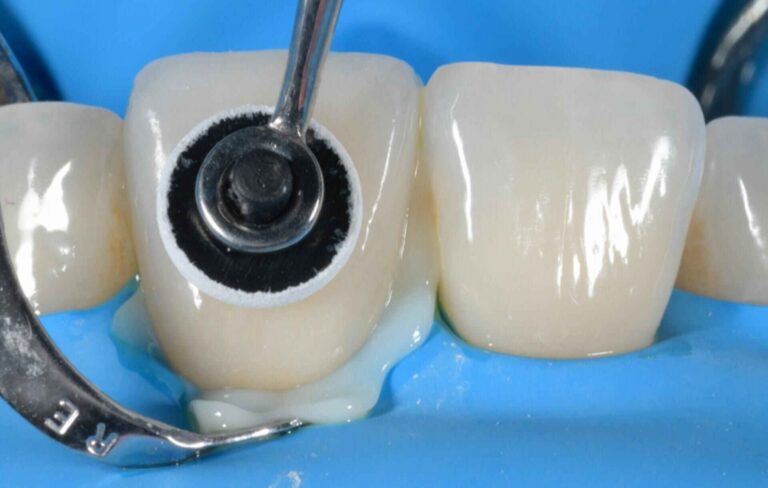
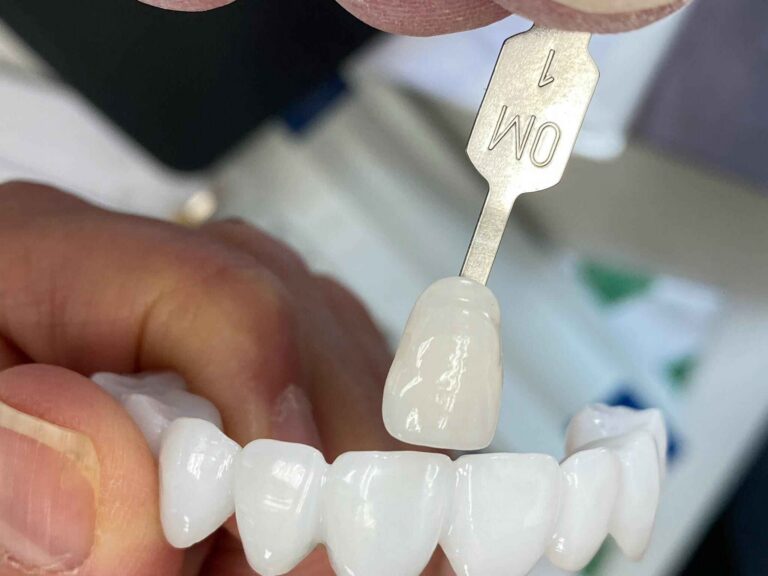
When clinics talk only about whiteness, they usually overfocus on the shade tab—A1, B1, BL2, 0M1—and under-describe the things patients actually notice: whether the cervical third is too bright, whether the incisal third looks gray, whether the veneer blocks light like a refrigerator panel, and whether four central incisors look like they came from the same factory tray.
For anterior cases, I would rather see a slightly warmer restoration with honest translucency than a dead-white restoration with no enamel behavior. That opinion annoys some people. Good. The industry has worshipped bleach shades long enough.
For cases where the clinic wants enamel-like translucency and micro-texture, link the prescription conversation early to hand-layered feldspathic veneer cases, because feldspathic porcelain is built for delicate incisal effects, complex shade blending, and high-end anterior characterization—not for every mouth, not for every bite, and not for every patient who walks in with a celebrity screenshot. Artist Dental Lab’s feldspathic page specifically asks for shade, stump shade, face and smile photos, value/translucency targets, and reference images.
The Data Says Your Phone Photo Is Probably Lying
Bad inputs first.
A single uncalibrated smartphone photo can distort value, flatten chroma, exaggerate glare, and erase incisal detail, which means the technician may be designing a restoration for a version of the tooth that never existed under neutral lighting in the first place.
Do we really want a $1,000-plus esthetic decision depending on auto white balance?
A 2024 in-vitro shade-selection study reported that intraoral scanners showed ΔE = 5.8, while the smartphone method showed ΔE = 12.09, the weakest precision among the tested methods using CIELab* analysis. That is not a small difference. That is the gap between “close enough” and “why does this crown look wrong?” Review the 2024 PubMed shade-selection study. (PubMed)
And yes, I know the argument: “We have always used phone photos.” We also used to accept lab slips that said “match adjacent.” Tradition is not a quality-control system.
A separate 2024 study on dental laboratory prescriptions compared 600 prescriptions and found that a technology-supported intake system improved how often key information was recorded, reduced recommunication, and improved prosthesis-quality metrics tied to shade, charting, and case details. Tooth-to-be-restored data appeared in 98.0% of technology-system prescriptions versus 77.2% in traditional ones. Read the 2024 laboratory prescription study.
That is the uncomfortable part of esthetic dentistry: better outcomes often start before the bur touches enamel.
What Labs Actually Need When You Say “Natural”
Clinics often think the lab wants “more information.” Not exactly. The lab wants the right information in the right order.
Here is the working table I would use for esthetic dentistry lab communication.
Clinic Request
What the Lab Hears
What the Clinic Should Send Instead
“Make it white but natural”
Contradictory aesthetic target
Target shade, value priority, chroma tolerance, facial photo, smile photo, patient age, and adjacent-tooth reference
“B1”
One shade tab, no optical map
B1 target plus cervical/middle/incisal zone notes, stump shade, and polarized/retracted photos
“More translucent”
Risk of gray show-through
Translucency zone map, stump shade, prep thickness, material choice, and cement shade plan
Specific bleach range such as BL1, BL2, 0M1, or 0M2, plus patient-approved mock-up or wax-up
“Natural-looking restoration”
Better, but still vague
Value, chroma, translucency, opacity, texture, fluorescence, facial context, and acceptable deviation range
If the case is lithium disilicate, say so with discipline. Artist Dental Lab’s E.max veneer workflow asks for STL scans, shade and stump shade, retracted and smile photos, margin notes, finish-line notes, and esthetic reference goals. That is the minimum. Not the luxury version.
For higher-end anterior makeovers where depth and incisal vitality matter, the conversation should move toward layered E.max veneers for nuanced translucency. The page is clear about what supports better outcomes: shade, stump shade, high-quality photos, wax-up or mock-up references, midline and smile-line notes, and surface texture preferences.
And when the restoration is a crown rather than a veneer, do not pretend the same communication packet works unchanged. Artist Dental Lab’s E.max crowns for natural translucency page calls out stump shade information, photos, occlusal and contact guidance, and clear esthetic targets because thickness, substrate, and crown form can change the final value fast.
Translucency Is Where “White” Goes to Die
A restoration can be white and still look fake. In fact, the fake-looking cases are often white enough. That is the problem.
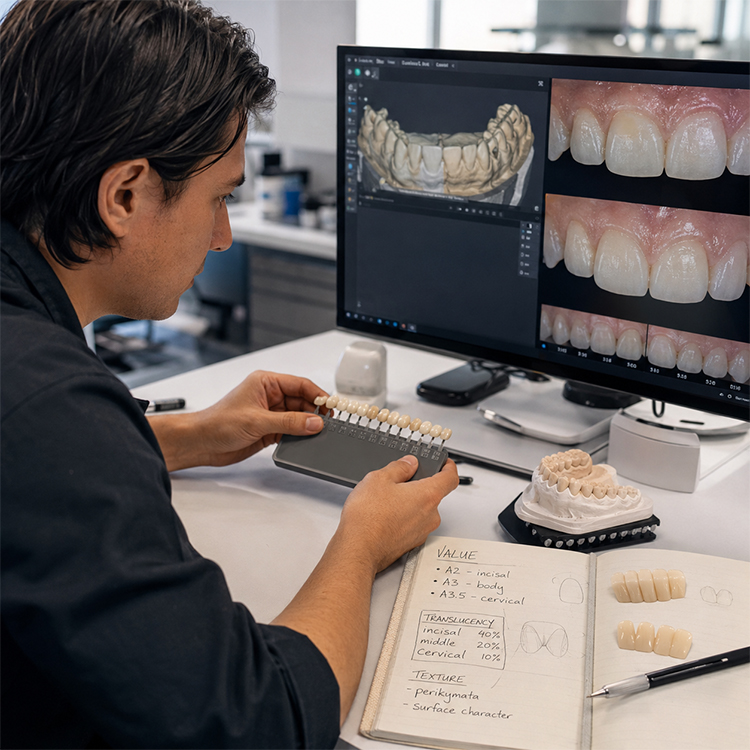
Natural teeth are not uniformly white objects. Enamel scatters light. Dentin warms the body. Incisal edges may carry blue-gray translucency. Cervical areas often show more chroma. Surface texture changes how light breaks across the tooth. If the lab is not told which of those effects the clinic wants, the lab must choose a safer average.
Average looks safe.
But average in anterior ceramics can look lifeless, especially when the patient wants “natural” but the prescription screams “opaque value block.” The technician may protect the value by lowering translucency. The clinic may complain the case looks dead. The patient may blame the lab. Everyone loses.
A 2024 BDJ Open study on CAD/CAM materials tested 40 specimens measuring 12 × 14 mm at 0.5 mm and 1 mm thicknesses, then measured color parameters and translucency; the authors reported that translucency parameter and ΔE00 values significantly decreased as thickness increased, and that 0.5 mm specimens exceeded the clinical acceptability threshold while 1 mm specimens did not. Read the BDJ Open study on translucency and masking.
That is why “communicating translucency to dental labs” needs to include thickness, stump shade, substrate darkness, cement plan, and material. If you leave out one, you are asking the lab to solve an equation with missing numbers.
Material Choice Should Follow the Face, Not the Sales Brochure
I have a bias here: dentists often talk about material as if material selection itself proves sophistication. It does not.
Lithium disilicate, feldspathic porcelain, monolithic zirconia, layered zirconia, and hybrid CAD/CAM materials all have a place. The mistake is choosing the material before the aesthetic problem is understood.
For a patient with minimal discoloration, strong enamel, low functional risk, and high demand for enamel-like vitality, feldspathic may be the right conversation. For a patient needing strength, repeatability, and efficient production across several units, monolithic E.max may make more sense. For posterior load or bridge workflows where chipping resistance and function are the priority, full-contour multilayer zirconia restorations deserve a serious look because the site describes them as monolithic multilayer zirconia with natural gradient esthetics, CAD/CAM precision, and reduced porcelain-chipping risk.
Here is the line clinics should stop crossing: do not ask zirconia to behave like feldspathic porcelain, and do not ask feldspathic porcelain to survive like high-strength zirconia in the wrong occlusal environment.
That is not being conservative. That is being honest.
A Better Lab Brief for “Natural-Looking” Restorations
Use the word “natural,” but define it. Every time.
A serious naturalness-focused case packet should include:
Incisal detail: halo, mamelons, blue-gray translucency, white craze lines
Photos: full face, smile, retracted, shade tab, stump shade, polarized if possible
Digital files: STL or IOS scan, bite, opposing arch, margin notes
Patient-approved reference: wax-up, mock-up, provisional photo, or approved smile design
This is where I like Artist Dental Lab’s broader site structure. Its article on teamwork in esthetic anterior restorations says the failures often begin when the brief is thin, photos are weak, stump shade is missing, and the technician is expected to guess on value, translucency, texture, midline, and occlusal intent. That is exactly the point.
Stop Letting Patients Choose in Bad Lighting
Patients are not wrong for asking for white teeth. Clinics are wrong when they translate that request too literally.
A patient sees teeth under bathroom LEDs, car mirrors, social-media filters, restaurant lighting, daylight, and wedding photography. The restoration must survive all of those environments. Operatory lighting alone is not enough.
So ask better questions:
“What do you mean by natural?”
“Do you want people to notice the teeth first, or the face first?”
“Do you prefer bright-but-soft or bright-and-uniform?”
“Are you okay with subtle incisal translucency, or do you read that as gray?”
“Should the smile look younger, cleaner, warmer, or camera-brighter?”
These questions sound simple. They are not. They protect the clinic, the lab, and the patient from the tyranny of one vague word: white.
FAQs
What is dental lab communication in esthetic dentistry?
Dental lab communication in esthetic dentistry is the structured exchange of shade data, digital scans, stump shade, photographs, material instructions, texture references, occlusal notes, and patient-approved goals between the clinic and technician so restorations can be fabricated to match the patient’s biology, face, and aesthetic expectations.
It should not rely on one shade tab or a vague request like “make it natural.” For anterior cases, the lab needs a complete optical brief: value, chroma, translucency, opacity, incisal effects, surface texture, and substrate influence.
How should clinics explain naturalness instead of whiteness to a dental lab?
Clinics should explain naturalness as a measurable combination of value, chroma, hue, translucency, opacity, surface texture, fluorescence, incisal characterization, and facial harmony rather than using “white” as a single target, because natural-looking dental restorations depend on how ceramic reflects, absorbs, and transmits light.
A better instruction is not “B1 natural.” A better instruction is: “Target B1 value, slightly warmer cervical third, moderate incisal translucency, subtle halo, low surface gloss, match contralateral texture, stump shade ND3.”
What photos should a clinic send for tooth shade matching?
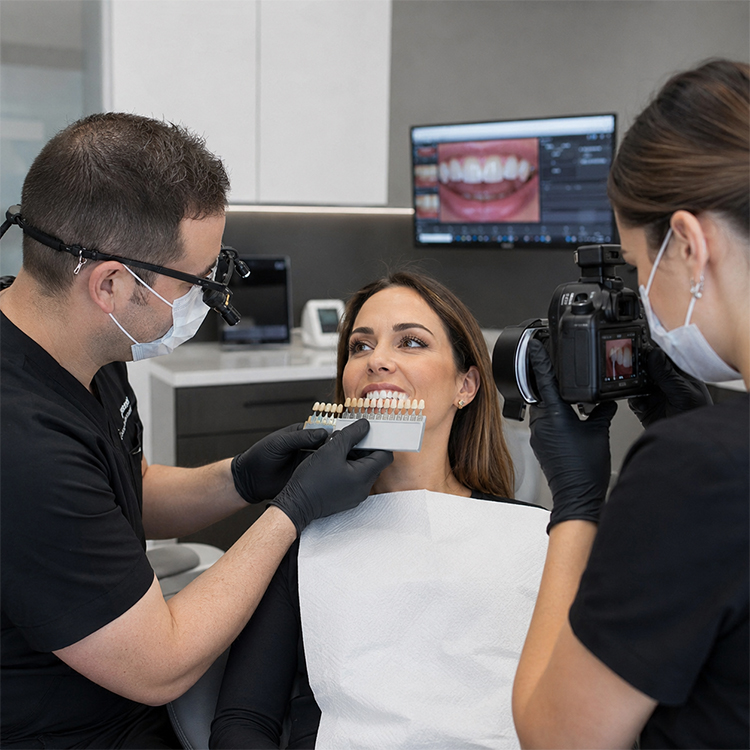
A clinic should send full-face, smile, retracted, shade-tab, stump-shade, and close-up anterior photos under controlled lighting, ideally with consistent camera settings and minimal glare, so the lab can judge value, chroma, incisal translucency, surface texture, gingival context, and how the restoration must fit the patient’s face.
For complex cases, polarized photography and a gray reference card can help. The shade tab should be in the same plane as the tooth, with the label visible, and the tooth should be hydrated before final shade capture.
Why does translucency matter in natural-looking dental restorations?
Translucency matters in natural-looking dental restorations because enamel is not visually solid; it allows and scatters light, creating incisal depth, edge vitality, and subtle color transitions that make ceramic look like tooth structure instead of a flat opaque white object placed in the smile.
Too much translucency can drop value and look gray. Too little can make the restoration look chalky. That is why labs need thickness, stump shade, cement shade, material choice, and incisal-zone instructions before fabrication.
Is a natural tooth shade guide enough for anterior restorations?
A natural tooth shade guide is useful but not enough for anterior restorations because shade tabs usually capture only a simplified color category, while real anterior teeth contain layered differences in value, chroma, translucency, surface texture, cervical warmth, incisal effects, and optical behavior under different light sources.
Use the shade guide as the starting point, not the prescription. The lab still needs photos, stump shade, prep thickness, material selection, patient age, facial context, and an approved aesthetic target.
Send the Lab a Better Brief This Week
If your clinic wants fewer remakes and more natural-looking dental restorations, stop writing “whiter” when you mean “alive.”
Build a one-page naturalness brief for every anterior case: target value, chroma, translucency, stump shade, incisal effects, surface texture, material, cement plan, and patient-approved reference. Then send it with scans and photos before the lab starts design.
For clinics, DSOs, and labs that want to test a cleaner esthetic workflow, start with a real case packet and request a B2B consultation through Artist Dental Lab’s case inquiry page. Their contact form already asks for business type, monthly case volume, product interest, material preference, indications, certifications, turnaround expectations, and project details—which is exactly the kind of structured intake serious dental lab communication needs.