How to Standardize Product Choice for Multi-Unit Anterior Restorations
The Unpleasant Truth About Anterior Restorations
Anterior Restorations are not an elegance competition.
They are danger administration.
I understand that seems less glamorous than “high-translucency ceramic” or “superior smile style,” yet the situations that go sideways normally do not stop working because the dental practitioner chose a useless product; they fail since no one forced the case with a repeatable choice system before the prescription struck the laboratory bench. Why are we still claiming that preferred ceramic can solve every former trouble?
The oral economic climate allows enough now that careless product selection is not a private inconvenience. It is an industrial leakage. The American Dental Association’s Health Policy Institute reported that national dental expense reached $189 billion in 2024, up $7 billion after inflation change from 2023, while dental costs stayed 3.6% of complete united state wellness expense, according to its nationwide dental expenditure information.
So, yes, product selection for former restorations issues.
Not philosophically. Economically. Medically. Operationally.
And the person pool is not getting less complex. NIDCR information show that nearly 90% of grownups aged 20– 64 have had decay in irreversible teeth, 1 in 4 have unattended degeneration, and grownups in that age variety balanced 9.3 rotted, missing, or loaded teeth in the 2011– 2016 NHANES cycle, according to the NIDCR grown-up caries data.
That implies multi-unit anterior restorations rarely stroll in as tidy textbook cases. They include old compounds, stump staining, occlusal marks, endodontic background, missing enamel, unequal decrease, and clients that want “natural” however covertly indicate “white adequate to validate the invoice.”
Table of Contents
Stop Asking “What Is the Best Material?” Ask This Rather
The “finest product for former crowns” is frequently the incorrect inquiry.
Here is my working regulation: standardized restorative material option begins with the failing mode, not the trademark name.
A multi-unit former case ought to be arranged by 6 variables prior to any individual says lithium disilicate, zirconia, feldspathic porcelain, or layered ceramic:
Stump shade: Is the underlying tooth ND1, ND4, ND8, metal-dark, endodontic gray, or tetracycline-banded?
Decrease room: Do we have 0.7 mm, 1.0 mm, 1.2 mm, or wishful thinking?
Occlusion: Is this a tranquil Course I instance, deep bite, edge-to-edge, bruxer, canine advice issue, or parafunctional wreckage?
Unit matter: Is it two centrals, 6 former crowns, 8 veneers, or a combined crown-veneer recovery?
Optical target: Are we matching a single main incisor or creating a regulated multi-unit smile?
Cementation logic: Is adhesive bonding realistic, or are we depending on retention kind and conventional cementation?
That is the entire fight.
Pretty blocks lose when the prescription is blind.
Artist Dental Lab’s very own item structure in fact sustains this sort of sorting. For esthetic-zone crowns, the E.max crowns workflow is mounted around lithium disilicate, clarity, fit, and anterior indications, while the full-contour multilayer zirconia choice is positioned for crowns and bridges where feature, cracking resistance, and CAD/CAM consistency bring even more weight.
That split is not cosmetic. It is diagnostic.
The Material Matrix I Would Really Use
The table below is not indicated to flatter anybody’s favorite ceramic. It is implied to avoid remakes.
Product Option
Chemistry/ Framework
Ideal Use in Multi-Unit Anterior Restorations
The Failing Danger Nobody Likes Saying Out Loud
What the Laboratory Has To Receive
Lithium disilicate/ E.max crowns
Li ₂ Si two O five glass ceramic
Anterior crowns, short-span esthetic situations, moderate stump control, strong need for translucency
Can look too transparent or low-value over dark stumps if density and concrete color are disregarded
Smile-zone crowns requiring stamina plus better facial deepness
Veneer porcelain includes breaking danger if style, support, and occlusion are careless
Practical medical diagnosis, lessening layout, incisal target, photos, call expectations
This is where I obtain opinionated: if a center can not provide stump shade, bite notes, images, and decrease clearance, it has not earned the right to whine regarding the material.
The lab is not psychic.
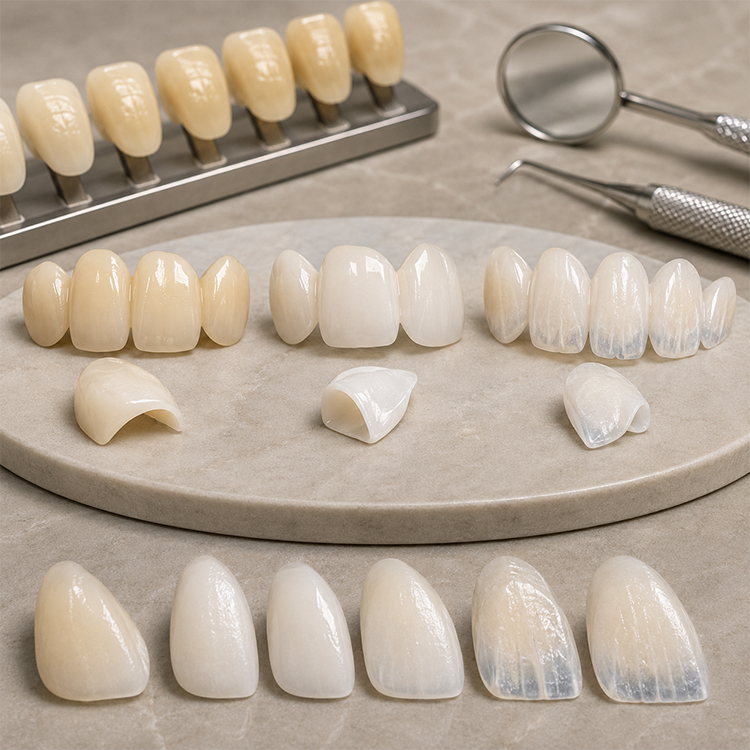
For veneer-heavy planning, I would certainly map cases right into E.max veneers when uniformity and sticky predictability issue, split E.max veneers when the situation demands extra incisal character, and feldspathic veneers only when enamel, bonding, and practical risk all behave. Musician Dental Lab’s veneer web pages separate those classifications clearly enough that a facility can transform them right into an interior prescription tree as opposed to sending out unclear “make it natural” notes.
What the Evidence Claims Concerning Zirconia vs Lithium Disilicate
The information do not crown one universal victor.
Good.
A 2023 regulated clinical test contrasting high-translucency cubic zirconia with lithium disilicate glass ceramic reported that the E.max group revealed much better clinical outcomes for esthetics and tooth clarity, according to the research abstract indexed at PMC.
That searching for matches what several professionals quietly recognize: zirconia has boosted, however clarity is not the like enamel behavior.
But function bites back.
A 2025 retrospective associate study contrasting zirconia and lithium disilicate prostheses reported 5-year collective survival of 94.0% for zirconia and 89.0% for lithium disilicate, with p = 0.210, meaning the distinction was not statistically substantial in that research study; the paper is offered via PMC.
So the inexpensive motto “E.max looks better, zirconia lasts longer” is also blunt.
That does not mean worldly choice is irrelevant. It suggests sign discipline is every little thing.
A lithium disilicate crown can be the best answer for a central incisor where worth, clarity, sticky bonding, and adjacent enamel integration dominate. A layered zirconia crown can be smarter when the individual has heavier function, much less pleasant preparation geometry, and still needs smile-zone characterization; Musician Dental Laboratory settings layered zirconia crowns precisely in that strength-plus-esthetics lane.
The Standard Operations: 6 Gates Before Material Approval
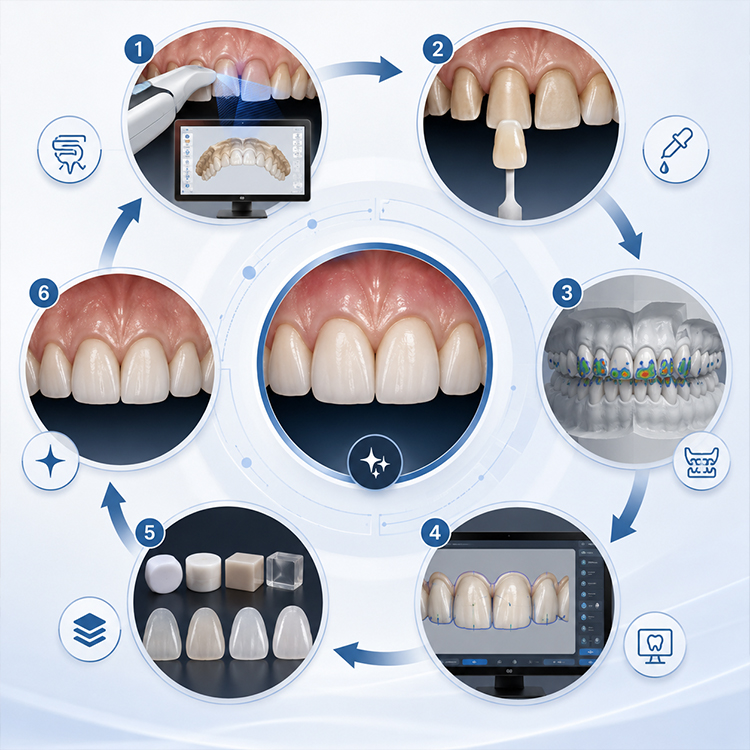
I would certainly not allow a multi-unit anterior instance get in manufacturing up until it removes 6 gateways.
That sounds stringent.
It needs to be.
Gateway 1: Define the System Technique
A six-unit veneer case is not the same as four crowns plus two veneers. Mixed prep work produce various thicknesses, concrete results, stump values, and development accounts.
Whether the instance is designed to match adjacent teeth or control the complete visible smile
Multi-unit anterior repairs stop working when the dental practitioner thinks in teeth and the lab needs to think in a smile.
Entrance 2: Document Stump Color Prior To the Individual Leaves
Stump color is not optional.
It is the peaceful authoritarian of former porcelains.
A 0.8 mm lithium disilicate veneer over a brilliant stump and a 0.8 mm lithium disilicate veneer over a dark stump are not the very same restoration, even if the invoice utilizes the same item name. Request for stump pictures with the shade tab in the exact same aircraft. Request withdrawed pictures. Request for hydration-aware timing.
And stop sending out “BL2 all-natural” as if that is a total thought.
Entrance 3: Procedure Reduction, Do Not Presume It
I would rather see an awful clearance photo than a lovely lie.
For ceramic anterior repairs, reduction adjustments optical actions. Also slim, and the stump wins. As well thick, and the tooth might look large. As well aggressive, and biology foots the bill.
This is where STL scans, reduction guides, and sectioned prep sights come to be more than digital cinema. They are danger evidence.
Entrance 4: Separate Esthetic Threat From Functional Danger
This is the fork in the road.
When aesthetic danger is high and practical danger is modest, lithium disilicate or layered ceramics typically are worthy of the first discussion. When functional danger rises– bruxism, edge-to-edge wear, restricted clearance, heavy guidance– zirconia goes into the area earlier.
Yet do not puzzle “more powerful” with “better.”
For high-strength aesthetic veneer situations, zirconia veneers might be defensible when longevity is focused on, yet the situation still requires color notes, stump color, occlusal info, and images; the site itself provides those inputs as part of what to send out.
Gateway 5: Select the Construction Style, Not Simply the Material
Product is insufficient.
Lithium disilicate can be monolithic, tarnished, lowering, or split. Zirconia can be monolithic multilayer, high-translucency, facially layered, or built over a core. Feldspathic porcelain is a hand-layered pet entirely.
That is why “zirconia vs lithium disilicate former reconstructions” is a weak binary. The far better inquiry is: which ceramic architecture matches the instance threat?
A monolithic restoration gets uniformity. A split restoration buys depth. Both can penalize lazy planning.
Gate 6: Lock the Lab Interaction Design Template
The prescription ought to compel information capture.
At minimum, I would certainly require:
STL prep scan
Opposite scan
Attack record
Margin notes
Stump color
Last shade target
Smile photo
Retracted color photo
Occlusal support notes
Parafunction history
Cementation plan
Texture recommendation
Midline and incisal edge notes
Authorized wax-up or mock-up for multi-unit instances
Monotonous?
Exactly. Boring systems conserve costly situations.
The Lab-Side Reality Nobody Wants to Price In
Dental labs are under pressure from automation, outsourcing, service technician lacks, turn-around demands, and customers that want costs esthetics at asset rate.
The U.S. Bureau of Labor Statistics reported a May 2024 average annual wage of $48,310 for oral research laboratory technicians, and it forecasts overall employment for oral and sensory lab professionals and medical appliance specialists to decrease 1% from 2024 to 2034, while still showing about 7,700 openings each year across the more comprehensive group; see the BLS Work Overview Handbook.
That issues due to the fact that costs anterior job is still technician-sensitive.
CAD/CAM can mill. Software application can propose makeup. Sintering can adhere to a timetable. However value control, appearance, incisal rhythm, line angles, and multi-unit symmetry still require human judgment.
Here is the tough fact: centers that send out weak documents move their uncertainty to the laboratory, then call the result a laboratory problem.
For DSOs, dental teams, and representatives, that unpredictability becomes systemic. That is where an OEM/ ODM oral restoration workflow makes good sense: specify materials, layout policies, completing, color approach, remake policy, labeling, and QC checkpoints prior to volume boosts. Artist Dental Laboratory’s OEM/ODM page clearly describes private-label specifications, product choice, shade strategy, ending up preferences, and QC checkpoints as configurable workflow components.
That is not documentation. It is margin defense.
My Material Rules for Multi-Unit Anterior Restorations
Select Lithium Disilicate When Esthetics and Attachment Lead
I pick lithium disilicate initially when the situation requires optical combination, adhesive bonding is reasonable, stump shade is managed, and the client expects enamel-like depth rather than pure opacity.
Utilize it for anterior oral repairs where clarity, worth, and minimal appeal issue.
However do not utilize it thoughtlessly over dark stumps.
And do not presume that an E.max crown and an E.max veneer act similarly. Preparation layout modifications density. Density modifications light. Light adjustments the instance.
Choose Layered E.max When the Situation Is Worthy Of Personalized Optics
Layered E.max is not a condition symbol.
It is a tool.
I would use it when the person’s smile line, incisal display, nearby tooth complexity, and charge level warrant even more hand-built characterization. If the person has low lip wheelchair and desires a consistent brilliant smile, the costs may be lost. If the case is a demanding upper former smile transformation with noticeable incisal clarity, layered porcelains can earn their seat.
Choose Feldspathic Porcelain When Enamel Is Still the Hero
Feldspathic porcelain is stunning, however it is not flexible.
It belongs in minimal-prep, enamel-rich, thoroughly bonded cases where the primary need is optical mimicry, not brute toughness. If the person has practical threat, poor enamel, hefty reduction, or impractical shade needs, feldspathic can transform from classy to breakable very swiftly.
This is where vanity obtains expensive.
Choose Zirconia When Feature Begins Making Hazards
Zirconia makes interest when practical lots, limited area, crack issue, or bridge layout issues.
Yet zirconia is not one point. 3Y-TZP, 4Y-TZP, and 5Y-TZP do not behave identically. A lot more clarity frequently implies a trade-off in mechanical book. So when a medical professional requests for “high-translucency zirconia anterior crowns,” I would like to know: how much clearance, what stump color, what opposing material, what assistance, and what smile-line direct exposure?
No documents, no self-confidence.
Select Layered Zirconia When Strength Demands a Better Face
Split zirconia can make good sense when a monolithic zirconia crown would look too flat however a totally glazed ceramic really feels underpowered.
I like it for chosen anterior crowns where strength issues, yet the facial surface area still needs depth and texture. The disadvantage is obvious: layering presents method sensitivity and prospective chipping if in need of support porcelain obtains abused.
Solid core. Delicate arrogance.
The Choice Tree Clinics Must Utilize Before Sending the Instance
Below is the compressed chairside formula:
Is the reconstruction primarily veneer-based with healthy enamel and modest color adjustment? Start with lithium disilicate veneers or feldspathic porcelain, depending upon esthetic ambition and functional risk.
Is it a multi-unit crown case with moderate esthetic need and controlled stump color? E.max crowns are typically the tidy initial conversation.
Is the stump dark, reduction limited, or worth control difficult? Think about lower-translucency lithium disilicate, opacity strategy, concrete shade control, or zirconia relying on the case.
Is practical risk high? Relocate zirconia earlier, but need complete occlusal paperwork.
Holds true in the high-smile area with strength and premium esthetics called for? Take into consideration split zirconia or layered E.max based on prep, stump, and function.
Is the buyer a clinic chain, DSO, or distributor? Standardize the accepted product food selection before scaling quantity, then validate with test situations and remake monitoring.
Artist Dental Lab’s customer case web page defines standard procedures, central electronic workflow, and lowered turn-around for multi-location drivers, including a North American DSO example with 28 centers and a shift from 15– 20 day complex-case turn-around to 9– 11 days for common cases and 12– 2 week for full-arch reconstructions.
That is business factor for standardization.
The clinical factor is easier: fewer surprises.
The Security and Conformity Angle: Do Not Abuse Information
I likewise view the FDA’s adverse-event globe, however very carefully.
The FDA MAUDE database consists of clinical tool records, yet the FDA warns that MDR information need to not be made use of to compute adverse-event prices, compare tools, or prove causation because reports may be insufficient, unreliable, underreported, or unproven.
That advising issues in dental materials.
Do not weaponize arbitrary unfavorable records to frighten patients far from zirconia, lithium disilicate, or ceramics as a whole. Yet do utilize postmarket reasoning as a self-control: product great deal, case paperwork, device recognition, remake factor, crack place, debond background, and chairside modification notes must be traceable.
The FDA likewise states that each year it obtains more than 2 million clinical gadget reports of presumed device-associated fatalities, significant injuries, and breakdowns, and that MAUDE has been openly available because 1999 as one source of info for people and service providers.
Translation: significant sectors keep records.
Oral should too.
FAQs
What is standard material selection for former repairs?
Standardized product choice for anterior restorations is a repeatable clinical-laboratory method that selects ceramic based on situation danger, stump shade, reduction space, occlusion, aesthetic demand, sticky strategy, and device matter instead of brand name preference, sales habit, or one dental practitioner’s favored block.
In practice, it indicates every former instance goes through the same checklist prior to lithium disilicate, zirconia, feldspathic porcelain, layered E.max, or split zirconia is authorized. The goal is not to make every instance the same. The goal is to make the thinking consistent.
What is the best material for multi-unit anterior remediations?
The best product for multi-unit former repairs is the ceramic system that matches the individual’s stump shade, enamel accessibility, useful lots, decrease thickness, desired clarity, and cementation strategy while allowing the lab to duplicate constant worth, structure, get in touch with style, and incisal rhythm across all devices.
For numerous cases, that might be lithium disilicate. For higher-load situations, zirconia may be safer. For elite minimal-prep enamel situations, feldspathic porcelain can still be unmatched. The “best” respond to modifications when the instance threat adjustments.
Is zirconia much better than lithium disilicate for anterior crowns?
Zirconia is better than lithium disilicate for anterior crowns just when the instance requires greater fracture resistance, has functional threat, or needs stronger architectural book; lithium disilicate is commonly better when optical combination, sticky bonding, translucency, and enamel-like esthetics are the leading concerns.
The blunder is treating zirconia vs lithium disilicate former remediations as a brand war. It is not. It is a threat compromise between toughness, clarity, thickness, stump masking, bonding actions, and professional control.
When should a dental professional choose split zirconia for anterior repairs?
A dental professional should pick layered zirconia for anterior remediations when the situation requires a zirconia core for toughness yet additionally needs porcelain layering to improve face depth, incisal personality, surface area structure, and lifelike clarity in the visible smile area.
I would certainly not choose split zirconia even if it seems costs. I would certainly choose it when monolithic zirconia threats looking as well level and lithium disilicate really feels mechanically underpowered for the patient’s practical account.
What documents should be sent to the oral laboratory for former repairs?
The oral laboratory needs to receive STL preparation and opposing scans, attack records, margin notes, stump color, last shade target, withdrawed shade-tab pictures, full-smile pictures, occlusal support notes, parafunction background, cementation strategy, appearance preferences, and authorized wax-up or mock-up references for multi-unit former repairs.
That checklist may seem hefty, however it is less costly than a remake. Multi-unit former situations magnify tiny errors. A single central can be hard; 6 anterior systems with inconsistent stump shades and unclear guidelines can come to be chaos.
Final Ideas: Build a Material System Before the Next Smile Instance
Do not systematize anterior repairs forcibly every patient into the exact same ceramic.
Standardize the choice.
Use lithium disilicate when light habits and bonding lead. Usage layered E.max when premium characterization makes its charge. Usage feldspathic porcelain when enamel and minimal prep work make it secure. Usage zirconia when function begins threatening the case. Usage layered zirconia when toughness needs a better aesthetic face.
And send better records.
For facilities, DSOs, distributors, and labs preparing repeatable multi-unit former restorations, start with a controlled test situation: specify the material, send complete images and STL documents, consist of stump color and occlusal notes, then assess the end result versus fit, worth, calls, surface texture, and remake threat. To begin that procedure with a laboratory operations already structured around E.max, zirconia, split porcelains, veneers, crowns, and B2B instance intake, start your next situation with Musician Dental Lab.