Why Zirconia Crowns Are Gaining Market Share in Long-Term Posterior Restorations
The Quiet Takeover Nobody in the Operatory Wants to Call a Takeover
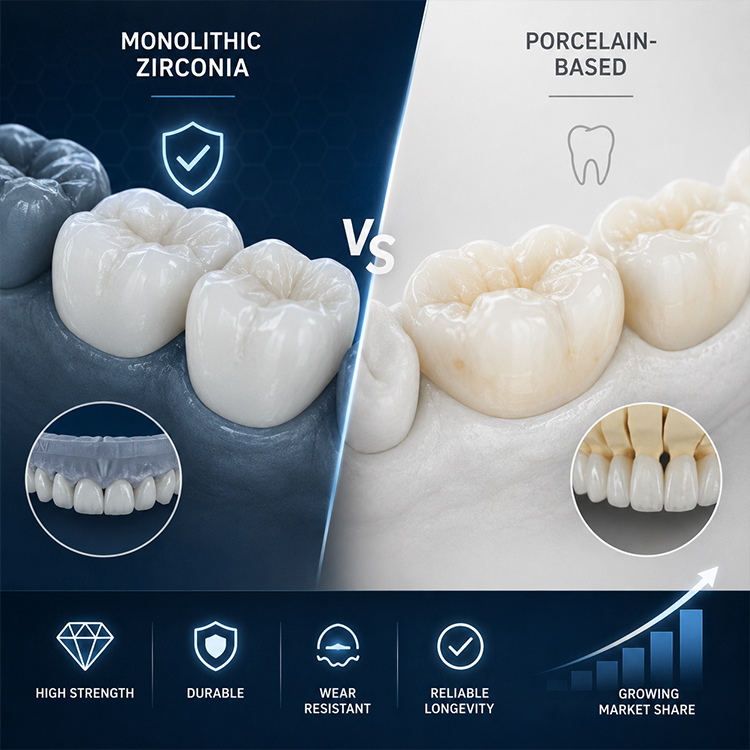
Zirconia crowns are gaining market share in long-term posterior restorations because they solve a brutally practical problem: posterior teeth need restorations that survive compressive force, parafunction, limited clearance, digital manufacturing, and impatient chairside schedules better than many porcelain-layered alternatives.
Load wins first.
I have watched clinicians talk about translucency for twenty minutes, then prescribe a posterior restoration for a bruxer with a shallow prep, a questionable bite record, and zero appetite for remakes; at that point, the material discussion stops being cosmetic and becomes mechanical risk management.
So why pretend this is just an “esthetic materials trend”?
The bigger story is that zirconia crowns, especially monolithic zirconia crowns and multilayer zirconia, fit the business model of modern dentistry. They scan well. They mill well. They scale in dental labs. They tolerate posterior abuse better when designed correctly. And, yes, they let clinics talk about metal-free restorations without asking patients to gamble on fragile beauty in the molar zone.
The market data backs up what many lab benches already know. Global Market Insights estimated the zirconia-based dental materials market at USD 342.1 million in 2025, projecting USD 774.6 million by 2035 at an 8.7% CAGR; it also reported zirconia discs at 63.9% product share in 2025 and dental crowns at 39.4% application revenue share. That is not a vague trend. That is capital moving toward milled, lab-friendly ceramics.
And demand is not appearing from nowhere. WHO reports that oral diseases affect nearly 3.7 billion people, with untreated caries in permanent teeth described as the most common health condition in the Global Burden of Disease 2021 data. WHO oral health fact sheet In the U.S., the CDC’s 2024 surveillance report found that nearly 21% of adults aged 20–64 and nearly 13% of adults aged 65+ had untreated decay in permanent teeth.
That is the patient funnel. Crowns follow disease, wear, endodontics, cracked teeth, failed fillings, aging dentitions, and implant restorations. Posterior crowns are not disappearing. They are getting industrialized.
Table of Contents
The Clinical Evidence Is Not Perfect. It Is Still Hard to Ignore
Here is the uncomfortable truth: zirconia is not magic. Bad prep, bad occlusion, bad sintering, bad polishing, poor connector design, and careless adjustment can still produce expensive failures.
But the survival data explains why dentists keep choosing posterior zirconia crowns.
A 2025 retrospective cohort study comparing posterior monolithic zirconia crowns and porcelain-fused zirconia crowns reported 10-year cumulative survival rates of 86.0% for monolithic zirconia crowns and 91.4% for porcelain-fused zirconia crowns, with success rates showing a different complication picture.
A separate 5-year follow-up study of 50 monolithic zirconia crowns reported a 98% survival rate and noted that only 6% of crowns presented some type of complication.
And in a more extreme implant-supported full-arch context, a 2025 PubMed-indexed study of 115 monolithic zirconia implant-supported fixed complete dental prostheses reported a 98.6% survival rate after a mean observation period of 62 months.
Short sentence. Big consequence.
When clinical results repeatedly show zirconia surviving high-load environments, the buying conversation changes from “Can it look good enough?” to “Can the lab make it consistent enough, fast enough, and with fewer remakes?”
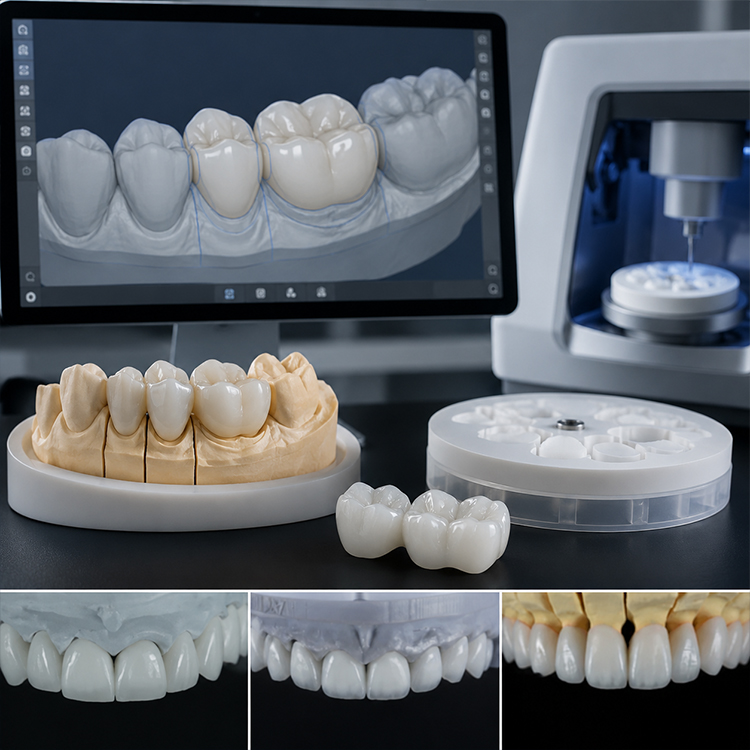
That is where Artist Dental Lab’s own product structure makes sense. Their full-contour multilayer zirconia restorations page positions zirconia for posterior strength cases, crown and bridge workflows, implant-supported restorations, and reduced porcelain chipping risk through monolithic design. The page asks for STL scans, margin notes, occlusal scheme guidance, shade selection, articulation, and clearance requirements, which is exactly the kind of information chain posterior zirconia needs.
I like that. It is not romantic. It is operational.
Zirconia Crowns vs Porcelain Crowns: The Posterior Argument Is Mostly About Failure Mode
Porcelain is beautiful. Nobody serious denies that.
But posterior dentistry is not a photography contest. It is a force-management problem disguised as restorative dentistry.
The old porcelain-fused-to-metal crown had a strong substructure but could bring metal margins, opacity, and porcelain chipping. Porcelain-fused zirconia improved some esthetic and metal-free concerns, but the veneering ceramic still created a layered system. Lithium disilicate, including E.max-type crowns, can be excellent in selected cases, especially where bonding, esthetics, prep design, and occlusion are controlled.
But posterior molars are rude.
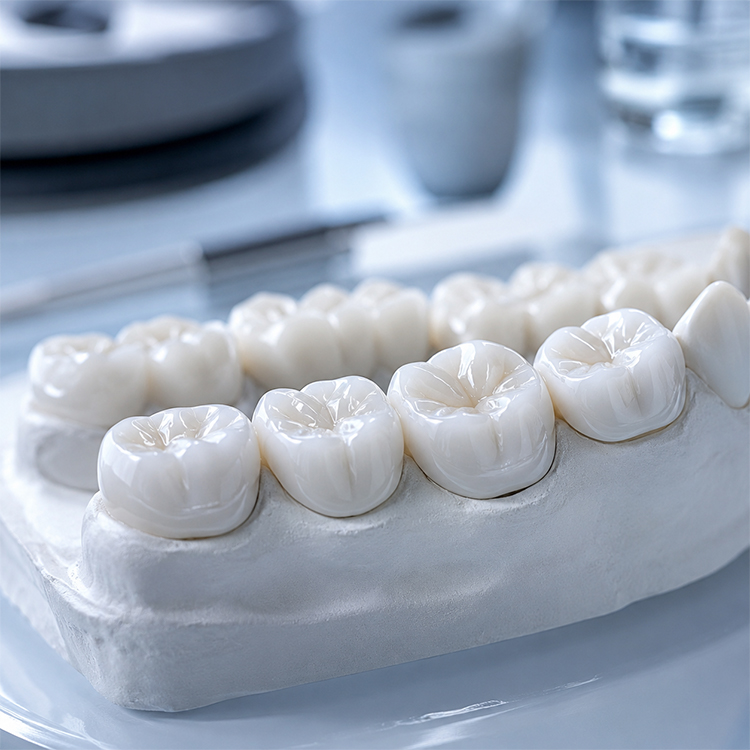
A zirconia crown for molars, particularly monolithic zirconia, removes one of the classic weak points: veneering porcelain fracture. It does not remove all risk, but it simplifies the risk stack. One material. One milled body. Fewer interfaces. Fewer arguments about whether the chip was lab, dentist, patient, or physics.
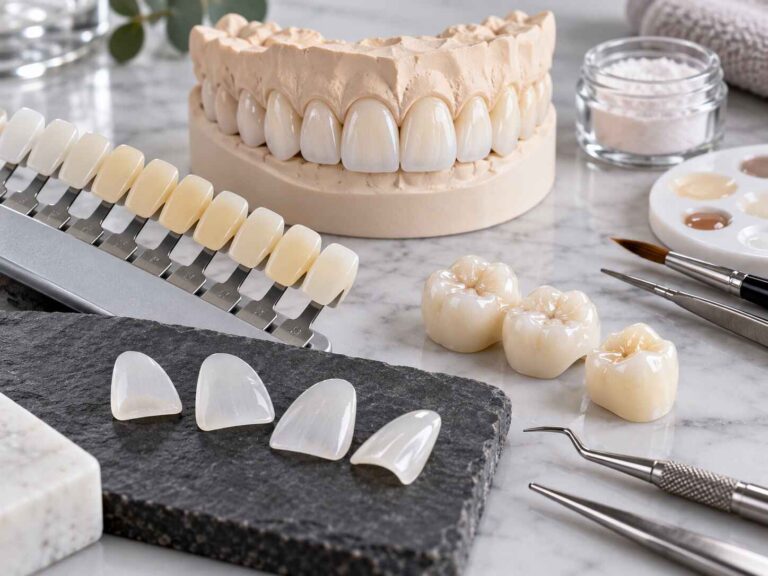
Artist Dental Lab separates this neatly. Their E.max crowns page frames lithium disilicate around natural translucency, esthetic zones, shade photos, stump shade, and anterior or select posterior indications. Their layered zirconia crown page frames zirconia core plus porcelain layering around premium anterior esthetics. That split matters because it avoids the lazy claim that one crown material should win every case.
Hard truth: in the posterior, I would rather defend a slightly less poetic crown that survives than a beautiful restoration that becomes a remake invoice.
The Data Table: Why Posterior Zirconia Keeps Taking the Case
Factor
Monolithic Zirconia Crowns
Porcelain-Fused Zirconia Crowns
Lithium Disilicate / E.max-Type Crowns
PFM Crowns
Typical posterior logic
High-load durability, fewer layering failures
Strength from zirconia core plus improved esthetics
Strong esthetics and bonding in selected cases
Long clinical history and metal-supported strength
Main structural concern
Surface finish, antagonist wear if poorly adjusted, design thickness
Veneering porcelain chipping
Bulk, bonding protocol, case selection
Porcelain chip, metal show-through, esthetic limits
Esthetic posterior or anterior cases where layering is justified
Anterior and controlled posterior restorations
Posterior cases where metal substructure is accepted
Lab workflow
CAD/CAM friendly, scalable, consistent
More technique-sensitive
CAD/CAM or press workflow, shade-sensitive
Conventional and digital options
Market momentum
Strong, driven by discs, CAD/CAM, posterior durability
Stable but pressured by monolithic options
Strong in esthetic and adhesive workflows
Losing some share to metal-free options
My blunt take
Best default for many posterior crowns
Useful, but layering must earn its risk
Excellent when the case is honest
Proven, but less aligned with metal-free demand
The Real Market Driver Is Not Strength. It Is Predictability at Scale
The industry keeps saying “strength” as if that alone explains everything. I do not buy it.
Zirconia crowns are gaining market share because the material matches the production economy of 2026 dentistry: intraoral scanning, STL-based prescriptions, CAD nesting, zirconia discs, milling centers, sintering furnaces, repeatable libraries, and fewer hand-built variables.
That matters for DSOs. It matters for overseas dental laboratories. It matters for private practices that do not want three remake appointments because a second molar crown chipped after the patient went home and ate almonds.
Global Market Insights reported that dental laboratories represented 43.4% revenue share in the zirconia-based dental materials market in 2025, with outsourcing of crowns, bridges, and implant restorations supporting demand. The same report says North America held 38.9% of the global market in 2025, while Asia Pacific was projected as the fastest-growing region.
Another 2026 market release reported CAD/CAM milling at 67.81% of zirconia-based dental materials manufacturing workflow share in 2025, with monolithic zirconia holding 39.72% material-type share and multilayer zirconia projected to grow quickly.
That is the money trail.
And Artist Dental Lab’s OEM / ODM services page speaks directly to that production reality: private label programs, defined material specs, design rules, finishing preferences, case labels, traceability, QC checkpoints, and production controls. In plain English, zirconia does not just win tooth by tooth. It wins when an organization needs a crown category that can be standardized without pretending every case is hand-layered art.
Posterior Zirconia Crowns Are Also a Communication Test
Most posterior zirconia failures begin before milling.
I know that sounds harsh. Good. It should.
A lab can make a beautiful crown from bad information, but it cannot make a predictable crown from missing information. If the clinician sends a vague shade, no bite record, no occlusal scheme, a questionable margin, and no note about bruxism, the crown is already carrying hidden risk before the blank touches the mill.
This is why the best crown material for back teeth is not just a material. It is a workflow decision.
For posterior zirconia crowns, I want to see:
Prep clearance and margin design that the scanner and milling strategy can actually read
Opposing arch data and bite records that do not invent occlusion
Bruxism, implant support, and parafunction flagged before design
Occlusal contact preferences stated clearly
Polish or glaze expectations documented
Shade and characterization expectations kept realistic for the posterior zone
Artist Dental Lab’s article on zirconia crowns and E.max crown margin design gets close to the real issue: zirconia can tolerate leaner strategies better than lithium disilicate in many cases, but it still dislikes poor geometry, sharp internal corners, unreadable margins, and fantasy minimal-prep thinking.
The crown is not the hero. The system is.
Why Zirconia Crown Durability Sells Better Than Beauty in the Molar Zone
Patients say they want beauty. Dentists say they want predictability. Labs say they want clean inputs. Insurers and group practices want cost control.
Zirconia sits at that intersection.
Modern zirconia is usually discussed as zirconium dioxide, ZrO₂, stabilized with yttria, often in families such as 3Y-TZP, 4Y, and 5Y compositions. The rough trade-off is familiar: more translucent formulations may give up some strength, while high-strength formulations may sacrifice optical softness. Multilayer discs try to manage that tension by shifting strength and translucency through the blank.
But molars do not need to look like central incisors. They need to survive, stay cleanable, fit properly, and avoid becoming an occlusal rock.
That is why posterior material coordination in full-mouth rehabilitation should be treated as a strategic decision, not a material popularity vote. The anterior zone can carry the emotional demand for light, texture, and incisal character. The posterior zone carries the boring, expensive demand for force control.
And boring often wins.
The Insider View: Zirconia Is Winning Because It Reduces Arguments
Here is my more controversial opinion: zirconia has become popular partly because it reduces blame.
When a layered ceramic chips, everybody argues. Was the prep under-reduced? Was the framework unsupported? Was the ceramic fired wrong? Did the patient grind? Did the clinician adjust without polishing? Was the lab rushing?
With monolithic zirconia, the post-failure investigation is often cleaner. Not always. But often.
That matters commercially. A crown material that reduces ambiguity has value beyond flexural strength. It improves lab-client relationships. It shortens remake debates. It supports standard operating procedures. It helps DSOs train across locations. It lets a lab build repeatable design parameters rather than depending on heroic artistry for every posterior unit.
Artist Dental Lab’s client case examples point in this direction: one North American DSO case mentions a standardized portfolio including zirconia, lithium disilicate, and PFM, centralized digital workflow, clear prescription templates, and reduced turnaround times from 15–20 days on complex implant and full-arch cases to 9–11 days for standard cases and 12–14 days for full-arch reconstructions.
That is not just technical dentistry. That is supply-chain dentistry.
FAQs
Why are zirconia crowns gaining popularity?
Zirconia crowns are gaining popularity because they combine high posterior strength, metal-free esthetics, CAD/CAM manufacturing compatibility, and reduced veneering-porcelain chipping risk in monolithic designs, making them attractive for molars, implant crowns, bridges, and long-term restorations where durability matters more than extreme translucency.
The simple answer is that zirconia fits how dentistry is now produced. Digital scans, milling workflows, multilayer zirconia discs, and standardized lab protocols all favor materials that can be designed and fabricated repeatably. Patients hear “strong” and “metal-free.” Clinicians hear “fewer remakes.” Labs hear “scalable.”
Are zirconia crowns good for molars?
Zirconia crowns are often good for molars because posterior teeth face high chewing forces, limited visibility, parafunction risk, and repeated occlusal stress, and monolithic zirconia can provide a strong, fracture-resistant option when preparation, clearance, contacts, cementation, and polishing are handled correctly.
But I would not call any material automatic. A second molar with poor clearance, no occlusal plan, and a heavy grinder still needs careful design. Zirconia gives the team more mechanical room for error than many esthetic ceramics, but it does not forgive laziness forever.
How long do posterior zirconia crowns last?
Posterior zirconia crowns can last many years, with published studies reporting strong medium- and long-term survival rates, but the real lifespan depends on preparation quality, occlusion, cementation, patient habits, surface polishing, lab design, material generation, and whether the crown is monolithic or layered.
The honest answer is not a single number. A well-designed monolithic zirconia crown in a controlled posterior case can perform very well. A poorly adjusted crown left rough against enamel can create trouble. Survival data is encouraging, but clinical discipline still decides the outcome.
Are zirconia crowns better than porcelain crowns?
Zirconia crowns are often better than porcelain-layered crowns for high-load posterior cases because monolithic zirconia avoids a veneering porcelain layer that can chip, while porcelain-based or layered restorations may still be preferable when optical depth, translucency, and high-end anterior esthetics are the main goal.
This is where marketers annoy me. “Better” is lazy unless the case is defined. For molars, bruxers, implant crowns, and limited-clearance posterior restorations, I usually lean zirconia. For demanding anterior esthetics, layered ceramics, lithium disilicate, or feldspathic approaches may still win.
What is the best crown material for back teeth?
The best crown material for back teeth is usually the one that balances occlusal load, preparation design, esthetic expectations, patient habits, and lab workflow; in many modern posterior cases, monolithic zirconia is the safer default because it prioritizes durability and simplified mechanical behavior.
That said, “default” does not mean “always.” Lithium disilicate can work in select posterior indications. PFM can still be clinically valid. Layered zirconia can make sense when esthetics need help. But for long-term posterior restorations under force, zirconia has earned its current market momentum.
Final Thoughts: Stop Selling Zirconia as a Miracle and Start Planning It Like an Engineering Material
Zirconia crowns are taking market share because they are useful, not because they are perfect.
That distinction matters.
If you are a clinic, DSO, distributor, or overseas lab trying to reduce posterior remake drama, start by tightening the inputs: STL files, margin notes, clearance, occlusal scheme, shade expectations, bite records, implant details, and patient risk factors. Then match the material to the case instead of forcing the case into a brochure sentence.