Why Feldspathic Veneers Still Lead in Premium Esthetic Cases
Stronger is not prettier.
That statement irritates people in a dental market trained to compare ceramics through flexural-strength numbers, brand charts, and increasingly automated workflows, but premium anterior dentistry is not a warehouse test of which material survives the biggest laboratory load.
So why do we keep discussing veneers as if megapascals decide beauty?
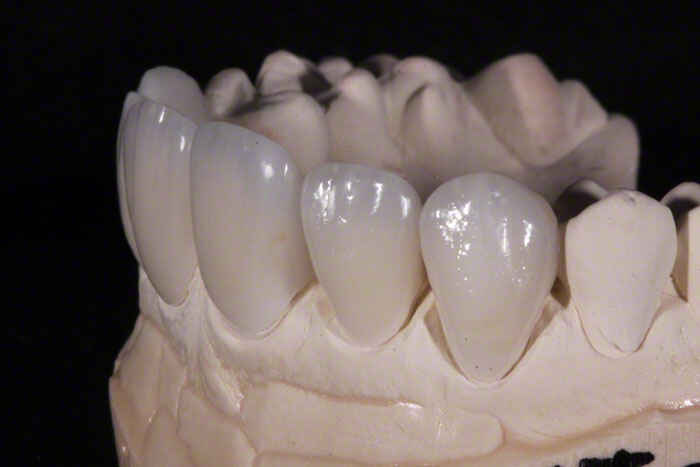
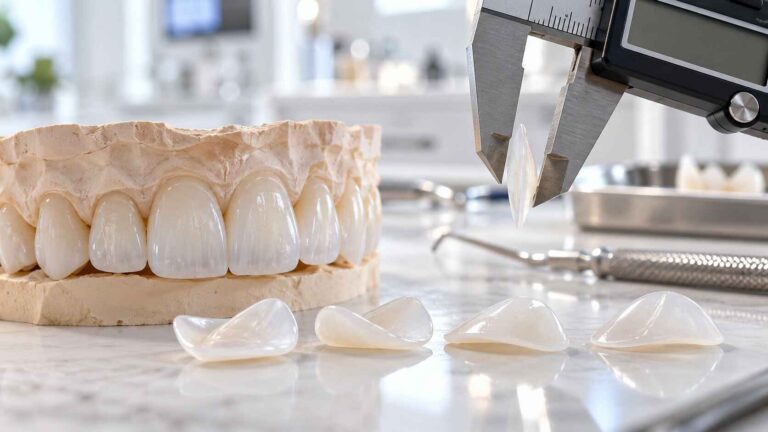
Feldspathic veneers remain the benchmark in a narrow but important class of premium esthetic cases because their highly glassy structure gives a skilled ceramist unusually fine control over translucency, value, fluorescence, internal effects, surface texture, and incisal personality.
They are not the safest universal choice. They are not the strongest. And they are certainly not the easiest restoration to manufacture at scale.
That is exactly the point.
When a patient is paying for a restoration that should disappear beside natural enamel—not merely look white, symmetrical, and expensive—the qualities that make feldspathic porcelain less industrially convenient can become its greatest advantage.
Why Feldspathic Veneers Still Lead in Premium Esthetic Cases
Table of Contents
Feldspathic Porcelain Still Wins the Optical Argument
Feldspathic porcelain is a silica-rich ceramic built primarily around a glassy aluminosilicate matrix containing compounds associated with SiO₂, Al₂O₃, and alkali oxides such as K₂O and Na₂O. Its relatively low crystalline content allows light to enter, scatter, reflect, and return in a way that can closely resemble natural enamel.
That matters enormously.
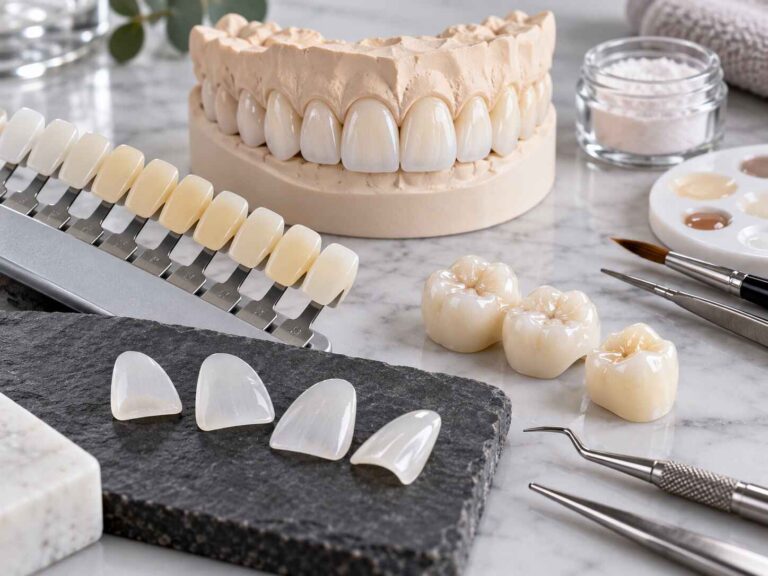
Natural teeth are not one color. Enamel changes value and translucency according to thickness, hydration, viewing angle, surface anatomy, underlying dentin, age, and lighting conditions. A restoration can match a VITA shade tab under operatory lights and still look dead in daylight.
A skilled technician working with hand-layered feldspathic porcelain veneers can build those optical variations incrementally rather than asking one prefabricated ceramic block to carry the entire effect.
The advantage is controlled imperfection
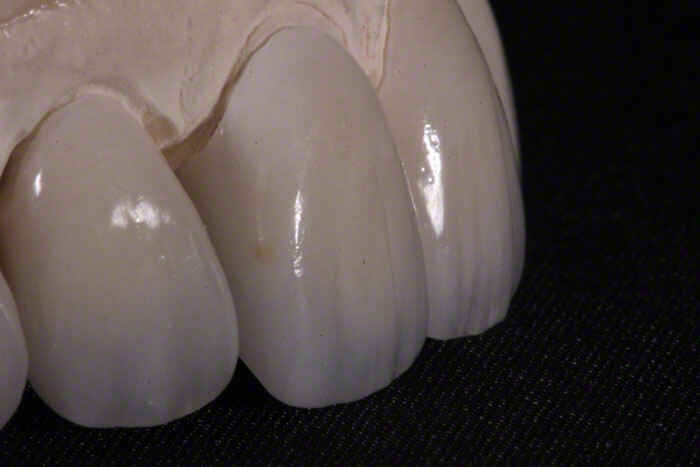
Real incisors contain asymmetry, faint mamelons, halos, localized opacity, variable translucency, craze lines, texture, and differences between the cervical, middle, and incisal thirds.
Perfect uniformity looks artificial.
With feldspathic porcelain, the ceramist can place very small quantities of translucent, opalescent, fluorescent, dentin, enamel, and effect porcelains exactly where they are needed. The result does not have to announce itself as a veneer. It can simply behave like a tooth.
That is much harder than making six identical bright units.
And yes, it costs more technician time.
But in high-value anterior cases, technician time is often the product.
Thinness changes what the technician can preserve
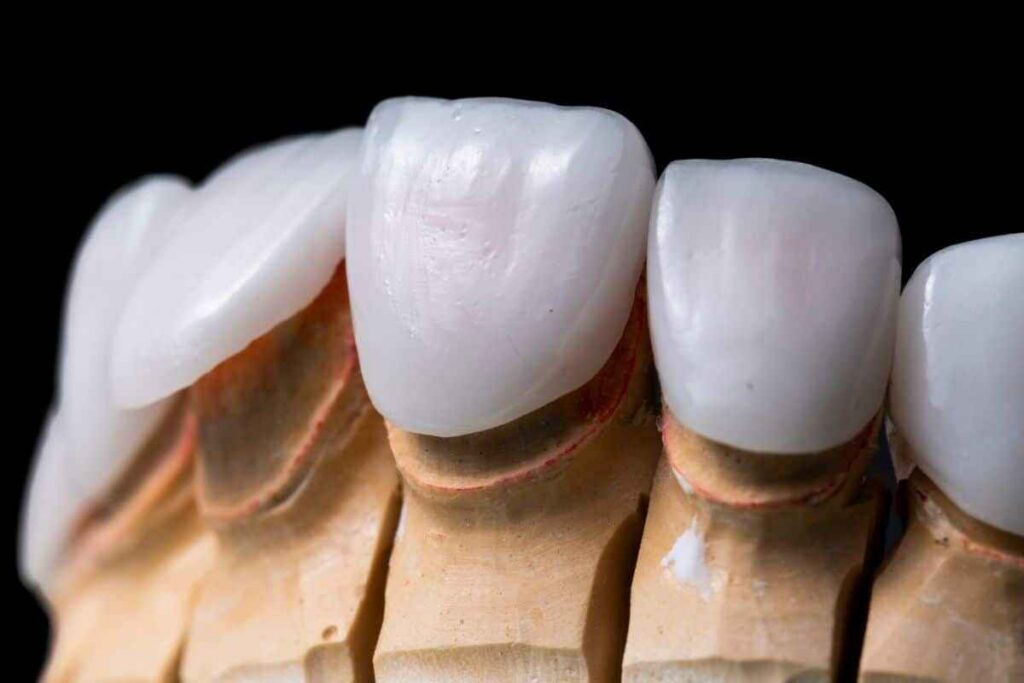
Feldspathic veneers can be fabricated as highly conservative restorations when the substrate, tooth position, shade target, and occlusion allow it. Less reduction may preserve more enamel, maintain familiar tooth geometry, and reduce the amount of restorative material needed to recreate natural volume.
Thin does not mean careless.
A minimal-prep veneer placed over a protrusive tooth can produce an overcontoured result. A highly translucent veneer placed over a dark substrate can reveal the discoloration beneath it. And an ultrathin margin handled badly can fracture before cementation.
This is where premium case planning separates itself from cosmetic salesmanship.
The Survival Data Is Better—and More Complicated—Than the Industry Admits
Here is the uncomfortable part: survival figures for feldspathic veneers vary widely according to preparation design, enamel preservation, patient selection, bonding protocol, operator technique, and how researchers define “failure.”
One number cannot settle the argument.
A landmark prospective study indexed by the US National Library of Medicine reported an estimated 21-year cumulative survival of 96% ± 2% for feldspathic porcelain veneers bonded to prepared enamel. That is not a short social-media follow-up. It is serious long-term evidence from a carefully controlled clinical setting, available in the 21-year feldspathic veneer outcome study on PubMed.
Yet a 2016 systematic review found an estimated pooled survival of approximately 87% for feldspathic porcelain veneers, with a 95% confidence interval of 82% to 93%. The systematic review comparing feldspathic and glass-ceramic veneers did not prove that feldspathic porcelain is unreliable. It showed that real-world outcomes become less flattering when diverse studies, techniques, patients, and clinical conditions are combined.
Both findings can be true.
That gap is the story.
Enamel is not a minor detail
A 2024 systematic review and meta-analysis reported survival and success rates approaching 99% for veneers bonded predominantly to enamel. The PubMed analysis of ceramic veneer survival and bonding substrate reinforces what experienced adhesive clinicians have argued for years: preserving enamel is not just biologically conservative; it can materially alter predictability.
Three words: enamel changes everything.
When most of the preparation remains within enamel, margins are controlled, the restoration is correctly etched and silanated, and the resin-cement protocol is executed without contamination, the bonded tooth-ceramic complex behaves very differently from a thin piece of porcelain tested alone.
Why judge the veneer without judging the bond?
This also explains why quoting the standalone flexural strength of feldspathic porcelain can mislead. Published values are often around 60–70 MPa, dramatically below modern lithium disilicate, but a bonded veneer is part of an adhesive assembly—not a free-standing bar waiting to be snapped.
The American Dental Association likewise notes that indirect restorative materials differ in composition, mechanical behavior, fabrication method, and clinical indication; material selection should therefore follow the case rather than a single strength ranking. See the ADA’s overview of materials for indirect restorations.
Feldspathic vs E.max Veneers: The Comparison That Actually Matters
Lithium disilicate deserves its popularity.
The current IPS e.max CAD system is reported by its manufacturer at a biaxial flexural strength of 530 MPa with fracture toughness of 2.11 MPa·m¹ᐟ² after crystallization. Its principal crystalline phase is lithium disilicate, commonly represented as Li₂Si₂O₅, within a glass-ceramic structure.
That is a huge mechanical advantage over conventional feldspathic porcelain.
It is also not the whole decision.
Decision factor
Feldspathic porcelain veneers
Layered E.max veneers
Full E.max veneers
Basic structure
Highly glassy, hand-layered feldspathic ceramic
Lithium disilicate core with added porcelain layering
Monolithic lithium disilicate
Representative strength
Commonly reported near 60–70 MPa for feldspathic porcelain
Core strength is higher, but the layered interface adds technique variables
IPS e.max CAD is manufacturer-rated at 530 MPa biaxial flexural strength
Optical control
Highest freedom for localized translucency, halo, mamelons, value and texture
Strong optical range with a more supportive core
Good translucency and shade consistency, but less internal layering freedom
Best substrate
Favorable, relatively light substrate with substantial enamel
Mild-to-moderate masking needs with premium characterization
Cases needing greater consistency, repeatability or mechanical margin
Typical strength
Bespoke single units and low-risk premium anterior cases
Premium anterior cases needing a balance of support and artistry
Multi-unit cases where repeatable contour, value and strength matter
Main limitation
Technique sensitivity, lower standalone strength and limited masking
Added layering complexity and potential interfacial variability
Can look flatter if characterization relies too heavily on external stain
Workflow style
Technician-led, highly individualized
Hybrid structural and artistic workflow
More standardized digital or pressed workflow
This is why standard E.max veneers often make more sense for routine cosmetic cases. Lithium disilicate offers a useful balance of strength, translucency, bonding potential, fit, and repeatability.
And it is why layered E.max veneers for premium anterior esthetics occupy a valuable middle position. The lithium disilicate core provides more structural support while porcelain layering gives the technician room to create depth, halo effects, and individualized incisal characterization.
Then there is the lower-variance option: monolithic full E.max veneers. These can be the smarter choice when the case involves six, eight, or ten units and the clinical priority is consistent value, contour, contacts, strength, and production repeatability.
My opinion is blunt: feldspathic is the connoisseur’s material, layered E.max is the negotiator, and full E.max is the operations manager.
None is automatically superior.
Why Feldspathic Veneers Still Lead in Premium Esthetic Cases
The Cases Where Feldspathic Veneers Earn the Premium
Feldspathic porcelain should lead only when the case gives it the conditions it needs. Using it everywhere is not sophisticated. It is sentimental.
Favorable enamel is present
The best indication is a tooth that allows conservative preparation with a dominant enamel bonding surface. Once broad areas of dentin, large existing restorations, or structurally compromised tooth tissue enter the case, the adhesive and mechanical equation changes.
That does not make feldspathic impossible. It makes the margin for error smaller.
The shade change is controlled
Highly translucent ceramics cannot perform magic over every substrate. Mild discoloration, favorable stump shades, and cases focused on contour, proportion, texture, diastema closure, or subtle value correction are better candidates than severe tetracycline staining or dark non-vital teeth.
A dark stump can force the technician to add opacity and thickness. Add enough, and the optical reason for choosing feldspathic begins to disappear.
The occlusion is quiet
Bruxism, edge-to-edge loading, unstable anterior guidance, deep overbite, traumatic contacts, and destructive habits should change the material discussion.
Beauty cannot cancel force.
Premium treatment planning may involve occlusal adjustment, orthodontic movement, protective splint therapy, alternative preparation design, or selection of lithium disilicate instead. Pretending otherwise merely transfers risk to the patient and the laboratory.
The case needs individuality, not factory symmetry
A single central incisor beside an untouched natural central is one of the most unforgiving assignments in restorative dentistry. So are two veneers surrounded by natural teeth with strong texture, translucency, and age-related character.
This is where hand-layered porcelain can justify itself.
By contrast, a ten-unit smile conversion may benefit more from the dimensional and value consistency of lithium disilicate—especially when the brief asks for highly symmetrical, bright, repeatable results rather than near-invisible integration with adjacent enamel.
The records are exceptional
Premium esthetic veneers cannot be prescribed with “BL2, natural, not too translucent.”
That is not a laboratory instruction.
A serious submission should include calibrated shade information, stump shades, cross-polarized images where available, retracted photographs, full-face and smile views, incisal-edge position, surface-texture references, opposing scans, bite records, provisional or mock-up scans, and notes describing value, chroma, translucency, halo, and characterization.
Artist Dental Lab’s client cases and veneer workflow resources reflect this team-based approach: file review, shade communication, quality-control checks, remake handling, and delivery support are not administrative extras. They are part of the restoration.
The Hard Truth About “Natural-Looking Porcelain Veneers”
Patients often ask for natural-looking porcelain veneers while simultaneously requesting maximum whiteness, perfect symmetry, zero texture, no translucency, and eight identical teeth.
Those requests conflict.
Natural teeth have hierarchy. The central incisors dominate, laterals often show variation, canines carry more chroma, incisal edges interact differently with light, and surface texture changes how value is perceived.
White is easy.
Believable is harder, because believable dentistry requires the clinician, patient, and ceramist to agree that some controlled variation is not a manufacturing defect—it is the mechanism that prevents the smile from looking manufactured.
Feldspathic porcelain gives the ceramist more room to build that variation. But it also exposes weak communication faster. When the prescription is vague, the technician must guess. When the photographs are poor, the technician must guess. When the patient’s idea of “natural” changes at try-in, everyone pays for the guess.
That is why premium esthetic work should be sold as a diagnostic and collaborative process, not as an upgraded material package.
Why Feldspathic Veneers Still Lead in Premium Esthetic Cases
FAQs
What are feldspathic veneers?
Feldspathic veneers are thin, adhesively bonded ceramic restorations made from a silica-rich, highly glassy porcelain that can be layered by hand to reproduce enamel-like translucency, value, fluorescence, incisal effects, and surface texture, making them especially suitable for selected low-risk anterior cases with favorable enamel and substrate color.
Unlike monolithic CAD/CAM veneers, each area can be characterized individually by the ceramist. Their lower mechanical strength makes conservative preparation, enamel bonding, occlusal assessment, and careful handling especially important.
Why do feldspathic veneers look more natural than some E.max veneers?
Feldspathic veneers can look more natural because their glass-rich porcelain can be applied in multiple localized layers, allowing the technician to control internal translucency, opacity, mamelons, incisal halo, fluorescence, warmth, texture, and value transitions instead of relying mainly on the optical properties of one prefabricated lithium-disilicate body.
That does not mean every feldspathic veneer will outperform E.max. A poorly designed feldspathic restoration can look bulky or lifeless, while an expertly layered E.max veneer can be outstanding.
Are feldspathic veneers stronger than E.max veneers?
Feldspathic veneers are not stronger than E.max veneers; conventional feldspathic porcelain is often reported near 60–70 MPa in flexural strength, while the current IPS e.max CAD lithium-disilicate system is manufacturer-rated at 530 MPa after crystallization, although clinical performance also depends heavily on bonding substrate, preparation, cementation, design, and occlusion.
The strength gap is real. Still, the survival of well-bonded feldspathic veneers can be excellent when substantial enamel remains and functional risk is controlled.
Are feldspathic veneers suitable for minimal-prep cases?
Feldspathic veneers are suitable for carefully selected minimal-prep cases where tooth position, existing contour, enamel volume, substrate shade, gingival architecture, and occlusal conditions permit a thin ceramic restoration without producing excessive facial bulk, visible margins, poor emergence profile, inadequate masking, or a mechanically vulnerable incisal design.
Minimal preparation is not automatically conservative. Adding ceramic to an already prominent tooth may create a biological and esthetic compromise even when little enamel is removed.
How long do feldspathic porcelain veneers last?
Feldspathic porcelain veneers can remain functional for decades when bonded mainly to enamel, protected from destructive occlusal forces, fabricated with appropriate thickness, and maintained properly; published evidence includes a 21-year estimated survival of 96% ± 2%, while pooled systematic-review outcomes are lower because they combine more varied clinical conditions.
Patients should understand that “survival” may include restorations with minor complications, while “success” can use stricter criteria. Follow-up care, parafunction control, oral hygiene, and the original case design all matter.
When should E.max be chosen instead of feldspathic porcelain?
E.max should generally be considered instead of feldspathic porcelain when the case requires greater fracture resistance, more predictable masking, broader dentin involvement, multi-unit consistency, a more standardized digital workflow, or additional tolerance for functional demand, provided the preparation, thickness, bonding method, and esthetic objectives remain compatible with lithium disilicate.
For premium cases that still need hand-built depth, layered E.max may provide a practical middle ground between fully individualized feldspathic porcelain and monolithic full E.max.
Build the Case Around the Patient, Not the Material
Feldspathic veneers still lead when the assignment is extremely specific: preserve enamel, reproduce subtle natural optics, integrate beside untouched teeth, and give an expert ceramist enough information and space to work.
Outside that lane, E.max may be the more responsible choice.
Send the laboratory the preoperative photographs, STL files, stump shades, mock-up, bite data, functional notes, and exact esthetic target before the teeth are prepared—not after the case has already become difficult.
For material selection, trial-case planning, or technical review of a premium anterior case, contact Artist Dental Lab and submit the clinical records for evaluation before finalizing the prescription.