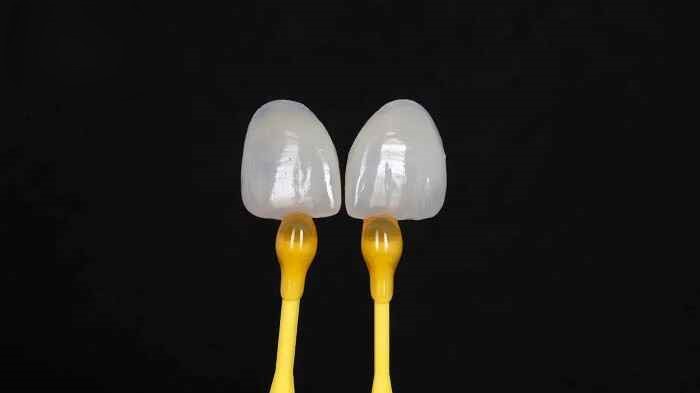
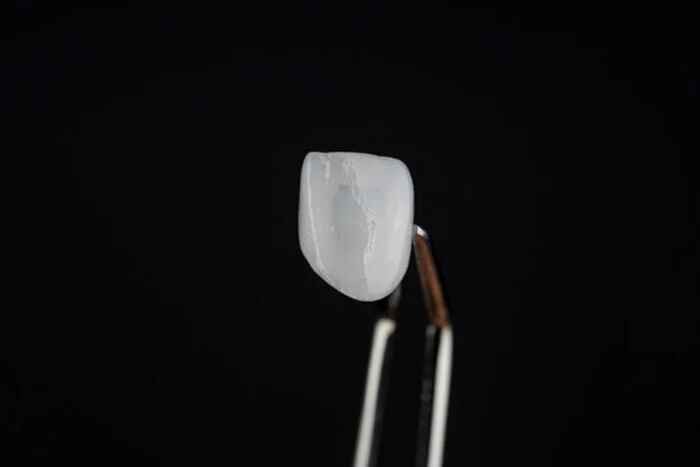
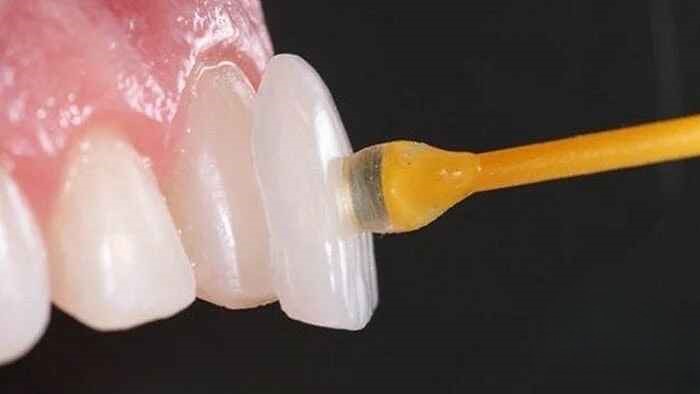
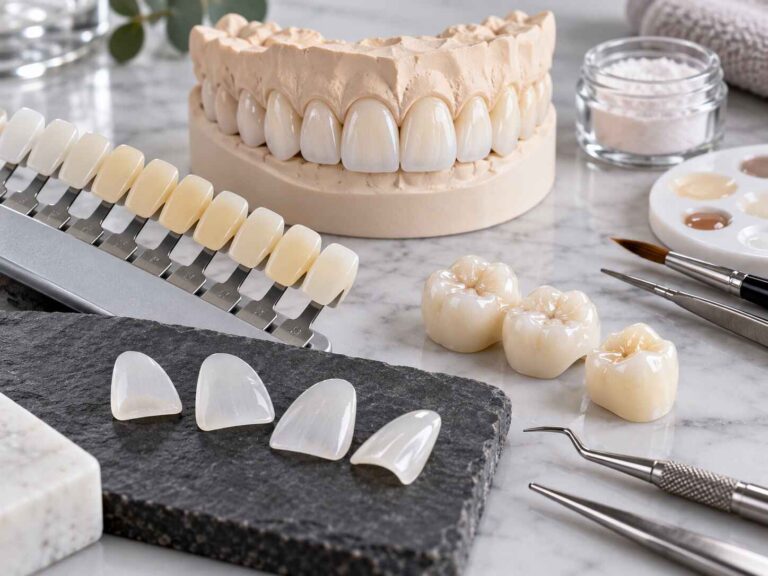
Why E.max Is Often Preferred for Single-Tooth Anterior Restorations
A single anterior crown sits beside a natural reference tooth under daylight, operatory LEDs, smartphone flash, bathroom lighting, and every other condition patients will use to judge the result, so even a small error in value, translucency, texture, or cervical opacity becomes painfully obvious.
Why make that job harder than it already is?
That is the practical reason E.max crowns are often preferred for a single-tooth anterior restoration. Lithium disilicate gives the dental technician a useful combination of translucency, shade control, surface characterization, etchability, and adequate mechanical performance. Not unlimited strength. Not automatic beauty. A workable balance.
I want to be blunt about this because the industry has turned material selection into a branding contest. “Use E.max” is not a treatment plan. Neither is “zirconia is stronger.”
The real question is narrower: which material gives this particular tooth the best chance of disappearing beside its natural neighbor without creating an avoidable fracture, bonding, contour, or masking problem?
The Single-Tooth Anterior Case Is an Optical Stress Test
A six-unit smile case gives the technician control over symmetry, value, line angles, incisal position, and surface texture across the entire visible segment. A single front tooth restoration offers no such mercy.
The adjacent natural tooth is the answer key.
A technically acceptable E.max anterior crown can still fail visually because the cervical value is slightly low, the incisal third is too transparent, the surface is too glossy, the line angle is misplaced, or the internal characterization looks painted rather than structural.
A shade tab captures only part of that information. Sometimes a very small part.
This is where lithium disilicate earns its reputation. Its glass-ceramic structure can transmit and scatter light in a way that technicians often find easier to tune against natural enamel than a highly opaque restorative system.
But translucency is not automatically attractive. It is a tool. Used badly, it becomes a gray-margin machine.
Why Lithium Disilicate Often Looks More Convincing
E.max is the trade name associated with Ivoclar’s IPS e.max material family. IPS e.max CAD is a lithium disilicate glass-ceramic, commonly represented chemically as Li₂Si₂O₅.
The manufacturer currently reports a mean biaxial flexural strength of 530 MPa, fracture toughness of 2.11 MPa·m¹ᐟ², four principal translucency levels, and an indicated minimum thickness of 1.0 mm for crowns. Ivoclar also reports an average survival rate of 95.2% over periods extending to 15 years, although clinicians should treat manufacturer summaries as product evidence rather than independent comparative proof. The specifications are available on the official IPS e.max CAD technical page.
Strength is seductive.
But when a clinician chooses the strongest available ceramic without considering substrate color, facial thickness, margin position, bonding surface, and the optical behavior of the adjacent tooth, the result can survive beautifully while looking unmistakably artificial.
What exactly has been achieved then?
E.max Offers More Than Generic “Translucency”
The usual sales claim is that E.max looks natural because it is translucent. That explanation is too shallow.
Natural teeth are not uniformly translucent. Enamel, dentin, cervical structure, incisal enamel, and internal effects all handle light differently. A successful lithium disilicate crown must therefore manage the amount and location of transmitted light, not simply allow more of it through.
IPS e.max CAD is offered in several optical categories:
HT, or High Translucency, permits greater light transmission and may suit smaller restorations or favorable substrates.
MT, or Medium Translucency, occupies the space between high-translucency and low-translucency options.
LT, or Low Translucency, provides more stable brightness and value control.
MO, or Medium Opacity, is intended for discolored preparations, frameworks, and cases requiring additional masking.
Impulse blocks provide specific opalescent effects, primarily for veneer applications.
That range matters in a single anterior tooth restoration because the technician is not forced to choose between “transparent” and “opaque.” There are intermediate tools.
And those tools can still be misused.
The Clinical Evidence Is Good, but It Is Not a Blank Check
The numbers supporting lithium disilicate are respectable.
A 2014 systematic review indexed by PubMed screened 2,033 titles and included 12 clinical studies of tooth-supported lithium disilicate restorations. The reported cumulative survival rate for single crowns was 100% at two years and 97.8% at five years. The estimated 10-year survival rate was 96.7%, although the authors warned that the long-term figure was driven largely by one study.
That distinction matters. Survival percentages are not magic guarantees, and a crown remaining in the mouth is not the same as a crown remaining complication-free, esthetically acceptable, and untouched.
A 2023 controlled three-year clinical trial comparing high-translucency cubic zirconia with E.max reported no statistically significant differences across the overall clinical variables assessed. However, the E.max group produced better clinical findings for esthetics and tooth translucency, while showing a slight increase in hypersensitivity.
That is a more honest result than “E.max wins.”
The materials performed similarly in broad clinical terms, but lithium disilicate showed an optical advantage. For a single anterior crown, that narrower advantage may be the deciding factor.
What the Data Does Not Prove
The evidence does not prove that every E.max anterior crown will look better than every zirconia crown.
It does not prove that lithium disilicate can ignore poor preparation design.
It does not prove that a dark endodontic stump will disappear behind a high-translucency block.
And it certainly does not prove that the material can rescue a prescription containing one blurred shade photo and the instruction “match adjacent.”
The hard truth is that many supposed material failures are information failures.
E.max Versus Zirconia for Front Teeth
The usual E.max vs zirconia debate is badly framed. One material does not defeat the other in every category.
Lithium disilicate generally offers stronger enamel-like light behavior and easier conventional glass-ceramic bonding protocols. Zirconia generally offers greater flexural strength, stronger masking potential in selected formulations, and more tolerance in high-load or limited-clearance cases.
That is not a rivalry. It is an indication map.
Clinical factor
E.max lithium disilicate
High-translucency zirconia
Layered zirconia
Typical chemical family
Li₂Si₂O₅ glass-ceramic
ZrO₂, commonly 4Y or 5Y formulations
ZrO₂ framework plus veneering ceramic
Main anterior advantage
Enamel-like optical integration
Strength with improved modern translucency
Strong framework with hand-layered characterization
Main anterior weakness
Can transmit an unfavorable stump shade
May appear bright, flat, or low in fluorescence
Veneering ceramic can chip under poor support or heavy load
Bonding behavior
Etchable with hydrofluoric acid and silane
Not glass-etchable; typically air abrasion and MDP-based treatment
Depends on zirconia surface and restoration design
Masking dark substrates
Moderate and block-dependent
Often stronger, especially with lower-translucency grades
Stronger framework masking potential
Best-fit case
Favorable substrate, adequate thickness, high esthetic demand
Higher load, dark substrate, limited space, or masking priority
Every tested material adequately masked normal dentin, but none adequately masked severely discolored dentin under the study conditions. At 0.8 mm over titanium, only 3Y-TZP and 4Y-PSZ provided adequate masking.
So no, E.max is not always the best crown material for front teeth.
When the preparation is severely discolored, contains a metal post, sits over a titanium abutment, or lacks enough facial thickness for an opacity strategy, a zirconia-based solution may be more defensible. The site’s detailed comparison of E.max crowns versus layered zirconia crowns covers that trade-off from the laboratory side.
Why the Stump Shade Can Ruin an Expensive Crown
Translucent ceramics do not create color in isolation. They combine with the preparation, ceramic thickness, cement shade, surrounding teeth, gingiva, and lighting environment.
Ignore the stump and the stump will control the case.
A dark endodontically treated tooth may push gray or low-value color through the cervical third of a thin lithium disilicate crown. The predictable but often ugly reaction is to make the crown brighter or more opaque. That may hide the stump, but it can also make the restoration look dense and disconnected from the adjacent enamel.
This is where technicians need more than a final shade.
They need:
A stump-shade photograph
A neutral-gray photographic background
A known shade reference such as VITA Classical or VITA 3D-Master
The planned ceramic thickness
Margin location
Core or post material
Provisional photographs
Incisal-edge reference images
Cement or try-in paste information
The relationship between crown strength and margin translucency is especially important in this zone. A restoration may look convincing in the body and incisal third, then reveal itself through one dull, gray, or overbuilt cervical margin.
Margins tell everything.
Bonding Is a Real Advantage, Not a Marketing Footnote
Lithium disilicate contains a glass phase that can be conditioned with hydrofluoric acid and silane according to the ceramic manufacturer’s validated protocol. This creates a bonding route that differs materially from zirconia, which cannot be treated as an etchable glass-ceramic.
For an E.max crown, the adhesive sequence may include:
Controlled hydrofluoric-acid etching for the specified time
Thorough rinsing and drying
Silane or a compatible ceramic primer
Tooth-surface conditioning
Adhesive or resin-cement placement
Controlled seating and excess-cement removal
Appropriate light or dual curing
Protocol details vary by product, preparation retention, restoration thickness, and clinician preference. The point is not that every E.max crown must be bonded identically. The point is that lithium disilicate offers a proven micromechanical and chemical bonding strategy.
But bonding is not a license to underprepare.
A thin, overcontoured crown created to compensate for inadequate reduction can produce poor emergence, weak cervical optics, occlusal interference, and a bulky appearance. Adhesive dentistry does not repeal geometry.
When I Would Not Choose an E.max Anterior Crown
I would hesitate before prescribing E.max when the case contains several of the following conditions:
A Severely Dark or Metallic Substrate
High-translucency lithium disilicate may transmit the discoloration. A lower-translucency or medium-opacity E.max option may work, but the technician needs adequate thickness and a deliberate masking plan.
Heavy Parafunction
Bruxism, edge-to-edge function, aggressive anterior guidance, or repeated ceramic fracture history changes the risk calculation. A night guard does not erase a destructive occlusal pattern.
Limited Reduction
Insufficient facial or incisal clearance can force the technician into overcontouring or a compromised ceramic thickness. “Minimal preparation” sounds attractive until the final crown looks bulky.
An Implant Abutment or Metal Post
The substrate may require more masking than a translucent glass-ceramic can provide at the available thickness. Selected zirconia formulations deserve serious consideration.
A High-Load Canine or Unfavorable Guidance Pattern
Not every tooth in the esthetic zone lives a gentle life. Canines and incisors can carry substantial lateral forces.
Poor Moisture Control or Weak Adhesive Conditions
When predictable adhesive isolation cannot be achieved and the preparation lacks adequate retention, the restorative plan needs to account for that reality.
In these cases, a custom layered zirconia crown may provide stronger masking and framework support while retaining some capacity for hand-built facial characterization.
It is not automatically prettier. It may simply be safer.
The Records That Make an E.max Anterior Crown Predictable
The laboratory cannot manufacture missing information.
For a serious single-tooth anterior case, I would send:
High-resolution STL files of the preparation, opposing arch, and bite
Full-face smile photographs
Retracted frontal and lateral views
A stump-shade photograph
Shade-tab images taken in the same plane as the tooth
Cross-polarized images when available
A black-background incisal photograph
The approved provisional scan or photographs
Incisal length and midline instructions
Surface-texture references
Anterior guidance and parafunction notes
Ceramic-space or clearance maps
Margin notes
The planned cement system
A written statement identifying the main priority
That final statement is underrated.
“Match adjacent” tells the technician almost nothing. A useful prescription might say:
“Restore #8 with a lithium disilicate crown. Adjacent #9 has high cervical value, moderate body chroma, a blue-gray translucent incisal third, faint white halo, medium vertical texture, and low surface gloss. Stump shade is ND3. Prioritize value match and cervical integration over maximum incisal translucency.”
That is evidence. The rest is wishful thinking.
Why E.max Is Preferred—And Why That Preference Has Limits
Why is E.max preferred for anterior teeth?
Because a well-selected lithium disilicate crown gives the technician a broad optical vocabulary without dropping into the low mechanical range associated with more delicate porcelain systems. It can be milled or pressed, stained, cut back, layered, etched, bonded, polished, and adjusted to suit a demanding esthetic target.
That versatility is valuable.
Still, I reject the lazy version of the recommendation. E.max is not the default because it is fashionable, and zirconia is not the fallback because it is ugly.
Choose E.max when the case needs light transmission, enamel-like depth, controlled translucency, predictable glass-ceramic bonding, and refined surface characterization—and when the preparation color, material thickness, occlusal load, and isolation conditions support those goals.
Choose zirconia when masking, functional risk, limited clearance, or framework strength outranks maximum optical integration.
Choose after diagnosis. Not before.
FAQs
What is an E.max anterior crown?
An E.max anterior crown is a full-coverage front-tooth restoration commonly fabricated from IPS e.max lithium disilicate, a Li₂Si₂O₅ glass-ceramic selected for its combination of enamel-like translucency, adjustable opacity, adhesive bonding potential, surface characterization, and sufficient strength for properly planned single-tooth restorations in the visible smile zone.
The term “E.max” should not be used loosely for every lithium disilicate product. IPS e.max is an Ivoclar product family, while other manufacturers produce separate lithium disilicate or lithium-silicate materials with different instructions and performance data.
Why is E.max often preferred for a single front tooth restoration?
E.max is often preferred for a single front tooth restoration because lithium disilicate gives technicians flexible control over value, translucency, chroma, incisal effects, texture, and cervical integration while providing substantially more strength than traditional low-strength esthetic porcelains and a predictable etching-and-silane bonding pathway when the clinical conditions are favorable.
The preference is strongest when the stump color is manageable, ceramic thickness is adequate, the patient is not a high-risk bruxer, and the laboratory receives detailed photographic and occlusal records.
Is E.max better than zirconia for front teeth?
E.max is generally better than zirconia for front teeth when natural light transmission, enamel-like depth, adhesive bonding, and subtle optical matching are the main priorities; zirconia is generally better when the case requires stronger masking, higher fracture resistance, reduced material thickness, or greater tolerance of heavy occlusal loading and unfavorable substrate conditions.
Modern 4Y and 5Y zirconias can be highly esthetic, so the decision should be based on the stump, preparation, thickness, bite, and desired failure resistance rather than an outdated “pretty versus strong” slogan.
Can an E.max crown hide a dark front tooth?
An E.max crown can hide a moderately dark front tooth when the technician selects an appropriate low-translucency or medium-opacity ingot or block, has enough ceramic thickness, receives an accurate stump-shade record, and coordinates the ceramic with the cement; severe discoloration, metal posts, and titanium substrates may require a stronger masking strategy.
Trying to hide a very dark stump with an excessively bright E.max crown often creates a restoration that looks opaque and artificial. In some cases, zirconia or a different restorative design is the more honest choice.
How long do E.max crowns last?
E.max crowns can provide high long-term survival when preparation design, ceramic thickness, cementation, occlusion, laboratory processing, and patient maintenance are properly controlled; a 2014 systematic review reported 97.8% cumulative survival for lithium disilicate single crowns at five years, while its 96.7% 10-year estimate relied heavily on one underlying study.
Survival is not the same as complication-free success. Chipping, marginal discoloration, debonding, wear, sensitivity, esthetic dissatisfaction, and repair may occur without requiring complete crown replacement.
What is the best crown material for front teeth?
The best crown material for front teeth is the material that can meet the case’s optical target while surviving its substrate color, available reduction, margin design, bonding conditions, anterior guidance, parafunction, and patient expectations; E.max, high-translucency zirconia, layered zirconia, and other ceramics each have defensible indications and recognizable failure modes.
For a favorable single central incisor with high esthetic demand, lithium disilicate is often my first material to evaluate. It is not my automatic final answer.
Send a Better Anterior Case, Not Just a Shade
Before prescribing the next E.max anterior crown, document the stump, clearance, adjacent tooth, provisional, surface texture, incisal effects, and functional risk. Then ask the laboratory to confirm whether the chosen translucency and opacity can actually deliver the intended result.