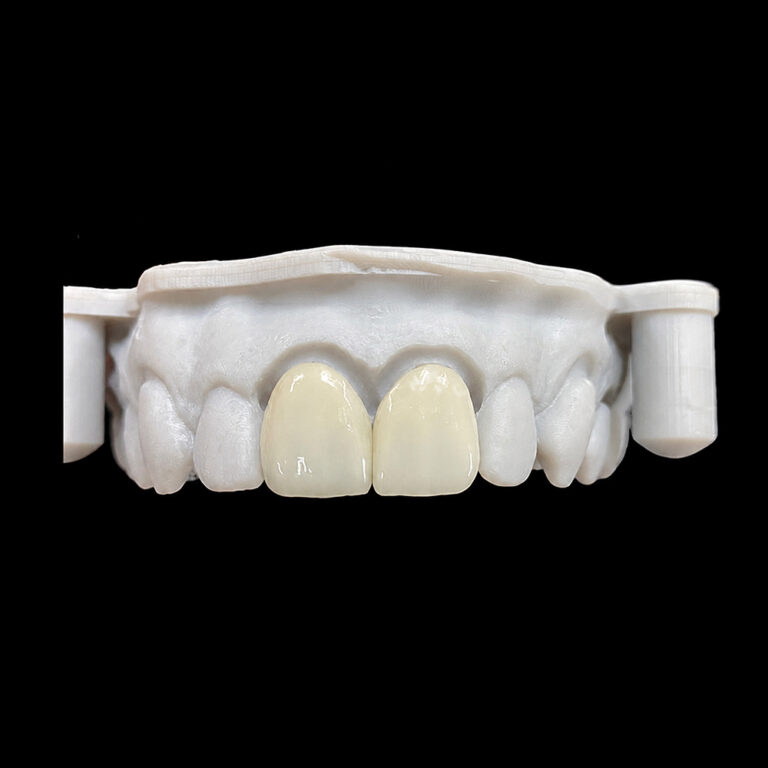
How to Balance Strength and Margin Translucency in Anterior Restorations
The Margin Is Where the Restoration Starts Telling the Truth
Margins tell everything.
I have seen anterior restorations look spectacular on a bench photo, with soft incisal halo, clean line angles, and a shade tab sitting beside them like courtroom evidence, only to become clinically disappointing because the margin was too thick, too bright, too gray, too unsupported, or simply too vague for the material chosen.
So why do we keep pretending this is only a “ceramic selection” problem?
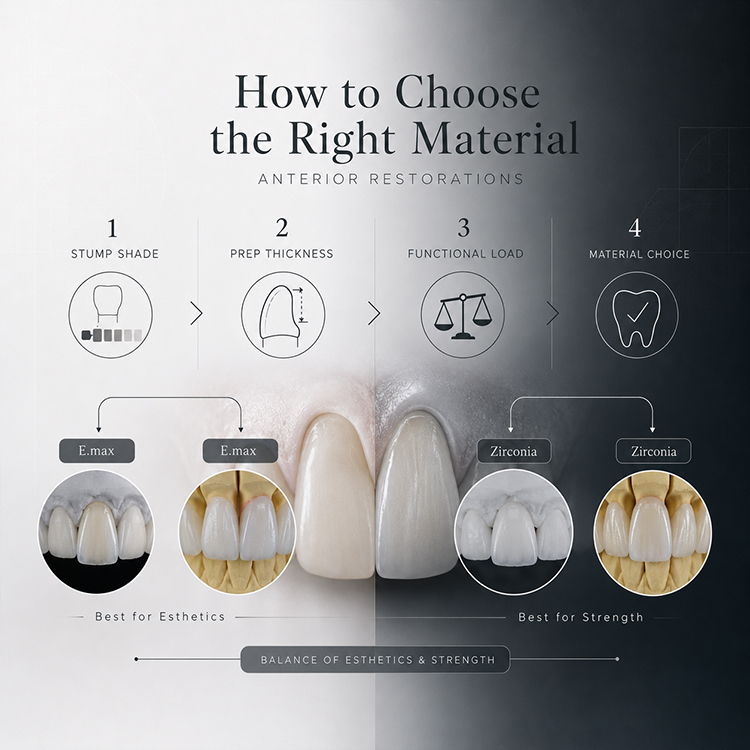
Here is my hard take: anterior restorations are not won by choosing the strongest material. They are won by choosing the material that can survive the preparation while disappearing at the margin.
That is a smaller target. And a meaner one.
A lithium disilicate crown can look alive and still fail optically if the stump shade is ignored. A zirconia anterior crown can survive function and still look dead if the cervical third is overbuilt. A feldspathic veneer can mimic enamel beautifully and still punish the clinician if the enamel support is weak. This is why I like starting with margin logic before material romance. Artist Dental Lab makes a similar point in its margin structure analysis of feldspathic, E.max, and zirconia, where the finish line is treated as the risk center rather than a minor technical note.
And yes, risk deserves records. The FDA MAUDE database exists because medical-device problems, malfunctions, injuries, and serious failures need structured reporting, not hallway gossip. Dentistry should learn from that attitude. We do not need panic. We need documentation.
Table of Contents
Strength Versus Translucency Is Not a Slider
Pick your poison.
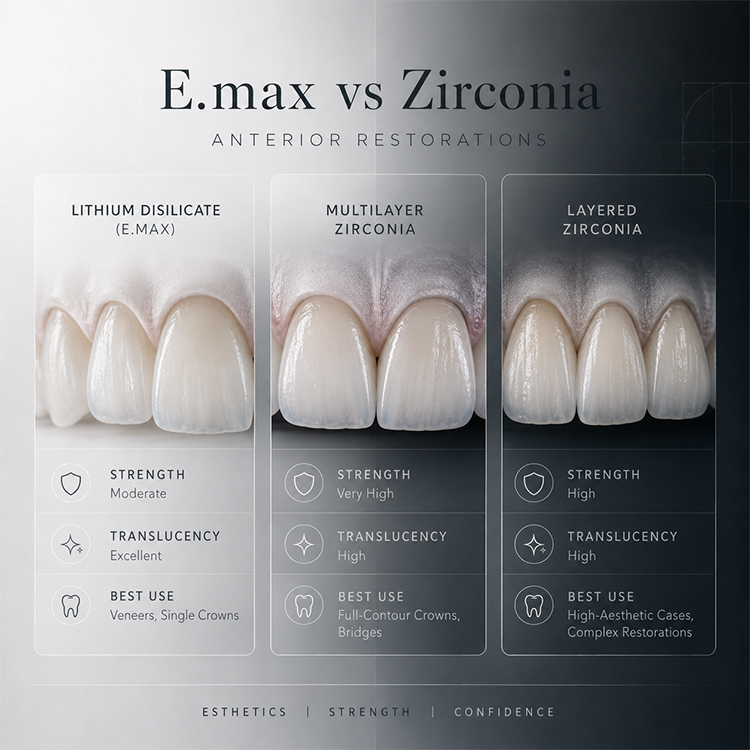
Lithium disilicate, usually discussed in the E.max family as Li₂Si₂O₅ glass-ceramic, gives clinicians a useful middle ground: better strength than traditional feldspathic porcelain, better optical life than many high-strength ceramics, and enough translucency control for many anterior dental restorations. Ivoclar lists IPS e.max CAD with 530 MPa flexural strength and four translucency levels, which explains why it became the default answer for so many esthetic crown and veneer cases.
But defaults get lazy.
Zirconia, ZrO₂, especially 3Y-TZP and 5Y-PSZ multilayer systems, brings higher mechanical confidence. The trade is optical discipline. More yttria can improve translucency but usually changes the strength profile. That is not marketing trivia; it is the material’s personality. A PubMed-indexed study on translucency and biaxial flexural strength of translucent zirconia ceramics directly frames the same tension: newer translucent zirconias were developed for better esthetics, but the strength-translucency relationship still has to be measured, not assumed.
The uncomfortable part? The cervical margin rarely forgives overconfidence.
For conservative cosmetic cases, Artist Dental Lab’s E.max veneer page positions lithium disilicate veneers around natural translucency, strength, and fit consistency. For crown work, its E.max crowns page pushes the same theme but adds a detail clinicians sometimes underplay: stump shade information supports value control in thinner areas.
That sentence should be printed above every shade-taking station.
The Material Choice I Would Actually Defend Chairside
Do not ask, “What is the best material for anterior restorations?”
Ask this instead: what must the restoration hide, transmit, support, and survive?
Premium anterior cases needing depth, halo, and characterization
Strong optical control when communication is excellent
Lithium disilicate base plus porcelain artistry
More variables than monolithic E.max; harder to standardize across many units
This is why the “zirconia versus E.max” debate bores me unless someone brings the prep photo.
For high-strength crown-and-bridge workflows, Artist Dental Lab’s full-contouring multilayer zirconia page makes sense when durability, reduced chipping risk, and CAD/CAM consistency are the main needs. But for smile-zone crowns where strength alone is too blunt, its layered zirconia crown option is the more honest esthetic compromise: zirconia core, porcelain layering, and customized translucency targets.
A compromise. Not magic.
The Data That Should Make Material Brochures More Humble
Numbers are rude.
A 2025 PubMed-indexed systematic review and meta-analysis reported pooled veneer survival rates of 96.13% for feldspathic, 93.70% for leucite-reinforced glass-ceramic, and 96.81% for lithium disilicate at 10.4 years. That is not permission to use anything anywhere; it is evidence that several ceramics can perform well when selected properly.
Another clinical paper on lithium disilicate ceramic veneers notes that ceramic veneers have shown survival rates exceeding 90% at 10 years in well-selected cases. I like that phrase: well-selected. It does more work than most marketing pages.
Selection is the whole fight.
A PubMed-indexed study on ultrathin lithium disilicate and translucent zirconia crowns reported that 0.5 mm ultraconservative lithium disilicate and zirconia crowns may be indicated for anterior restorations and premolars, while warning that high-load regions must be evaluated carefully. That is exactly the kind of sentence clinicians should respect. Thin can work. Thin can also become reckless.
The dirty secret is that anterior failures are often not material failures. They are communication failures wearing a ceramic costume.
My Lab-Side Protocol for Balancing Strength and Margin Translucency
Here is the packet I would want before touching a high-value anterior case:
1. Give the lab the stump shade before asking for translucency
If the prep is dark, endodontically treated, metal-influenced, tetracycline-stained, or simply low-value, margin translucency becomes a liability fast. A translucent ceramic over a compromised substrate can turn the cervical third gray. Then everyone blames the lab.
No. Send the stump shade.
Use ND stump guides if available. Photograph the stump and shade tab in the same plane. Add cross-polarized images when the case is serious. And if the patient wants “natural white,” translate that into value, chroma, incisal translucency, halo, texture, and surface gloss.
Artist Dental Lab’s article on communicating naturalness instead of just whiteness is worth linking here because it names the real variables: value, chroma, hue, translucency, opacity, texture, fluorescence, incisal characterization, and facial harmony.
That is the vocabulary. “Make it nice” is not.
2. Choose E.max when you need beauty with structure
For many ceramic anterior restorations, lithium disilicate is the sane middle path. It is not the strongest. It is not the most translucent. It is not the cheapest answer if the case needs premium layering. But it often gives the best balance between strength and margin translucency.
I would lean E.max when the case needs:
Moderate masking without killing vitality
Predictable fit across multiple units
Conservative veneers with enough enamel support
Single anterior crowns where value control matters
A repeatable workflow for B2B lab production
But do not over-translucency your way into a remake. HT is not automatically more natural. Sometimes LT or medium-opacity choices are the adult decision.
3. Choose zirconia when function is louder than romance
Zirconia earns its seat when the case has parafunction, limited clearance, implant-supported design, posterior transition concerns, or a patient who treats anterior guidance like a stress test.
But here is the warning: zirconia can be strong and still ugly.
High-translucency zirconia does not automatically equal enamel mimicry. Multilayer zirconia improves gradient effects, but the margin still needs facial cutback strategy, finish-line clarity, texture, and correct value. In a single central incisor case, I would not let a “high-translucency” label make the decision for me. I would ask for photos, stump shade, adjacent tooth mapping, and a frank discussion about whether layered porcelain is worth the added risk.
4. Use feldspathic only when the case has earned it
Feldspathic porcelain is beautiful.
It is also merciless.
I would reserve it for cases with strong enamel support, favorable stump shade, disciplined prep, low functional risk, and a patient who understands that elite optical mimicry comes with narrower mechanical tolerance. When someone asks for feldspathic on a dark stump with questionable enamel and heavy edge-to-edge function, I hear a future complaint being born.
The Margin Translucency Mistake Nobody Wants to Admit
The industry loves bright before-and-after photos because they sell quickly.
But the clinical truth is slower: margin translucency must be designed, not hoped for.
A margin that is too opaque looks like a ceramic border. A margin that is too translucent over the wrong substrate turns gray. A margin that is too thin may chip. A margin that is too bulky may inflame tissue or distort emergence. And a margin that is unreadable in the scan gives the technician a guessing game disguised as CAD/CAM dentistry.
So here is my working rule:
Strength protects the restoration. Margin translucency protects the illusion. Preparation design protects both.
That is the balance.
FAQs
What are anterior restorations?
Anterior restorations are dental restorations placed on the front teeth, usually incisors and canines, where esthetics, speech, smile line, incisal translucency, margin blending, and facial harmony matter as much as strength, fit, and occlusal function. They include veneers, crowns, implant crowns, and ceramic cosmetic restorations.
How do you balance strength and margin translucency in anterior restorations?
Balancing strength and margin translucency means selecting a ceramic material, thickness, opacity level, margin design, and cementation strategy that can survive function while allowing the restoration edge to blend naturally with the tooth structure, stump shade, gingival frame, and adjacent teeth without looking gray, bulky, or artificial.
In practice, I start with stump shade and reduction. Then I choose the material. If the prep is favorable and enamel support is strong, feldspathic or lithium disilicate may work beautifully. If the load is higher or clearance is limited, zirconia may be safer, but it needs stronger esthetic planning.
Is lithium disilicate good for anterior restorations?
Lithium disilicate is often a strong choice for anterior restorations because it offers a practical mix of flexural strength, translucency control, bonding potential, shade options, and workflow consistency, especially in E.max-type veneers and crowns where the clinician needs esthetics without giving up too much structural security.
I use lithium disilicate when the case needs balance. It is especially useful for veneers, single crowns, and multi-unit esthetic cases where predictable value and margin behavior matter. But if the stump is dark, the translucency level must be chosen carefully.
Is zirconia too opaque for anterior restorations?
Zirconia is not always too opaque for anterior restorations, but it can look artificial if the case relies on enamel-like translucency, subtle cervical blending, or single-central matching without enough characterization, layering, shade mapping, and surface texture control from the lab.
Modern high-translucency and multilayer zirconias are much better than older opaque zirconia systems. Still, they are not automatically the best choice for every smile-zone case. I trust zirconia more when function is aggressive and trust lithium disilicate or feldspathic more when optical mimicry is the main demand.
What causes gray margins in anterior ceramic restorations?
Gray margins in anterior ceramic restorations usually come from a mismatch between ceramic translucency, stump shade, margin thickness, cement shade, preparation design, and gingival optics, causing the dark underlying tooth or insufficient value control to show through the cervical area.
The usual culprit is not one dramatic mistake. It is a chain: dark prep, high-translucency ceramic, weak stump documentation, thin margin, wrong cement value, and no cervical shade strategy. That is why stump photos and margin notes matter.
What is the best material for anterior dental restorations?
The best material for anterior dental restorations is the one that matches the tooth substrate, preparation thickness, esthetic target, occlusal risk, margin design, cementation protocol, and patient expectations, rather than the material with the strongest brochure claim or the most fashionable brand name.
My personal hierarchy is simple: feldspathic for elite enamel mimicry in ideal cases, lithium disilicate for balanced esthetic structure, layered E.max for premium characterization, multilayer zirconia for strength-driven cases, and layered zirconia when strength and hand-built esthetics both matter.
Your Next Step Before the Case Goes to the Lab
Do not send the next anterior case with only an STL file and a shade name.
Send the prep scan, opposing scan, bite, stump shade, shade-tab photos, full-face smile photo, retracted views, margin notes, clearance map, occlusal risk notes, patient-approved esthetic target, and a clear instruction on whether strength or margin translucency gets priority if the two conflict.