À l'intention des laboratoires dentaires, des cliniques, des distributeurs et des équipes d'approvisionnement qui comparent les couronnes en zircone, les couronnes en disilicate de lithium, les facettes, les services OEM ou les commandes de restaurations en gros.
Indiquez-nous le type de produit, le matériau, le volume mensuel, le pays de destination et votre demande d'échantillon afin que notre équipe commerciale puisse vous proposer la prochaine étape la plus adaptée.
Fluorescence des facettes E.max : quels sont les possibilités de personnalisation offertes par le laboratoire ?
La couleur ne suffit pas.
Un laboratoire est capable de reproduire les teintes A1, B1, BL2 ou toute autre teinte indiquée sur l'ordonnance avec une précision remarquable, tout en fabriquant un Placage E.max qui semble étrangement terne à côté des dents naturelles, car les méthodes conventionnelles de communication des teintes nous renseignent étonnamment peu sur ce qui se passe lorsque la lumière riche en ultraviolets interagit avec la dentine, l’émail, la céramique, le cément dentaire et les couches de caractérisation.
Pourquoi continue-t-on à parler de « problème de teinte » ?
Non, je ne le fais pas.
La fluorescence est une variable optique à part entière, et dans le domaine exigeant de la dentisterie antérieure, elle mérite d'être traitée comme telle.
Les dents naturelles absorbent l'énergie à courte longueur d'onde et en réémettent une partie sous forme d'énergie à plus longue longueur d'onde. La dentine joue ici un rôle particulièrement important. Une étude répertoriée dans PubMed, menée par des chercheurs affiliés à l’Université fédérale de Santa Catarina et à l’Université du Minho, a révélé que la fluorescence des dents naturelles est plus intense dans la dentine que dans l’émail et qu’elle produit généralement un aspect blanc-bleuâtre. Cette même étude souligne que les céramiques dentaires tirent en partie leur fluorescence de centres luminescents à base d’éléments de terres rares.
Cela peut sembler théorique, jusqu’à ce qu’un cas de facettes de huit unités paraisse convaincant dans le cabinet dentaire et étrangement sans vie ailleurs.
Et là, ça revient cher.
La vraie question n'est donc pas de savoir si Les facettes IPS e.max présentent un effet fluorescent.
C'est vrai.
La question pertinente est la suivante : Dans quelle mesure le laboratoire peut-il contrôler délibérément l'intensité finale de la fluorescence, et où s'arrête ce contrôle ?
La fluorescence des facettes E.max n'est pas simplement un paramètre de teinte parmi d'autres
La fluorescence se produit lorsqu'un matériau absorbe un rayonnement électromagnétique de haute énergie et émet de la lumière de plus faible énergie.
Cette distinction est importante car deux restaurations peuvent présenter une teinte visible similaire sous un éclairage ordinaire, tout en produisant des réactions différentes en présence de longueurs d'onde ultraviolettes ou proches de l'ultraviolet.
La dentine naturelle n'est pas simplement “ jaune ”.”
Cela apporte de la lumière.
Et un système céramique qui reproduit la teinte mais ne parvient pas à reproduire ce comportement optique peut sembler acceptable d'un point de vue esthétique tout en ne correspondant pas à la référence biologique.
IPS e.max repose sur disilicate de lithium, Li₂Si₂O₅, un système en vitrocéramique particulièrement apprécié car il offre aux techniciens un contrôle nettement supérieur sur la transmission de la lumière par rapport aux matériaux de restauration très opaques. Le laboratoire dentaire Artist Dental Lab propose son propre Flux de travail des placages E.max considère déjà la teinte, la teinte de la souche, la translucidité, la valeur, les photographies et la caractérisation comme des variables de prescription distinctes, plutôt que de tout regrouper sous un seul code de teinte Vita.
C'est la bonne approche.
Mais la fluorescence ajoute une dimension supplémentaire.
Une étude approfondie sur la fluorescence des matériaux de restauration a révélé que les céramiques disponibles dans le commerce ne reproduisent pas nécessairement la fluorescence des dents naturelles avec la même intensité ni la même distribution spectrale. Le vieillissement, la température, le blanchiment, la composition du matériau et la technique de mesure peuvent tous influencer le résultat.
Je voudrais donc rejeter d'emblée une idée reçue très répandue :
Il n'existe pas de “ réglage de fluorescence idéal ” universel valable pour toutes les facettes E.max.
La cible, c'est le patient.
Ce n'est pas le catalogue.
Ce que le laboratoire peut réellement personnaliser dans les facettes E.max
Le laboratoire exerce bel et bien un contrôle réel.
Beaucoup, en fait.
Mais ces commandes fonctionnent comme un système et non comme un curseur imaginaire permettant de régler un “ pourcentage de fluorescence ”.
Variable de laboratoire
Ce qui peut être modifié
Incidence sur le résultat optique final
Risque principal
Sélection des blocs/lingots E.max
Options HT, MT, LT, MO, Impulse/Opal
Modifie la transmission lumineuse, la valeur, le masquage et la profondeur optique
Choisir la translucidité en se basant uniquement sur la teinte
Épaisseur de la céramique
Entre environ 0,3 et 1,0+ mm, selon les cas
Modifie à la fois la transmission de la lumière et la fluorescence observée
En supposant que les placages fins et épais se comportent de la même manière
Superposition de céramique
Dentine, émail/couche incisale et couches de céramique spécialisées
Permet de contrôler localement la fluorescence et l'opacité
Accumulation de couches et perte de cohérence
Caractérisation interne
Modificateurs locaux et colorants céramiques
Modifie la chaleur, la saturation, la profondeur et les effets localisés
Création d“” effets spéciaux » artificiels”
Glaçure fluorescente
Glaçure FLUO aux endroits indiqués
Confère une fluorescence aux surfaces recouvertes d'une fine couche de céramique peu fluorescente par nature
Considérer le glaçage comme une correction universelle
Finition de surface
Stratégie relative à la texture, au polissage et au glaçage
Modifie la réflexion, la brillance et la luminosité perçue
Confondre la réflexion de surface avec la fluorescence
Planification de la production de ciment
Le laboratoire communique au praticien les valeurs cibles d'opacité et de translucidité
Le ciment peut modifier la fluorescence du système de facettes collées
Tester la céramique sans tenir compte du ciment
Compensation de l'ombre projetée par les souches
Opacité du noyau et stratégie de superposition
Contribue à équilibrer les différents substrats sous-jacents
Tenter de corriger les préparations sombres uniquement par la caractérisation
1. Le laboratoire peut commencer avec différents niveaux de translucidité IPS e.max
Voici le premier levier.
Et on s'y trompe sans cesse.
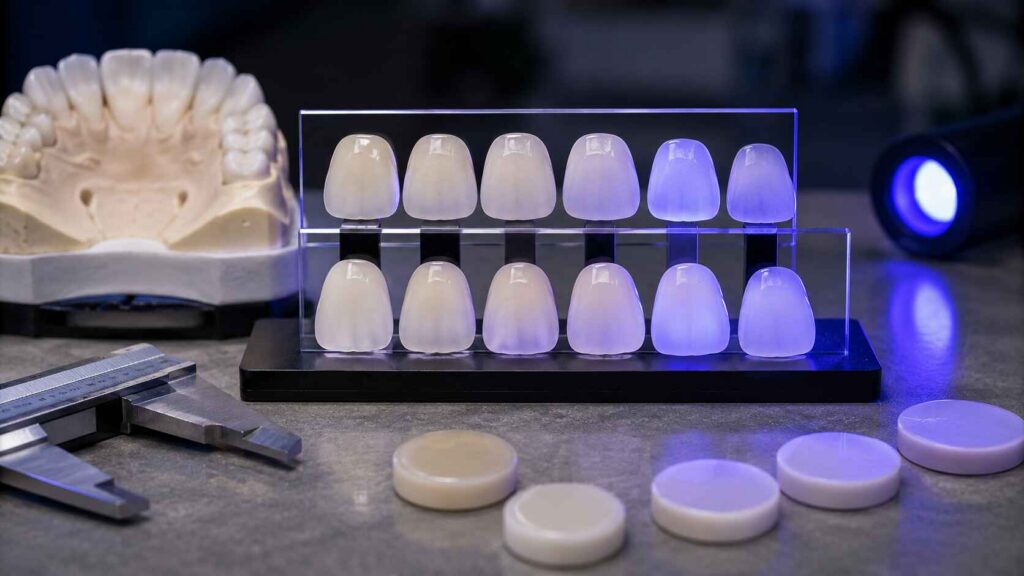
Ivoclar propose actuellement HT, MT, LT et MO niveaux de translucidité pour IPS e.max CAD, ainsi que Impulsion des options spécialement conçues pour obtenir des effets opalescents plus prononcés. La version HT offre une meilleure transmission ; la version MT se situe entre la HT et la LT en termes de luminosité et de translucidité ; la version LT améliore la stabilité des valeurs ; la version MO permet de mieux masquer les préparations décolorées.
Il ne s'agit pas là de quatre versions d'un même objet optique.
Ils déterminent dans quelle mesure la souche sous-jacente, le ciment et l'éclairage ambiant contribuent à l'aspect final.
Un placage très translucide confère davantage de prestance au support.
Un revêtement opaque confère à la céramique davantage de prestance.
Aucune des deux n'est automatiquement meilleure.
Dans le cas d’une incisive centrale légèrement préparée dont l’émail sous-jacent est sain, une translucidité élevée peut permettre une intégration d’un naturel exceptionnel. Appliquez cette même stratégie sur un moignon foncé ou sur des substrats sous-jacents hétérogènes répartis sur six dents, et le technicien risque de passer le reste du temps à lutter contre les différences de teinte.
C'est pourquoi j'apprécie la manière dont Artist Dental Lab présente le problème dans son article sur Facettes E.max monolithiques ou stratifiées dans les sourires à plusieurs éléments: l'ombre du moignon, l'épaisseur de la céramique, le ciment, la translucidité et la valeur doivent être considérés comme un ensemble optique unique.
Un seul code ne suffit pas à décrire cette pile.
2. L'épaisseur de la céramique modifie la fluorescence
Celui-ci s'appuie sur des données.
Une étude en laboratoire a évalué 48 échantillons de céramique, notamment l'IPS e.max, la céramique feldspathique, la zircone et la céramique hybride, à épaisseurs de 0,5 mm et 1,0 mm.
Le résultat ?
La fluorescence a augmenté de manière significative lorsque l'épaisseur est passée de 0,5 à 1,0 mm, avec P = 0,007. Les différents systèmes céramiques ont également présenté des différences statistiquement significatives en termes de fluorescence.
Relis ça.
Même catégorie de matériau de restauration.
Épaisseurs différentes.
Une fluorescence différente.
Cela revêt une importance capitale pour la conception des facettes, car les restaurations antérieures présentent rarement une épaisseur parfaitement uniforme.
La région cervicale peut être relativement fine.
Le visage s'épaissit.
La zone incisale peut présenter, là encore, des différences en termes de réduction, de volume de céramique, de translucidité et de caractérisation.
Par conséquent, quand quelqu’un me demande : “ Quelle est la fluorescence d’une facette E.max ? ”, je trouve que la question n’est pas complète.
Quelle épaisseur ?
Où ?
Sur quel substrat ?
Avec quel ciment ?
Et sous quel éclairage ?
Sans ces réponses, ce chiffre est moins utile qu'il n'y paraît.
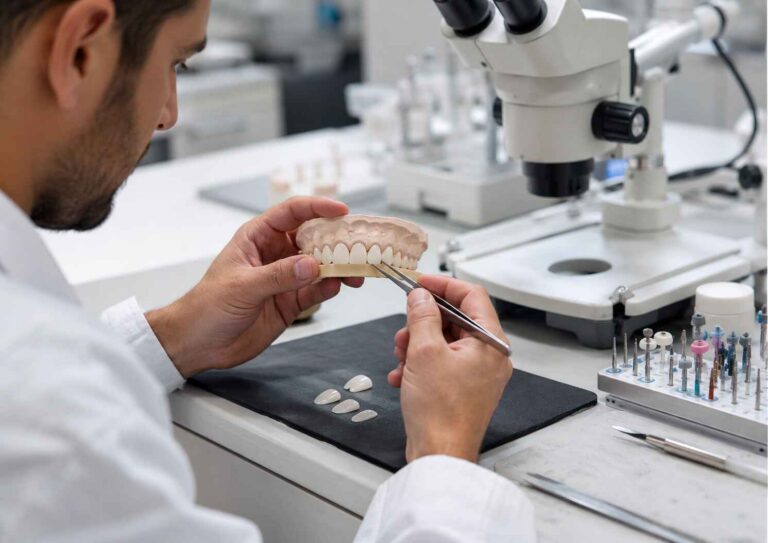
La technique de stratification E.max offre au technicien un meilleur contrôle de la fluorescence
C'est ici que Personnalisation des facettes E.max devient bien plus intéressant.
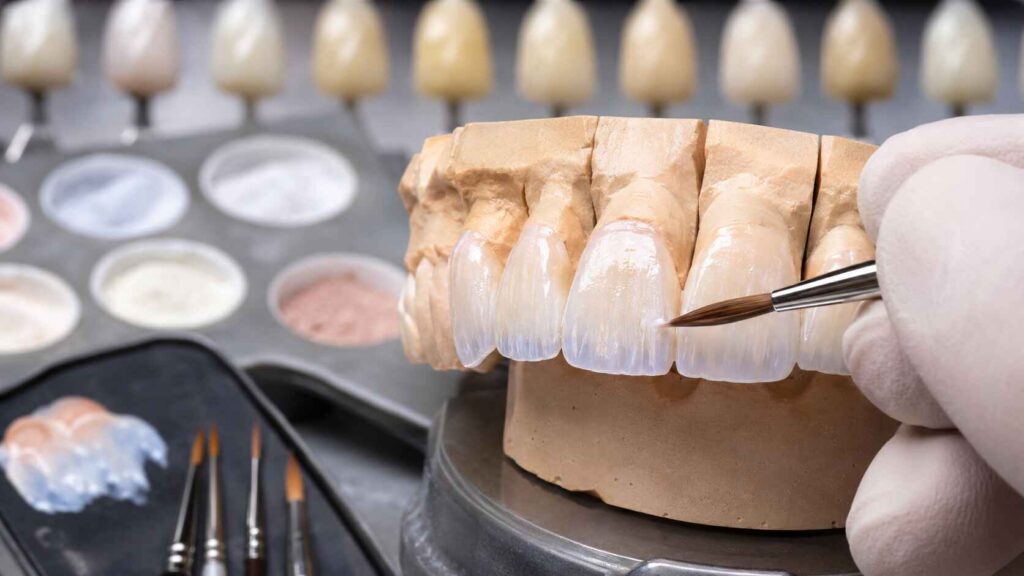
Le disilicate de lithium monolithique peut être teinté et recouvert d'un émail, mais une restauration en couches permet au technicien de répartir les propriétés optiques dans différentes zones de la céramique, plutôt que d'essayer de tout régler au niveau de la surface externe.
Ivoclar décrit IPS e.max Ceram en tant que vitrocéramique à base de fluorapatite destinée au recouvrement et à la caractérisation du disilicate de lithium et de la zircone. Selon le fabricant, la structure de ce matériau est conçue pour imiter le comportement des dents naturelles dans translucidité, opacité et fluorescence.
Ce n'est pas une distinction négligeable.
Dans la documentation technique du fabricant, la concentration en agent fluorescent est délibérément répartie de manière inégale dans le système céramique, avec une fluorescence plus intense au niveau des matériaux de type dentine et une fluorescence plus faible vers les matériaux incisaux, conformément à la structure optique générale des dents naturelles.
C’est précisément pour cette raison qu’un céramiste expérimenté peut faire bien plus que simplement “ ajouter du bleu à l’incisal ”.”
Ils peuvent créer des zones.
Fluorescence de type dentinaire
La dentine naturelle présente une fluorescence plus importante que l'émail.
Du coup, quand je passe en revue un projet exigeant placage E.max en couches Conformément aux spécifications, je préfère que le technicien réalise correctement le corps interne en dentine plutôt que de devoir compenser par la suite par un traitement de surface fluorescent trop agressif.
Pourquoi ?
Parce que la fluorescence naturelle est volumétrique.
On devrait avoir l'impression que cela provient de l'intérieur de la dent.
Ce n'est pas dû à la peinture qui reste en surface.
Une étude comparant cinq systèmes de céramique dentinaire dans le cadre de 16 nuances avec 12 échantillons de dentine humaine a mis en évidence des différences significatives entre les différentes marques de céramique. Il convient notamment de noter que les céramiques Ivoclar et Noritake testées présentaient un comportement de fluorescence statistiquement plus proche de celui de la dentine naturelle que plusieurs autres systèmes.
C'est un élément de preuve utile.
Cela met également fin à une autre idée reçue : toutes les céramiques dentinaires A2 seraient optiquement équivalentes.
Ce n'est pas le cas.
La fluorescence incisale devrait généralement être différente
Le tiers incisif n'est pas simplement une couche plus claire de la masse.
L'émail naturel présente des caractéristiques de transmission, d'opalescence et de fluorescence différentes de celles de la dentine.
Cela signifie que le laboratoire devra peut-être réduire l'intensité de la fluorescence vers le bord incisif tout en contrôlant simultanément la translucidité, le halo, le relief des mamelons et l'opalescence.
C'est l'une des raisons pour lesquelles le choix entre les restaurations monobloc et les restaurations en couches ne doit pas se résumer à un simple choix entre “ résistance et esthétique ”.”
Le travail minutieux du laboratoire dentaire Artist Comparaison entre les facettes E.max monobloc et les facettes E.max stratifiées établit une distinction plus pertinente : les restaurations monolithiques réduisent les variables techniques, tandis que les restaurations en couches offrent une plus grande liberté en matière de profondeur incisale, de caractérisation interne et de comportement lumineux personnalisé.
Plus de liberté.
Et plus de risques aussi.
C'est un aspect qui figure rarement dans la brochure.
Caractérisation de la fluorescence et glaçure FLUO : utiles, mais dont on abuse facilement
Les techniciens ne se limitent pas à la céramique de base.
IPS e.max Ceram comprend des matériaux de caractérisation permettant de créer différents effets fluorescents. Ivoclar précise que son Poudres d'essence sont disponibles pour la caractérisation interne et externe et présentent différents degrés de fluorescence selon la teinte.
Et puis, il y a le glaçage.
Ivoclar propose IPS e.max Ceram Glaze FLUO en particulier pour les zones présentant peu ou pas de céramique de revêtement fluorescente et pour les armatures présentant une fluorescence limitée.
Donc oui, le laboratoire peut modifier délibérément la fluorescence à un stade avancé du processus.
Mais voici ce qui me pose problème avec cette approche lorsqu'elle devient une habitude :
Un vernis fluorescent ne remplace pas la conception optique.
Si le matériau de base, l'épaisseur, l'opacité, l'architecture des couches et l'adaptation au moignon ne sont pas adaptés, le fait d'ajouter davantage de matériau de surface fluorescent risque simplement de donner lieu à une restauration qui réagit plus fortement aux UV sans pour autant ressembler davantage à une dent naturelle.
L'objectif n'est pas d'obtenir une fluorescence maximale.
L'intégration, c'est….
La couche de ciment peut modifier la fluorescence une fois que la facette a quitté le laboratoire
C'est un point que les cliniciens et les laboratoires doivent aborder ensemble.
Une étude de 2022 a été fabriquée de toutes pièces 192 facettes en céramique en utilisant IPS e.max CAD, IPS Empress CAD et Zenostar, puis en les associant à trois ciments résineux différents et en évaluant leur fluorescence sous Lumière UV à 405 nm.
La fluorescence la plus intense a été observée avec IPS e.max CAD associé au ciment résine Choice 2.
Les chercheurs ont conclu que la fluorescence finale du placage était influencée par tant la céramique que le ciment résineux.
Ce résultat devrait empêcher les laboratoires de prétendre qu’ils contrôlent entièrement le résultat optique final.
Ce n'est pas le cas.
Le laboratoire fabrique l'un des composants du système.
C'est le clinicien qui s'en charge.
Céramique + ciment résineux + interface adhésive + substrat dentaire = ce que le patient porte réellement.
Le niveau B1 ne m'apprend pratiquement rien sur la fluorescence.
La fluorescence des facettes dentaires devient évidente sous un éclairage inadapté
La plupart des patients ne se trouvent pas sous une lampe UV de laboratoire de 365 nm.
C'est un argument valable.
Mais écarter la fluorescence sous prétexte que “ personne ne vit sous une lumière noire ”, c'est passer à côté de la manière dont les dents humaines interagissent avec un éclairage réel.
Les différentes sources de lumière artificielle présentent des distributions spectrales très différentes. La lumière du jour varie. L'éclairage de spectacle varie. L'éclairage photographique varie. L'éclairage utilisé pour la mise en correspondance des teintes dentaires varie.
Et lorsque l'énergie ultraviolette ou quasi-ultraviolette devient importante, les matériaux incompatibles sont plus facilement mis en évidence.
Un rapport clinique publié illustre bien ce problème. Des chercheurs ont pris en charge la rééducation d’un patient atteint de sept facettes et un bridge à trois éléments, en évaluant le comportement fluorescent des substrats et des restaurations céramiques dans les deux cas Éclairage à 365 nm et 405 nm. Leur protocole de restauration associait une armature en disilicate de lithium à des facettes en vitrocéramique renforcée à la leucite afin d'améliorer la reproduction de la fluorescence naturelle.
Je ne considérerais pas un seul cas clinique comme une preuve universelle.
Mais cela illustre parfaitement le propos.
Une restauration peut être conçue pour réagir différemment à certaines longueurs d'onde de la lumière.
Ce comportement n'est pas pris en compte par l'onglet A1.
Quel doit être le degré de fluorescence d'une facette E.max d'aspect naturel ?
De quoi se sentir à sa place.
C'est fini.
Le la meilleure fluorescence pour des facettes E.max d'aspect naturel Il ne s'agit pas de la fluorescence la plus intense possible, mais d'une fluorescence qui s'harmonise visuellement avec les dents voisines dans différentes conditions d'éclairage, tout en conservant une valeur, une translucidité, une saturation, une opalescence et une réflexion de surface appropriées.
C'est là que, selon moi, le secteur se laisse parfois distraire par la technique.
Mamelons.
Salut.
Bleu.
Ambre.
Des lignes blanches.
Poudres fluorescentes.
Tout cela est utile.
Tout cela n'a aucune importance si la restauration se remarque déjà à deux mètres de distance.
Pour une incisive centrale isolée, la dent naturelle adjacente sert de référence.
Pour les restaurations de six ou dix unités, le technicien dispose d'une plus grande liberté, car le kit de restauration crée en grande partie son propre environnement visuel.
Dans le cas de prothèses composées de plusieurs matériaux, les choses se compliquent à nouveau. Le guide d’Artist Dental Lab sur Assortiment des facettes en zircone aux restaurations E.max adjacentes souligne à juste titre que deux restaurations peuvent partager la même teinte nominale tout en présentant des différences substantielles en termes de translucidité, de valeur et de réaction à la lumière.
La fluorescence a également sa place dans cette discussion.
Comment je définirais la fluorescence pour le laboratoire dentaire
N'écrivez pas “ fluorescence naturelle ”.”
Cette consigne ne sert pratiquement à rien.
Fournissez des preuves au technicien.
Pour les restaurations antérieures complexes Facettes IPS e.max, j'enverrais :
Photographies de face et de profil correctement exposées.
Photographies de la languette de référence avec celle-ci placée dans le même plan que la dent.
Photographies de la zone d'ombre du tronc après préparation.
Images de dents adjacentes montrant leurs caractéristiques cervicales, médianes et incisales.
Informations concernant les couronnes, facettes ou implants déjà en place.
Type de restauration souhaité : monolithique, en cut-back ou entièrement stratifiée.
Une déclaration relative à l'obligation de port du masque.
Un objectif de valeur clairement défini.
Un objectif clair en matière de translucidité.
Photographies de référence pour le halo incisal, les mamelons, la translucidité et la caractérisation interne.
Pour une seule unité antérieure, prenez des photos sous plusieurs conditions d'éclairage appropriées lorsque la situation le justifie.
Et si le patient possède déjà des restaurations en céramique dont la teinte doit être harmonisée, précisez au laboratoire de quoi il s'agit exactement.
Cette information change tout.
“ Match #8 ” ne correspond pas.
Ce que le laboratoire ne peut pas entièrement personnaliser
Cette distinction est tout aussi importante que la liste des outils disponibles.
Un laboratoire dentaire ne peut pas déterminer de manière indépendante la fluorescence finale d'une facette E.max après le collage, car la restauration observée résulte d'un ensemble d'effets optiques liés à la céramique, à son épaisseur, au support dentaire, au ciment résineux, à l'état de la surface et à l'éclairage.
Le laboratoire peut superviser la restauration.
Il ne peut pas contrôler les lois de la physique en dehors de la restauration.
Cela signifie qu'un technicien ne peut pas compenser de manière fiable un « dark stump » non documenté.
Le technicien ne peut pas savoir quelle teinte de résine sera utilisée à moins que le clinicien ne le lui indique.
Le technicien ne peut pas faire en sorte qu'une facette de 0,3 mm se comporte comme une facette de 1,0 mm tout en conservant toutes les autres propriétés inchangées.
De plus, le technicien ne peut garantir un comportement visuel identique sous toutes les LED, tous les flashs, toutes les sources de lumière du jour et dans tous les environnements riches en rayons UV.
Quiconque fait cette promesse exagère les qualités de ce produit.
FAQ
Qu'est-ce que la fluorescence dans les facettes E.max ?
La fluorescence des facettes E.max correspond à l'émission de lumière visible après que le système de restauration en céramique a absorbé un rayonnement à haute énergie, notamment des longueurs d'onde ultraviolettes ou proches de l'ultraviolet. Son intensité dépend de la composition de la céramique, de son épaisseur, des matériaux de stratification, de la caractérisation, du ciment et du substrat dentaire ; la fluorescence est donc liée à la correspondance de teinte classique, mais s'en distingue fondamentalement.
La dentine naturelle présente généralement une fluorescence plus intense que l'émail ; c'est pourquoi, pour obtenir des restaurations antérieures réussies, il est souvent nécessaire de créer une profondeur optique interne plutôt qu'une surface présentant une fluorescence uniforme.
Un laboratoire dentaire peut-il personnaliser la fluorescence des facettes E.max ?
Un laboratoire dentaire peut personnaliser la fluorescence des facettes E.max en choisissant différents degrés de translucidité du disilicate de lithium, en contrôlant l'épaisseur de la céramique, en utilisant des céramiques à stratification à base de fluorapatite, en ajustant l'architecture de la dentine et de l'incisal, en appliquant des matériaux de caractérisation et, le cas échéant, en utilisant un glaçage fluorescent. Le laboratoire peut donc modifier considérablement la fluorescence, bien qu’il ne puisse pas déterminer à lui seul le résultat final après collage.
Ivoclar propose notamment des systèmes de revêtement et de caractérisation présentant différents comportements fluorescents, notamment les matériaux de glaçage IPS e.max Ceram et FLUO.
L'épaisseur de la facette a-t-elle une incidence sur la fluorescence de l'E.max ?
L'épaisseur de la facette influe sur la fluorescence de l'E.max, car l'augmentation du volume de céramique peut modifier la quantité et la contribution optique du matériau fluorescent, tout en modifiant simultanément la transmission à travers la restauration. Une étude contrôlée comparant des échantillons de céramique de 0,5 mm et 1,0 mm d'épaisseur a mis en évidence une fluorescence significativement plus importante pour l'épaisseur la plus élevée, avec une valeur de P = 0,007.
L'épaisseur devient ainsi une variable optique, et non plus simplement une variable structurelle.
Le ciment résineux modifie-t-il la fluorescence des facettes E.max ?
Le ciment résineux peut modifier la fluorescence des facettes E.max collées, car la restauration finale constitue un système optique combiné et non une coque céramique isolée. Dans une étude portant sur 192 facettes en céramique exposées à un rayonnement UV de 405 nm, la fluorescence variait en fonction du type de céramique et du ciment résine ; c'est la combinaison IPS e.max CAD et Choice 2 qui a produit la fluorescence la plus élevée mesurée.
Un test de teinte en laboratoire ne permet donc pas de prédire avec certitude le résultat obtenu après la cimentation.
Les facettes E.max stratifiées sont-elles plus adaptées à la personnalisation par fluorescence ?
Les facettes E.max en couches offrent généralement davantage de souplesse pour la personnalisation de la fluorescence, car le technicien peut répartir les céramiques imitant la dentine, l'émail et celles destinées à la caractérisation dans différentes zones, au lieu de s'appuyer principalement sur un seul corps céramique monolithique. Cela permet d’appliquer, aux zones cervicales, au corps et aux zones incisales, différentes combinaisons d’opacité, de translucidité, de fluorescence et d’effets optiques internes.
Le revers de la médaille réside dans la sensibilité technique : un contrôle artistique accru entraîne également davantage de variables d'une restauration à l'autre.
Quelle est la meilleure fluorescence pour obtenir des facettes E.max d'aspect naturel ?
Pour obtenir des facettes E.max d’aspect naturel, il convient de choisir un niveau de fluorescence qui reproduise celui de la dentition adjacente, plutôt que la fluorescence maximale que le système céramique est capable de produire. Les dents naturelles présentent des variations en termes d’épaisseur de l’émail, de volume de la dentine, d’âge et de substrat ; il est donc nécessaire de déterminer la valeur cible appropriée au cas par cas, en tenant compte de la teinte, de la translucidité, de l’opalescence et de la texture de surface.
Une facette très fluorescente peut être tout aussi artificielle qu'une facette non fluorescente.
Les facettes monolithiques en E.max présentent-elles une fluorescence ?
Les facettes monolithiques en E.max peuvent présenter une fluorescence, mais leur réponse fluorescente finale dépend du disilicate de lithium utilisé, de l’épaisseur de la restauration, de sa caractérisation et du système de collage employé. Elles offrent moins de possibilités de répartition spatiale des couches fluorescentes de dentine et d’émail que les facettes en E.max stratifiées, bien que la coloration, le glaçage et le choix des matériaux permettent tout de même un contrôle optique significatif.
Pour les cas antérieurs impliquant une seule dent et nécessitant une approche hautement personnalisée, la technique de stratification peut offrir une plus grande liberté ; pour les cas multi-unités uniformes, la construction monolithique peut garantir une meilleure reproductibilité.
Cessez de prescrire “ A1 E.max ” en espérant obtenir un résultat aussi naturel qu’une dent naturelle
La vérité la plus difficile à accepter dans Caractérisation des facettes E.max est également la plus simple :
Le laboratoire ne peut pas reproduire des informations qu’il ne reçoit jamais.
La luminosité de la fluorescence est réglable.
La transparence est réglable.
L'opacité est réglable.
La caractérisation interne est réglable.
L'épaisseur peut souvent être déterminée dans le cadre de la préparation clinique.
Mais le technicien doit tout de même savoir ce qu'on cherche à reproduire.
Une prescription indiquant “ E.max, B1, aspect naturel ” n'est pas une spécification esthétique. C'est un point de départ.
Pour les interventions postérieures de routine, cela suffit peut-être.
Pour une incisive centrale dont l'émail naturel est intact ?
Absolument pas.
Si votre cas présente une teinte de moignon complexe, un mélange de matériaux céramiques, une restauration antérieure unique ou une réhabilitation du sourire haut de gamme, veuillez transmettre au laboratoire les informations relatives au substrat, les photographies de référence et la cible optique avant le début de la production.