Surface Texture in Veneers: Matching Age, Expression, and Personality

Dental veneer surface texture should reproduce the patient’s own pattern of facial contour, developmental detail, wear, and gloss while supporting the expression the patient has approved. Age can guide the starting point. Personality can guide the conversation. Neither should replace photographs, video, adjacent teeth, provisionals, or informed consent.

Texture changes everything.

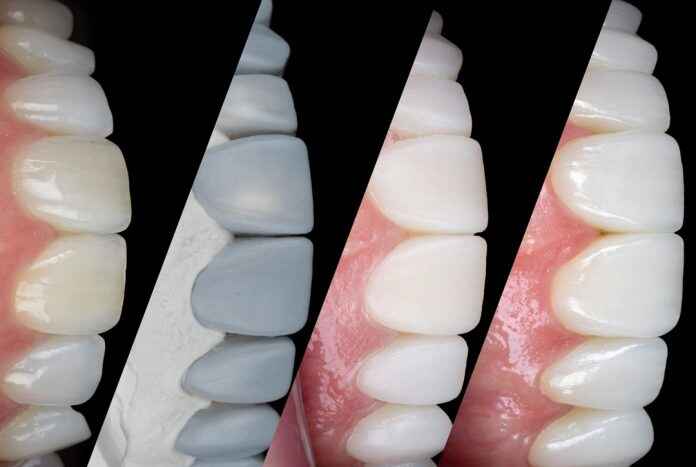
Under operatory LEDs, daylight, bathroom lighting, a smartphone flash, and the moving frame of the lips, two veneers made from the same ceramic and shade can look entirely different because their line angles, facial lobes, microtexture, and gloss redirect light differently.

So why do so many prescriptions still say only “A1, natural texture”?

My blunt answer is that shade is easy to name. Texture forces the dentist and technician to define what the patient should actually look like.

ベニア

A Veneer Is Read as a Reflection Pattern

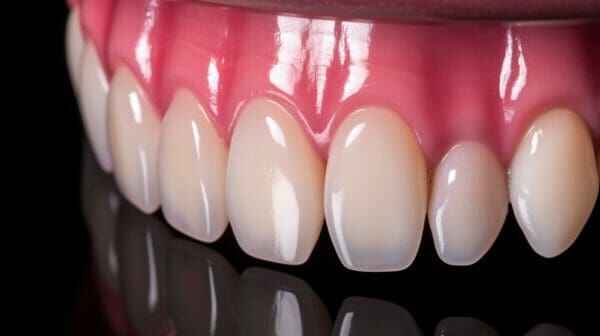
Natural enamel is not a flat white surface. Its mineral structure is primarily hydroxyapatite, Ca₁₀(PO₄)₆(OH)₂, arranged within a surface carrying developmental lobes, shallow depressions, perikymata, wear facets, line angles, and areas of different gloss.

The eye does not inspect these features individually. It reads the reflection pattern they create.

A broad, flat facial surface produces a wide reflection and can make a central incisor look wider, brighter, and more dominant. Moving the transition line inward narrows the reflective zone and makes the same physical tooth appear slimmer. Strong horizontal texture can visually shorten a crown, while vertical surface direction may strengthen the impression of length.

That is why tooth surface texture cannot be treated as decoration added after the shade is finished. It changes perceived:

  • Width and length
  • Value and brightness
  • Facial prominence
  • Incisal vitality
  • Apparent age
  • Symmetry between units
  • Integration with adjacent enamel

The broader mechanics are covered in why surface texture determines realism in anterior restorations. The distinction I would make here is narrower: a realistic surface is not automatically the right surface for a specific person.

“Natural” is personal.

Age-Appropriate Veneer Design Starts With Evidence

Age leaves evidence.

From adolescence through later adulthood, incisal wear, passive eruption, proximal attrition, gingival position, crown proportions, lip length, and tooth display change together, so copying the surface of an unworn 20-year-old central incisor onto a mature smile can create an obvious biological mismatch.

Why would we expect a date of birth alone to tell the laboratory which details survived?

A 2023 observational longitudinal study examined dental models from 23 untreated individuals at approximately 13, 17, and 61 years of age. Across that period, the researchers found changes in anterior crown width-to-height proportions, mesiodistal angulation, gingival steps, and incisal steps.

The sample was small. Still, it recorded something cosmetic marketing routinely ignores: anterior teeth do not remain frozen at their adolescent geometry.

The lip frame changes too. A study of 265 adults aged 19 to 60 included 122 men and 143 women and found that maxillary incisor display decreased with age, particularly in men, while mandibular incisor display increased. This does not produce a universal veneer formula. It shows why a static close-up of the prepared teeth is not enough.

What age can legitimately influence

For a younger-looking design, I may consider:

  • Clearer developmental lobes
  • Visible but controlled perikymata
  • Sharper, less-worn incisal anatomy
  • More pronounced incisal embrasures
  • Selective gloss over convex facial zones
  • Delicate incisal translucency rather than a painted blue band

For a mature design, I may consider:

  • Softened facial relief
  • Reduced tertiary microtexture
  • Subtle wear facets
  • Less regular incisal edges
  • Fine craze-line characterization where appropriate
  • Lower or more selective gloss
  • Reduced incisal drama

But these are starting points, not rules. A 62-year-old patient may want a deliberately rejuvenated smile. A 28-year-old bruxer may already have flattened incisal anatomy. Erosion, diet, occlusion, brushing, previous restorations, and parafunction can matter more than chronological age.

My rule is simple: match biological evidence first and the age label second.

Expression Comes From Movement, Not a Tooth-Shaped Personality Test

“Expression” describes how the teeth behave within the moving face: how much central-incisor dominance appears during speech, how the incisal edge follows the lower lip, whether the laterals soften the composition, and whether the canines create a gentle or forceful transition.

Surface texture contributes to that expression by controlling where light stops, spreads, or disappears.

A patient asking for a “strong” smile may prefer clearer line angles, restrained embrasures, defined canines, and a cleaner reflective pattern. Someone asking for a “soft” result may prefer rounder transitions, less aggressive canine character, delicate microtexture, and reflections that fade gradually toward the proximal surfaces.

Those descriptions are useful. They are not diagnoses.

The industry’s personality language often goes too far. Square teeth supposedly mean confidence. Rounded teeth supposedly mean warmth. Pointed canines supposedly mean dominance. It sounds persuasive in a consultation room, but the evidence does not support reading personality directly from dental morphology.

A 2025 study involving 412 participants did find associations between Big Five personality traits and preferences for certain smile features. However, the reported correlations were small, around (r=0.112) to (r=0.147), and concerned aesthetic preferences—not a reliable method for converting personality into tooth texture.

That difference matters.

Personality should be used to ask better questions:

  • Do you want the veneers to disappear into the face or look intentionally designed?
  • Do you prefer crisp or softened incisal edges?
  • Should the smile feel restrained, youthful, bold, or relaxed?
  • Which feature of the approved provisional feels most like you?
  • Which feature feels artificial?
  • When you say “natural,” which real smile are you referencing?

The patient’s answers should then be tested in a mock-up or provisional. They should not be translated directly into permanent ceramic by intuition.

A Practical Veneer Surface Characterization Matrix

The following matrix is a communication tool, not a biological classification system.

Approved design directionMacro-contour and line anglesDental veneer microtextureGloss strategy主な故障リスク
Single-tooth integrationCopy the adjacent tooth’s reflective width and facial convexityReplicate visible grooves and perikymata asymmetricallyMatch neighboring enamel by zoneA technically attractive veneer that still looks like the “odd tooth”
Youthful and expressiveDefined lobes, intact incisal form, open embrasuresFine, visible developmental textureSelective high points with controlled peripheral reflectionExcessive texture that resembles carving
Mature and restrainedSoftened transitions and mild edge wearLow-to-moderate texture with limited tertiary detailModerate or locally reduced glossMaking the restoration flat, dull, or prematurely aged
Bold and definedStronger central dominance and clearer transition linesControlled vertical direction rather than random roughnessFocused facial reflectionOver-wide, over-bright central incisors
Soft and approachableRounded transitions and less aggressive canine formDelicate, blended textureGradual reflection without mirror-like zonesLosing anatomy and producing generic oval teeth
Multi-unit natural variationShared design family with controlled unit-to-unit differencesSlightly varied surface patternsConsistent overall finish with selective differencesSix identical teeth that resemble a denture setup

The best veneer texture for a natural smile is rarely the most detailed option. It is the least exaggerated surface that still produces the correct reflection, apparent age, and relationship with the surrounding dentition.

ベニア

How to Create Surface Texture in Veneers Without Guessing

Capture color and texture separately

Cross-polarized photographs help suppress reflections so the laboratory can evaluate value, chroma, and internal color. They are poor references for judging gloss and facial topography because the reflections have deliberately been removed.

Texture therefore needs its own records:

  • Full-face view at rest
  • Natural and broad smile
  • 後退した正面図
  • Right and left 45-degree views
  • Profile or near-profile views
  • Close-ups with light directed from above and each side
  • Adjacent-tooth images under raking light
  • Incisal photographs against a dark background
  • Short speech and smile video
  • Approved provisional or mock-up photographs

The site’s anterior veneer case-submission guide provides the wider scan, bite, shade, stump-shade, and clinical-record requirements.

Approve the macro-form before chasing microtexture

Primary form comes first: tooth length, width, line angles, facial convexity, incisal position, and emergence. Secondary anatomy comes next: lobes, grooves, depressions, and broad surface direction. Tertiary anatomy—perikymata and very fine irregularities—comes last.

A technician cannot rescue incorrect proportions with elegant scratches.

Before fabrication, the clinic should document the patient-approved form, function, shade, integration, and emotional target. The five esthetic goals every veneer case should define offer a practical framework for that approval.

Prescribe the surface by zone

“Medium texture” is still vague. A stronger prescription divides the facial surface into three zones:

  • Cervical third: emergence, cervical convexity, fine horizontal developmental detail, and tissue integration
  • Middle third: vertical lobes, transition lines, reflective width, and primary value perception
  • Incisal third: edge wear, translucency, halo, mamelon expression, and surface interruption

Incisal texture also has to coordinate with internal optics. The guide to incisal translucency in veneer design explains why translucency cannot be prescribed independently from stump shade, ceramic thickness, surface reflection, and the darkness of the oral cavity behind the edge.

Choose the ceramic for the required control

Lithium disilicate, Li₂Si₂O₅, can carry effective texture through contouring, staining, glazing, and mechanical polishing. A full-contour E.max veneer may provide greater unit-to-unit consistency, while layered E.max offers more freedom for internal depth, incisal effects, and individualized characterization.

Feldspathic porcelain can support delicate enamel-like effects in carefully selected cases. Zirconia, ZrO₂, may solve different strength or masking problems, but an anterior zirconia surface still needs controlled contour and light reflection.

The comparison of full versus layered E.max veneers shows the real trade-off: repeatability versus additional characterization freedom.

No ceramic creates personality by itself.

Separate visible anatomy from uncontrolled roughness

This distinction is frequently mishandled. Macrotexture and microtexture can make a veneer look natural, while uncontrolled microscopic roughness can feel unpleasant, stain, and complicate maintenance.

A British Dental Journal in-vivo study asked 25 volunteers to rank composite specimens using their tongues. Sixty percent ranked them correctly, and participants detected roughness differences between approximately 0.25 and 0.50 μm. The authors recommended keeping the final roughness at or below about 0.50 μm to avoid tactile detection.

That study used composite specimens, not ceramic veneers, so it does not define the perfect porcelain veneer texture. It proves a narrower point: patients can feel very small finishing differences.

The surface must look alive without feeling unfinished.

A Better Dental Veneer Surface Texture Prescription

I would replace “make it age-appropriate and natural” with a structured brief such as this:

  • Teeth: #6–#11
  • Material: Layered lithium disilicate
  • Approved reference: Provisional scan dated [date]
  • Overall direction: Mature, restrained, naturally asymmetric
  • Macrotexture: Soft vertical lobes; narrow central reflective zones
  • Microtexture: Low-to-moderate; faint cervical perikymata only
  • Incisal character: Light wear, softened corners, no exaggerated mamelons
  • Gloss: Moderate facial gloss; slightly lower toward proximal zones
  • Age and wear reference: Match untreated mandibular and adjacent posterior enamel
  • Expression goal: Calm and professional, not aggressive or ultra-youthful
  • Do not copy: Existing over-rounded lateral incisors
  • Records supplied: Full face, smile video, retracted views, 45-degree views, stump shades, approved mock-up, STL files, opposing arch, and bite
  • Approval status: Form approved; final texture requires photographic confirmation

That gives the laboratory something it can manufacture, inspect, and reproduce.

ベニア

よくあるご質問

What is dental veneer surface texture?

Dental veneer surface texture is the intentionally designed combination of facial contour, developmental lobes, grooves, perikymata, line angles, incisal detail, microscopic finish, and controlled gloss that determines how a veneer reflects light, feels to the tongue, and visually integrates with the patient’s adjacent teeth, age, and smile.

It includes both visible anatomy and final smoothness. These must be controlled separately because a surface can carry realistic contours while remaining polished and comfortable.

How does age affect porcelain veneer texture?

Age affects porcelain veneer texture by changing the biological reference: younger teeth often retain clearer developmental lobes, perikymata, sharper incisal anatomy, and stronger selective reflections, while older teeth may show softened relief, wear facets, craze lines, flatter edges, or altered gloss, depending on diet, function, erosion, brushing, and parafunction.

Chronological age should establish a starting hypothesis, not dictate the result. The laboratory should prioritize existing enamel, wear patterns, lip movement, and the patient-approved design.

Can veneers be designed to match personality?

Veneers can be designed to support a personality the patient wants to express, but no validated dental rule can diagnose personality from tooth shape or texture; the responsible method is to use words such as soft, bold, calm, youthful, or restrained as preference prompts, then approve the result in a mock-up.

Personality language helps the clinic and patient discuss preferences. It should never replace facial analysis, functional assessment, photographic references, or informed approval.

How do technicians create surface texture in veneers?

Technicians create surface texture in veneers by establishing primary contour and line angles first, adding secondary vertical lobes and developmental depressions next, refining tertiary details such as perikymata only where indicated, and then controlling glaze and mechanical polish so the surface looks natural without becoming plaque-retentive or uncomfortable.

The sequence matters. Adding fine texture before correcting facial contour usually produces detailed ceramic with the wrong overall reflection.

What is the best veneer texture for a natural smile?

The best veneer texture for a natural smile is the lowest-intensity pattern that reproduces the patient’s adjacent enamel, breaks light in the correct zones, survives clinical adjustment, remains smooth to the tongue, and supports the approved tooth form; it is not automatically the roughest, glossiest, youngest, or most hand-characterized option.

For a single central incisor, the adjacent tooth is usually the strongest reference. For multi-unit cases, the approved mock-up and full facial frame become equally important.

What should a dentist send the lab for age-appropriate veneer design?

A dentist should send the laboratory full-face and retracted photographs, 45-degree and profile views, close-ups under raking light, shade and stump-shade records, approved provisionals or mock-ups, STL or IOS files, bite information, age and wear references, and explicit instructions for macrotexture, microtexture, incisal character, and gloss.

A birth date and the phrase “natural texture” are not enough. The laboratory needs visual evidence of what should be copied, changed, softened, or preserved.

Turn “Natural” Into a Measurable Case Brief

Before sending your next anterior case, define the surface with the same discipline used for shade, material, margins, and occlusion.

Choose the approved expression. Identify the age and wear references. Separate macrotexture from microtexture. Specify the gloss. Then send photographs that prove what those words mean.

For a material review, digital file assessment, trial case, or customized veneer production plan, submit the scans, photographs, shade records, and texture prescription through the Artist Dental Lab case consultation page.

Do not ask the technician to guess what “natural” means. Define it.

コメント