Ultra-Thin Veneers: When Less Ceramic Creates More Natural Esthetics
Thinness changes everything.
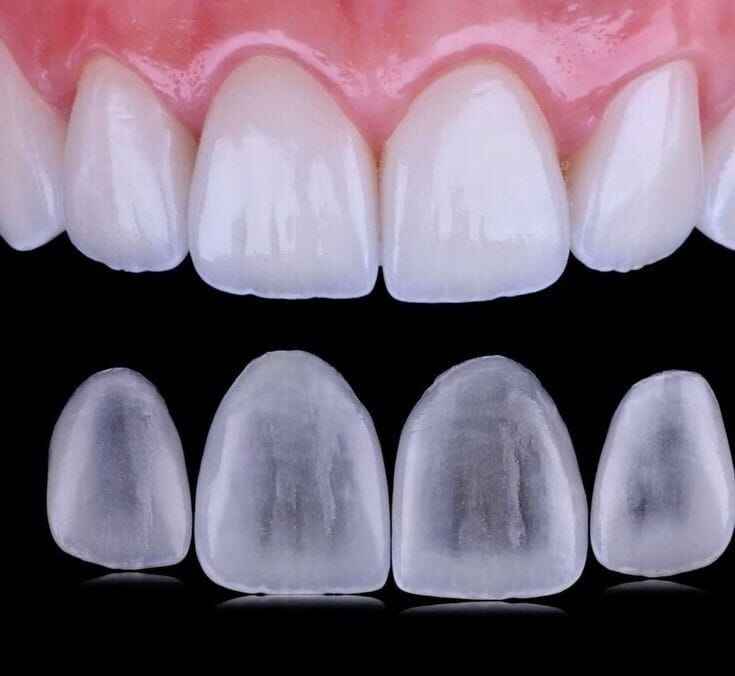
When an ultra-thin veneer is planned around the existing enamel rather than imposed over an unsuitable tooth, less ceramic can preserve the natural substrate, transmit more believable light, reduce aggressive preparation, and produce a restoration that belongs in the mouth instead of sitting visibly on top of it.
But is thinner always better?
No.
That claim sells cases, but it does not survive serious examination. An ultra-thin porcelain veneer has less space to hide a dark stump, correct a facially positioned tooth, rebuild substantial volume, or compensate for a vague laboratory prescription. Every tenth of a millimetre removed from the ceramic also removes part of the technician’s margin for error.
My position is blunt: ultra-thin veneers should be the result of favorable case conditions, not the starting promise of a cosmetic treatment plan.
Thin Ceramic Is Not the Same as Conservative Dentistry
The term “ultra-thin veneers” generally describes ceramic laminates fabricated at approximately 0.2 to 0.5 mm in selected areas. Some minimally invasive veneers involve slight enamel modification, while true no-prep veneers are bonded without intentional tooth reduction. Published reviews have described approximately 0.2 to 0.3 mm as a workable lower range for selected ceramic veneer applications, but that number is not a universal preparation target. atters.
A restoration can require no drilling and still be biologically or esthetically aggressive. Adding 0.3 mm of ceramic to a tooth that is already facially prominent may create excessive convexity, thick cervical contours, compressed papillae, visible margins, or an artificial “stuck-on” appearance.
A 2018 clinical protocol for no-prep ultrathin ceramic veneers specifically focused on margin placement near the tooth’s maximum convexity to reduce the overcontouring associated with poorly planned no-prep restorations. That is not a minor technical detail. It is an admission that additive treatment can create its own damage when contour is ignored.
I ask:
Is the tooth positioned far enough lingually to accept added ceramic?
Is the existing enamel shade compatible with the target shade?
Does the cervical contour have room for an additive restoration?
Can the final margins remain cleansable and visually controlled?
Will the restoration bond mainly to enamel?
Does the occlusion permit a thin ceramic design?
Is the requested shape change small enough to achieve without overbuilding?
When those answers are favorable, enamel preservation in veneer preparation can support both adhesive performance and natural optical integration. When they are not, “no-prep” becomes a marketing label covering a poor indication. c Can Produce More Natural-Looking Veneers
Natural enamel is not opaque paint.
It transmits, reflects, refracts, and scatters light over the dentin beneath it. The final appearance changes with enamel thickness, surface texture, hydration, viewing angle, underlying tooth value, incisal anatomy, and the darkness of the oral cavity behind the edge.
Ultra-thin ceramic can preserve more of that existing optical system.
Instead of forcing the restoration to manufacture the entire color internally, a thin ceramic veneer can allow a favorable enamel substrate to participate in the final result. The ceramic, resin cement, and natural tooth then behave as one optical stack.
That is the advantage.
And the risk.
A thin ceramic veneer does not merely show its own shade. It reveals what lies beneath it. Stump color, resin-cement value, ceramic translucency, ceramic thickness, try-in paste accuracy, dehydration, and polymerization behavior can all influence the final appearance.
This is why a shade instruction such as “BL2” or “A1” is not enough. The laboratory also needs stump-shade photographs, calibrated images, intended ceramic thickness, target value, translucency zones, incisal design, and the degree of color change expected.
Artist Dental Lab’s guide to value control in veneer esthetics makes the same practical point: hue and chroma matter, but a value error is often what makes a veneer look immediately false. ack beneath an ultra-thin veneer
The visible result is influenced by four interacting layers:
The tooth substrate: enamel thickness, exposed dentin, restorations, stains, and stump value.
The resin cement: transparent, neutral, warm, bright, or opaque formulations can shift the result.
The ceramic body: feldspathic porcelain, lithium disilicate, and zirconia do not transmit light identically.
The external surface: texture and gloss control where light reflects and how wide or flat the tooth appears.
Ignore one layer and the others cannot always rescue the case.
A randomized clinical study placed 0.3-mm ceramic veneers on unprepared premolars in 10 participants and monitored color with a spectrophotometer for 24 months. The trial demonstrated that extremely thin restorations can be clinically studied and color-monitored, but its small sample also shows why broad lifetime promises should not be built from one short trial. The study is available through PubMed’s record on 0.3-mm ceramic laminate veneers. Thickness: What Each Extra Tenth of a Millimetre Changes
Ceramic thickness is not just a strength number.
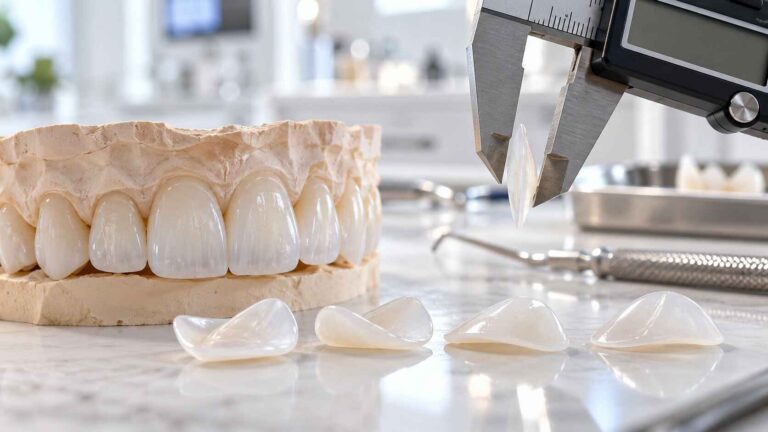
It changes translucency, masking, contour, preparation requirements, cement influence, laboratory handling, and the amount of internal characterization a technician can build.
The following ranges are practical planning zones rather than fixed prescriptions. Final dimensions must come from the treating clinician’s preparation design, material instructions, manufacturer guidance, and laboratory assessment.
Approximate facial thickness
Likely optical behavior
Typical opportunity
Main limitation
0.2–0.3 mm
Very high substrate influence
Minor additive contouring on favorable enamel
Weak masking and little room for correction
0.3–0.5 mm
Controlled translucency with some characterization space
Selected minimally invasive veneers
Stump shade and cement remain highly influential
0.5–0.7 mm
Greater masking and contour control
Moderate color or form correction
More reduction may be needed to avoid bulk
Around 0.8 mm or more
Stronger masking potential
Severe discoloration or larger shape changes
Treatment may no longer qualify as ultra-thin
Laboratory research published through PubMed Central found that approximately 0.8 mm of multilayer IPS e.max Press ceramic was required to mask severe discoloration under the tested conditions. That does not mean every dark tooth requires exactly 0.8 mm, but it destroys the fantasy that a 0.2-mm veneer can reliably hide any substrate merely by selecting a brighter cement. Read the PMC study on minimum ceramic thickness for masking severe discoloration. reported that increasing veneer thickness reduced translucency and improved masking ability. Its practical warning was especially relevant for restorations at 0.5 mm or thinner: the substrate, ceramic type, translucency, and luting material need to be considered together. The abstract is indexed in PubMed’s thickness and masking study. ruth: cement is a fine-adjustment tool, not a substitute for sufficient ceramic thickness.
Trying to convert a heavily discolored stump into a high-value result with an ultra-thin translucent veneer and an opaque cement frequently produces flatness, excessive brightness, or a restoration that looks acceptable under one light and gray under another.
Feldspathic, Lithium Disilicate, or Zirconia?
There is no single best ceramic for ultra-thin veneers.
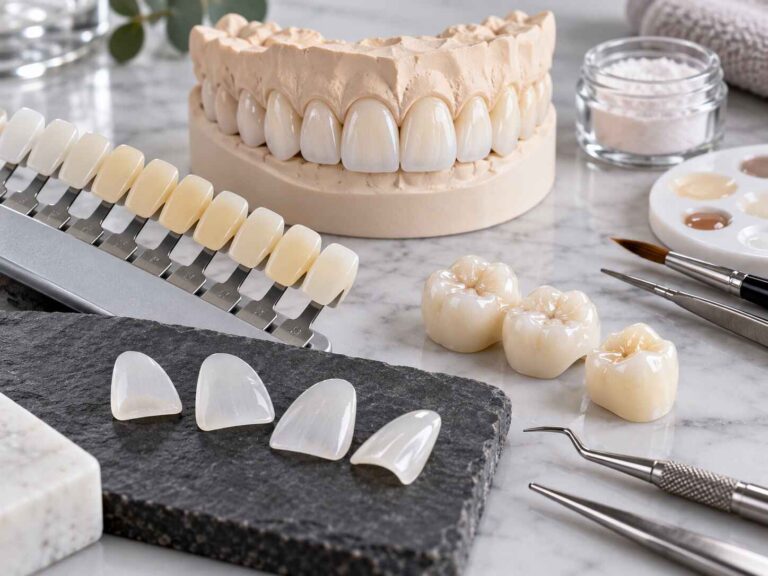
The right material depends on the available enamel, required masking, planned thickness, preparation geometry, functional load, desired internal effects, and the laboratory’s manufacturing method.
Feldspathic porcelain: maximum optical freedom
Feldspathic porcelain is a highly glassy ceramic system associated with silica-based compounds such as SiO₂, Al₂O₃, K₂O, and Na₂O. Its low crystalline content can support delicate layering, localized translucency, halo effects, mamelon characterization, and enamel-like surface detail.
For a favorable, enamel-rich substrate with a limited color change, a hand-layered feldspathic veneer can be an outstanding choice. It gives the ceramist room to create controlled irregularity rather than factory-perfect uniformity. rcelain is not an invisibility cloak.
If the stump is dark, the tooth is facially positioned, the incisal design is unsupported, or the patient has significant parafunctional risk, the most beautiful ceramic powder in the laboratory cannot erase the indication problem.
Lithium disilicate: the balanced option
Lithium disilicate glass-ceramic, commonly represented chemically as Li₂Si₂O₅, generally offers more mechanical tolerance than traditional feldspathic porcelain while retaining useful translucency and adhesive capability.
An E.max veneer is often the more controlled choice when the case requires a balance of natural esthetics, repeatable fabrication, moderate masking, and multi-unit consistency. It may be pressed or milled, then stained, glazed, cut back, or layered according to the prescription. ilicate does not make thickness irrelevant. A highly translucent ingot at 0.3 mm over a dark preparation remains a highly translucent ingot at 0.3 mm over a dark preparation.
Material branding cannot repeal optics.
Ultra-thin zirconia: promising, but the evidence is younger
A 2025 two-year clinical study of no-prep Prettau Skin zirconia veneers reported favorable short-term esthetic, mechanical, and biological outcomes, while the authors also stated that longer studies and comparisons with conventional techniques remain necessary. The study can be reviewed through PubMed Central’s two-year zirconia veneer report. sible evidence should be read.
Two years is encouraging. It is not 10 years.
I would not present a newer ultra-thin zirconia protocol as clinically equivalent to every well-documented glass-ceramic approach merely because both can be fabricated thinly.
What the Survival Data Actually Says
The survival figures for ceramic veneers are good.
They are also regularly abused.
A 2025 systematic review and meta-analysis reported long-term survival estimates of 96.13% for feldspathic veneers, 93.7% for leucite-reinforced glass ceramic, and 96.81% for lithium disilicate veneers across the included evidence. Lithium disilicate also showed a lower pooled complication rate than the other ceramic groups in that review. See the 2025 PubMed meta-analysis of ceramic partial restorations and veneers. review estimated a 95.5% cumulative survival rate at 10 years for porcelain laminate veneers. Fracture was the most common complication, followed by debonding, and both occurred more frequently during the earlier years after cementation. The data are available in the 10-year porcelain laminate veneer review. ut survival is not the same as perfect esthetics, zero maintenance, or a universal indication. A veneer can remain attached while showing marginal staining, contour dissatisfaction, gingival recession, surface wear, shade mismatch, or patient disappointment.
Bonding substrate also changes the picture. A 2024 systematic review found pooled survival and success rates near 99% for enamel-bonded veneers, with reported ranges of 98% to 100% in the included studies. That finding supports enamel preservation, but it should not be converted into a promise that every thin veneer bonded partly to enamel will achieve 99% survival. Review the PubMed meta-analysis on veneer bonding substrates. eers have their own warnings.
A clinical study involving 49 patients and 194 ultrathin veneers reported fractures in 19 restorations, representing a total fracture occurrence of 9.8%. Thirteen of those fractures occurred during the first 12 months after bonding. The study included prepared, minimally prepared, and no-prep restorations, but the groups were highly uneven, so simplistic comparisons between preparation types would be misleading. Read the PubMed clinical cohort of 194 ultrathin ceramic veneers. e pattern matters.
It suggests that some failures are not slow material aging. They may reflect case selection, occlusion, design, ceramic support, handling, bonding, or immediate functional overload.
Where Ultra-Thin Porcelain Veneers Make Sense
Ultra-thin porcelain veneers are most persuasive when the treatment is additive, enamel-rich, and optically favorable.
Minor shape correction
Small lateral incisors, narrow teeth, mild asymmetry, minor incisal wear, and limited black-triangle management may permit ceramic addition without excessive facial bulk.
Favorable tooth position
Lingually positioned or slightly undercontoured teeth provide physical space for ceramic. Facially prominent teeth usually do not.
Limited shade change
A bright, relatively uniform substrate can support thin translucent ceramics. A dark stump, metal post, deep tetracycline band, or heavily restored tooth may demand more masking than an ultra-thin design can provide.
High enamel availability
Bonding primarily to enamel is supported by strong clinical evidence and allows a more predictable adhesive interface than extensive dentin exposure. ctional risk
Thin ceramic needs intelligent occlusal design. Edge-to-edge relationships, deep overbite, bruxism, protrusive interference, and unsupported incisal extension require greater caution.
A patient who wants natural integration
The best natural-looking veneers are rarely the whitest or most symmetrical restorations possible. They preserve controlled differences in line angles, translucency, incisal form, surface texture, and value.
The same logic applies to surface texture in veneers: texture should reproduce a believable pattern of development, wear, expression, and gloss rather than covering every tooth with identical grooves. Becomes the Wrong Promise
I become skeptical as soon as “no-prep veneers” are sold before tooth position and substrate shade have been evaluated.
The concept is backwards.
No-prep treatment is appropriate only after diagnosis shows that no intentional reduction is necessary. It should not be a package selected from a menu before the smile design, wax-up, mock-up, periodontal assessment, and occlusal review are complete.
Warning signs include:
Facially inclined or rotated teeth
Dark substrates requiring substantial masking
Existing cervical restorations
Bulky natural emergence profiles
Limited interproximal space
Large requested width changes
Deep overbite or edge-to-edge function
Insufficient enamel at planned margins
A demand for extreme shade change
Inadequate photographic or stump-shade records
Sometimes 0.2 mm of selective enamel modification is more conservative than adding 0.4 mm of ceramic over an already prominent contour.
That statement irritates no-prep marketing teams. It remains true.
The Laboratory Workflow That Protects Thin Ceramic
Ultra-thin veneers tolerate less guessing.
When the restoration is only a few tenths of a millimetre thick, a small error in the preparation scan, margin identification, stump shade, cement plan, or contour target can represent a large percentage of the total restoration thickness.
Records the laboratory should receive
A serious ultra-thin veneer case should include:
Preoperative and prepared digital scans
Opposing arch and verified bite
Full-face repose and natural-smile photographs
Retracted frontal and lateral photographs
Polarized shade photographs when available
Individual stump shades
Approved wax-up or mock-up
Planned resin-cement strategy
Required minimum and maximum ceramic thickness
Occlusal and parafunctional risk notes
Surface texture and gloss references
Incisal translucency instructions
Do not prescribe “natural translucency” without defining it.
Artist Dental Lab’s guide on incisal translucency in veneer design recommends communicating the size and pattern of the translucent zone, stump shade, ceramic thickness, reference photography, halo intensity, mamelon expression, oral-background exposure, and intended age character. That is a usable prescription. “Make it natural” is not. ould decide the preparation
A diagnostic wax-up and intraoral mock-up allow the clinician to examine the proposed facial volume before irreversible preparation.
If the mock-up looks bulky without preparation, the final no-prep veneers will not magically look thinner after they are made in ceramic.
The mock-up can help identify:
Areas that remain fully additive
Areas needing selective enamel reduction
Incisal edge-position changes
Cervical emergence problems
Phonetic effects
Lip support
Width-to-length changes
Patient acceptance before final fabrication
This is where minimally invasive veneers separate themselves from minimally planned veneers.
FAQs
What are ultra-thin veneers?
Ultra-thin veneers are bonded ceramic restorations generally designed around approximately 0.2 to 0.5 mm of facial thickness, although the final thickness must be determined by tooth position, enamel volume, substrate color, margin design, occlusion, and the amount of shape or shade correction required.
They may be made from feldspathic porcelain, lithium disilicate, or selected zirconia systems. Some are placed without preparation, while others require small, selective enamel adjustments to create space, define margins, or prevent overcontouring.
How thin can porcelain veneers be?
Porcelain veneers can be fabricated at approximately 0.2 to 0.3 mm in carefully selected regions and cases, but the thinnest technically possible restoration is not automatically the safest or most natural because masking requirements, ceramic support, margin geometry, tooth position, laboratory handling, and functional loading may demand greater thickness.
At 0.5 mm or below, the underlying tooth and resin cement can strongly influence the final color. Severe discoloration may require substantially more ceramic thickness or a different restorative strategy. neers the same as minimally invasive veneers?
No-prep veneers are ceramic restorations bonded without intentional tooth reduction, whereas minimally invasive veneers may involve small, selective enamel adjustments; both approaches aim to preserve tooth structure, but they are conservative only when the resulting contour, margins, emergence profile, substrate masking, adhesive interface, and occlusion remain biologically and esthetically acceptable.
A selective 0.2-mm adjustment can sometimes prevent a much larger additive contour. Treatment names matter less than the final biological and mechanical result.
Do ultra-thin porcelain veneers look more natural?
Ultra-thin porcelain veneers can look more natural when a favorable enamel substrate contributes to the final color, depth, fluorescence, and light transmission, but thinness alone cannot create realism without accurate value control, restrained contour, individualized line angles, suitable surface texture, controlled gloss, appropriate incisal translucency, and a compatible resin-cement system.
A thick veneer can look natural when properly designed. A 0.3-mm veneer can look artificial when it is overcontoured, too bright, uniformly textured, or unable to mask the substrate.
What is the best ceramic for ultra-thin veneers?
The best ceramic for ultra-thin veneers is the material that meets the case’s required thickness, enamel availability, substrate shade, masking demand, preparation geometry, functional risk, fabrication method, and esthetic target; feldspathic porcelain favors individualized optical layering, while lithium disilicate generally offers a broader balance between strength, translucency, and production consistency.
Selected zirconia systems may be appropriate for specific indications, but their ultrathin clinical evidence is newer than the evidence supporting established glass-ceramic veneers. veneers hide dark or discolored teeth?
Ultra-thin veneers have limited ability to hide dark or severely discolored teeth because reducing ceramic thickness increases substrate influence, meaning that stump shade, ceramic opacity, resin-cement color, value target, and available preparation space must be assessed together before promising a bright or uniform final result.
Laboratory evidence has shown that approximately 0.8 mm of multilayer ceramic was needed to mask severe discoloration under specific test conditions. Opaque cement may help fine-tune the result, but it cannot reliably replace missing ceramic space. tra-thin veneers last?
Ultra-thin veneers can provide durable service when bonded predominantly to enamel, fabricated with sufficient ceramic support, protected from destructive occlusal forces, and maintained appropriately, but their longevity varies with preparation design, material, substrate, cementation, parafunction, operator technique, laboratory execution, and whether the original case was suitable for an additive restoration.
Broader porcelain veneer reviews report survival near 95% to 96% at 10 years or over long-term pooled observation, while individual ultrathin cohorts have documented early fractures that deserve serious attention. Around the Tooth, Not the Word “Ultra-Thin”
Less ceramic can create more natural esthetics.
But only when the tooth has already earned the right conditions.
Start with tooth position, enamel volume, stump shade, gingival architecture, functional risk, and the approved mock-up. Then decide how much preparation is genuinely needed. After that, select the ceramic and thickness that can deliver the required contour and optical correction without asking cement, glaze, or marketing language to hide a design error.
Do not prescribe a thickness because it sounds conservative.
Prescribe the result.
For an upcoming minimal-prep or no-prep anterior case, send Artist Dental Lab the preoperative scan, approved wax-up, stump shades, patient photographs, occlusal records, intended cement strategy, and required optical target. Request a technical case review before final preparation so ceramic thickness, material selection, masking requirements, and contour can be evaluated as one system.