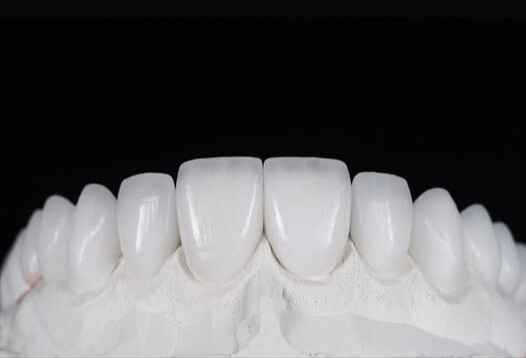
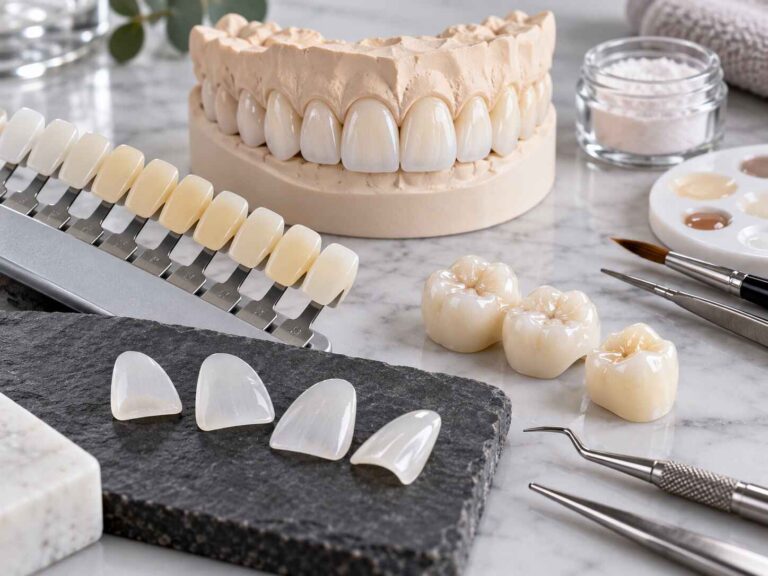
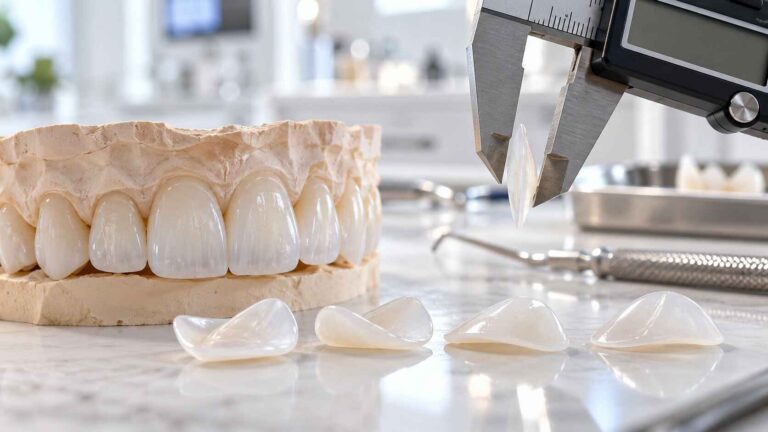
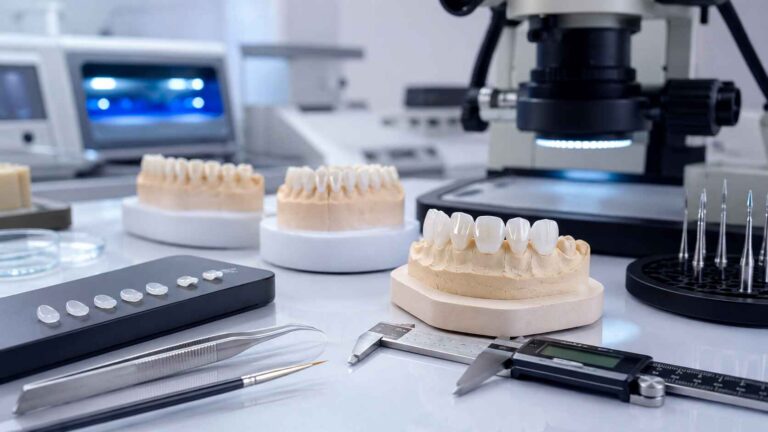
E.max vs Feldspathic Veneers for Ultra-Thin Esthetic Cases
Thin changes everything.
When ceramic thickness falls toward 0.3–0.5 mm, material selection stops being a simple argument about which veneer is stronger or more natural, because substrate color, cement shade, enamel support, margin design, firing control, and surface texture begin influencing the final result far more aggressively. So which material deserves the case?
My blunt answer is this: E.max is the safer default, but feldspathic porcelain can still be the better esthetic instrument.
That distinction matters.
For most ultra-thin porcelain veneers involving several teeth, moderate functional uncertainty, digital production, or a need for repeatable value, I lean toward lithium disilicate. For a tightly controlled anterior case with abundant enamel, mild substrate discoloration, low functional risk, and a genuinely skilled ceramist, feldspathic porcelain may produce optical behavior that monolithic ceramics struggle to imitate.
The material name does not make the result premium. Case selection does.
E.max vs Feldspathic Veneers Is Really a Risk-Allocation Decision
The usual sales pitch is painfully simple: E.max is strong; feldspathic is beautiful.
That is not completely wrong. It is just incomplete enough to cause expensive mistakes.
An E.max veneer is made from lithium disilicate glass-ceramic, commonly expressed chemically as Li₂Si₂O₅. Depending on the selected system, it can be milled from a partially crystallized CAD/CAM block or pressed in a laboratory, then finished through staining, glazing, cut-back, or ceramic layering.
A feldspathic veneer is typically built by hand from feldspathic porcelain powders. The ceramist controls dentin, enamel, translucency, halo, internal effects, value, and surface texture through multiple powder applications and firing cycles.
One is structurally standardized. The other is artistically granular.
But neither is automatically better.
I see E.max as a controlled engineering platform: the laboratory starts with an industrially manufactured ceramic body and modifies it. Feldspathic porcelain is closer to freehand optical construction: the laboratory creates the restoration layer by layer, with more freedom and more opportunity for human variation.
That freedom can produce brilliance. It can also produce a remake.
Artist Dental Lab’s own product structure reflects this division: its E.max workflow emphasizes strength, fit, shade consistency, and conservative anterior use, while its feldspathic option emphasizes minimal-prep cases, custom translucency, microtexture, and delicate incisal characterization.
What “Ultra-Thin” Actually Means in Ceramic Veneers
“Ultra-thin” is often used as a marketing term when it should be a design specification.
A veneer measuring 0.3 mm at one facial location may still be 0.6 mm near a transition, 0.8 mm at an additive contact, or considerably thicker where length, contour, or discoloration correction demands more ceramic. Average thickness tells us less than the thickness map.
For current IPS e.max CAD, Ivoclar lists veneers at 0.4 mm or greater, while other E.max system indications include thin pressed veneers around 0.3 mm. The same manufacturer reports a mean biaxial flexural strength of 530 MPa for crystallized IPS e.max CAD, alongside fracture toughness of 2.11 MPa·m¹ᐟ². Those figures describe controlled material testing, not the guaranteed fracture resistance of a bonded veneer inside a patient’s mouth.
That last point is regularly ignored.
A 530 MPa ceramic can still fail after poor preparation, unsupported margins, internal adjustment damage, contamination, inadequate bonding, or unmanaged parafunction. Meanwhile, a mechanically weaker feldspathic veneer can perform well when it remains predominantly bonded to enamel and operates under a favorable occlusal scheme.
Strength is not immunity.
Thickness Changes Color Before It Changes the Brochure
At 0.3–0.5 mm, the restoration is optically dependent on everything underneath it:
The prepared tooth or existing enamel
The stump shade
The selected ceramic translucency
The resin cement shade
The thickness distribution
Surface texture and final gloss
Ambient and operatory lighting
A 2017 laboratory study compared 0.3 mm and 0.5 mm CAD/CAM veneers made from lithium disilicate and leucite glass-ceramic. The investigators found that cement color and ceramic thickness produced detectable color differences, while 0.3 mm lithium disilicate veneers recorded failure loads comparable to the tested 0.5 mm groups. The authors concluded that 0.3 mm lithium disilicate could be a potential clinical option, but it remained an in-vitro study using controlled specimens rather than living patients. Read the indexed study on PubMed.
What does that tell us?
Ultra-thin E.max can be mechanically credible. It does not tell us that every 0.3 mm veneer should be milled, nor does it eliminate the visual influence of the underlying tooth.
The Material Comparison That Actually Helps With Case Selection
Decision Factor
E.max / Lithium Disilicate
Feldspathic Porcelain
Basic structure
Lithium disilicate glass-ceramic, usually milled or pressed
Silica-rich porcelain built through hand layering
Typical strength position
Higher intrinsic material strength
Lower intrinsic material strength
Ultra-thin capability
System-dependent; approximately 0.3–0.4 mm minimum indications exist
Can be built extremely conservatively in suitable hand-layered cases
Optical control
Strong, but influenced by ingot/block translucency and available space
Exceptional layer-by-layer control of translucency, halo, warmth, and fluorescence
Multi-unit consistency
Usually easier to standardize
More dependent on one ceramist’s firing and layering discipline
Dark-substrate masking
Better options through opacity and controlled ceramic selection
Difficult when very thin unless sufficient masking space is available
Enamel dependence
Preferable, especially for thin adhesive veneers
Very strongly dependent on favorable enamel bonding
Functional tolerance
More forgiving when load conditions are not perfectly calm
Less forgiving of bruxism, edge-to-edge loading, and unsupported extension
Elite anterior cases with favorable enamel and demanding optical integration
Main hidden risk
Assuming strength can compensate for bad design
Assuming artistry can compensate for weak case selection
The hard truth is that many clinics choose feldspathic because it sounds exclusive, while others choose E.max because the strength number feels defensible.
Both shortcuts are lazy.
Where E.max Wins in Ultra-Thin Esthetic Cases
E.max Gives the Team More Mechanical Breathing Room
Current IPS e.max CAD data cite 530 MPa mean biaxial flexural strength after crystallization, four translucency categories, and an official veneer indication beginning at 0.4 mm. Pressed E.max products are commonly documented around 400 MPa, depending on the product and testing method.
Does that mean E.max is four or five times more likely to survive than feldspathic porcelain?
No.
Material strength tests and clinical survival are not interchangeable. The bonded tooth-restoration complex includes enamel, dentin, adhesive, resin cement, preparation geometry, ceramic defects, occlusion, and patient behavior. A laboratory MPa number cannot summarize that system.
But stronger ceramic does provide useful reserve during fabrication, try-in, seating, finishing, and function. This becomes valuable when the case includes:
Incisal overlap or added length
Multiple units requiring stable cross-arch value
Moderate discoloration
Inconsistent preparation depth
Limited enamel exposure
Uncertain functional loading
A clinic seeking repeatable digital production
In those conditions, the full E.max versus layered E.max comparison also becomes relevant. Monolithic E.max generally reduces variables, while layered E.max introduces additional optical control at the cost of more technique sensitivity.
E.max Is Better When Consistency Matters More Than Individual Drama
A single central incisor allows the ceramist to obsess over one restoration.
An eight-unit case is different.
Across teeth 6–11 or 13–23, tiny variations in ceramic thickness, firing shrinkage, value, incisal translucency, contour, and glaze become visible as a group. A controlled lithium disilicate workflow can reduce that variation, particularly when the design is digitally approved and the laboratory works from a complete photo and scan package.
That does not make E.max lifelike by default.
The final appearance still depends on facial contour, transitional line angles, lobe development, incisal edge position, and texture. Artist Dental Lab’s guide to transitional line angles in veneers explains why two veneers with the same measured width can look dramatically different once reflected-light zones change.
Geometry often beats material mythology.
Where Feldspathic Veneers Still Win
Feldspathic Offers More Optical Decisions Per Fraction of a Millimeter
This is the part E.max advocates sometimes refuse to admit.
When space is severely limited, a master ceramist can use feldspathic powders to place localized opacity, translucency, warmth, mamelon effects, halo, and enamel character exactly where they are needed. The restoration is not merely selected from a block translucency category. It is optically constructed.
That can matter in:
Single-tooth or small anterior cases
Young enamel with visible opalescence
High-smile-line patients
Minimal-prep additions
Diastema closure with favorable function
Mild shape correction
Cases requiring subtle asymmetry rather than factory symmetry
The advantage is not simply “more translucency.” Excess translucency can make a veneer gray, low-value, or unable to hide the substrate.
The real advantage is selective translucency.
A skilled ceramist can control where light enters, where it scatters, where warmth appears, and where the incisal edge becomes more transparent. That is a more precise claim than saying feldspathic porcelain always looks more natural.
Surface Detail Can Be Built Instead of Painted
Natural enamel is not flat.
It may show restrained perikymata, developmental grooves, age-related wear, craze lines, vertical lobe evidence, and irregular gloss. Feldspathic layering gives the ceramist extensive freedom to integrate these effects into contour and surface development rather than relying only on stain.
But restraint matters.
As the article on perikymata in ceramic veneers argues, texture should interrupt an artificial reflection without turning the facial surface into a decorative pattern. Too much texture traps light, lowers apparent value, complicates polishing, and can make a young restoration look old.
Feldspathic offers more control. It also demands better taste.
The Long-Term Data Ruins the Easy Sales Pitch
Here is where the argument gets interesting.
A systematic review and meta-analysis published in 2025 evaluated 29 studies on feldspathic, leucite-reinforced, lithium disilicate, and zirconia laminate veneers. At a mean follow-up of 10.4 years, pooled survival was reported as:
96.13% for feldspathic porcelain
93.70% for leucite-reinforced glass-ceramic
96.81% for lithium disilicate
The researchers found no statistically significant survival difference among the three established ceramic groups. However, the reported pooled technical, esthetic, and biological complication figures were lower for lithium disilicate than for feldspathic porcelain, although heterogeneity and inconsistent event definitions limit simple one-to-one interpretation. Review the full meta-analysis.
Read that again.
The strongest headline is not “E.max wins.” It is that both materials can survive well when correctly indicated, while lithium disilicate may produce a lower-complication workflow across broader clinical conditions.
An earlier systematic review estimated approximately 95.7% five-year survival for feldspathic veneers and suggested that ten-year survival could approach 95% when restorations were bonded predominantly to enamel. The authors also warned about substantial clinical heterogeneity.
So feldspathic is not obsolete.
It is selective.
Short-Term Ultra-Thin Success Is Encouraging, Not Conclusive
A 2024 clinical study evaluating ultra-thin lithium disilicate veneers bonded to nonprepared teeth reported 100% clinical success during its stated follow-up period. That is encouraging evidence for conservative lithium disilicate treatment, but a small or short-term clinical result should never be converted into a lifetime promise. Read the clinical report through PubMed Central.
This is where marketing language usually becomes dishonest.
“100% success” sounds absolute. In research, it means no recorded failures within one defined sample and observation period. It does not mean the material cannot fail after longer service, under different occlusion, or in a less controlled workflow.
Enamel Preservation Matters More Than the Ceramic Brand
I would rather bond a thoughtfully designed feldspathic veneer to healthy enamel than force a high-strength E.max veneer onto a heavily reduced, poorly isolated preparation.
That may be controversial. It should not be.
Adhesive ceramic veneers gain much of their performance from the bonded complex. Enamel provides a predictable substrate for phosphoric-acid etching and adhesive resin bonding. As preparations extend into dentin, bonding becomes more technique-sensitive, moisture control becomes less forgiving, and the restoration may depend more heavily on the material’s own mechanical behavior.
This changes the material decision:
Favor E.max when:
Dentin exposure is unavoidable
Added incisal length increases leverage
The patient has moderate functional risk
The prep thickness varies significantly
The substrate needs controlled masking
The case contains six, eight, or ten units
The workflow requires digital reproducibility
Favor feldspathic when:
Most or all bonding remains in enamel
Tooth movement and preparation are minimal
The substrate shade is already favorable
The case has low functional risk
Optical integration is the dominant objective
A highly experienced ceramist controls the case
The clinic provides excellent photographs and shade mapping
This is not a rigid rulebook. It is a risk map.
Dark Stumps Expose the Weakness of Ultra-Thin Thinking
But thin ceramic also transmits more information from the substrate. That becomes a serious issue with tetracycline staining, metal posts, dark endodontically treated teeth, deep discoloration, or nonuniform preparations.
Feldspathic porcelain can provide localized masking, but there is a physical limit to how much darkness can be blocked without enough ceramic thickness. Push opacity too far and the restoration may become flat, high-value, or lifeless.
E.max offers more standardized translucency and opacity choices. Ivoclar currently lists HT, MT, LT, MO, and Impulse options within the IPS e.max CAD family, with different indications for optical integration, brightness control, discolored preparations, and opalescent veneer effects.
Still, no block code fixes an impossible thickness prescription.
When the substrate is very dark, the honest answer may be greater reduction, a different restorative design, internal bleaching, a more opaque material, or a crown rather than a veneer. Calling every case “minimal-prep” is not conservative when it creates a gray restoration that must be removed and remade.
The Records the Laboratory Needs Before Choosing a Material
Material selection should not begin with “E.max or feldspathic?”
It should begin with evidence.
For a serious ultra-thin esthetic case, the laboratory should receive:
Full-face smile and repose photographs
Retracted frontal and lateral views
Cross-polarized shade images when available
Tooth shade and stump shade
Preparation scans
Opposing-arch scan
Verified bite record
Approved diagnostic design or provisional
Requested tooth length and width
Midline and incisal-plane instructions
Occlusal and parafunctional history
Intended cement shade
Surface-texture reference
Final value and translucency target
Artist Dental Lab requests STL or intraoral scans, opposing and bite records, shade and stump-shade information, smile photographs, margin notes, and defined esthetic goals for both its lithium disilicate and feldspathic workflows.
Without those records, the material discussion is mostly theater.
My Verdict: Which Is the Best Veneer Material for Thin Veneers?
For the average ultra-thin esthetic case, E.max is the more defensible default.
It gives the laboratory higher intrinsic strength, greater production consistency, multiple translucency choices, CAD/CAM compatibility, and more tolerance when the clinical conditions are not perfect. It is especially persuasive for multi-unit cases, moderate discoloration, added incisal length, and uncertain functional load.
But feldspathic porcelain remains my preferred answer for a narrower class of case: enamel-dominant, low-risk, highly visible anterior restorations where subtle light behavior matters more than workflow standardization.
That is the distinction most comparison articles avoid.
E.max wins the wider indication range.
Feldspathic wins selected optical contests.
And in both cases, poor preparation, weak bonding, inadequate records, or careless contouring can erase the material advantage before the restoration is even cemented.
FAQs
Are E.max or feldspathic veneers better for ultra-thin cases?
E.max veneers are generally the safer choice for ultra-thin cases requiring mechanical reserve, repeatable fabrication, multi-unit consistency, or moderate masking, while feldspathic veneers may be better for enamel-dominant anterior cases where highly customized translucency, internal effects, and surface detail are the main objectives.
The answer therefore depends on the tooth substrate, preparation depth, functional load, discoloration, number of units, and the ceramist’s experience. There is no universally superior material.
What is the minimum E.max veneer thickness?
The minimum E.max veneer thickness depends on the specific product, fabrication method, preparation design, and manufacturer instructions, with current IPS e.max CAD guidance listing veneers at 0.4 mm or greater and some pressed E.max workflows supporting thin veneer indications around 0.3 mm.
These numbers should not be treated as automatic clinical targets. Margins, incisal extensions, internal adjustments, substrate color, bonding conditions, and localized contour additions may require greater thickness.
Do feldspathic veneers look more natural than E.max veneers?
Feldspathic veneers can look more natural when an expert ceramist uses hand layering to control localized opacity, translucency, fluorescence, warmth, halo, incisal effects, and surface texture within a favorable enamel-supported case, but feldspathic porcelain is not automatically more natural than a well-designed E.max restoration.
Poor feldspathic work can appear bulky, gray, overtextured, or inconsistent. Well-designed monolithic or layered E.max can look highly natural when thickness, value, contour, and substrate management are correct.
Which material is stronger: E.max or feldspathic porcelain?
E.max lithium disilicate is intrinsically stronger than conventional feldspathic porcelain, with current IPS e.max CAD documentation reporting 530 MPa mean biaxial flexural strength after crystallization, although laboratory strength figures do not directly predict the survival of a bonded veneer in a specific patient.
Clinical performance also depends on enamel preservation, preparation geometry, adhesive treatment, resin cement, occlusal load, ceramic handling, internal defects, and patient parafunction.
Are feldspathic veneers suitable for patients who grind their teeth?
Feldspathic veneers are generally a less forgiving choice for patients with active bruxism, edge-to-edge loading, heavy anterior guidance, or uncontrolled parafunction because the material has lower intrinsic strength and highly conservative designs may provide limited ceramic volume for resisting repeated stress.
Functional assessment, occlusal planning, material selection, preparation design, and protective appliance use should be decided by the treating clinician. E.max may provide more mechanical reserve, but it is not immune to bruxism-related failure.
Can ultra-thin veneers hide dark or tetracycline-stained teeth?
Ultra-thin veneers have limited masking capacity because reduced ceramic thickness allows the stump shade and cement color to influence the final restoration, meaning severe tetracycline staining, dark endodontic substrates, metal posts, or uneven discoloration may require additional thickness, controlled opacity, pretreatment, or another restorative design.
Feldspathic and E.max can both manage selected discoloration cases, but neither can violate optical physics. A no-prep promise should never take priority over a predictable final value.
How long do E.max and feldspathic veneers last?
E.max and feldspathic veneers can both achieve high long-term survival when correctly selected, adhesively bonded, and maintained, with a 2025 meta-analysis reporting pooled survival of 96.81% for lithium disilicate and 96.13% for feldspathic veneers at a mean follow-up of 10.4 years.
Those figures are population estimates, not guarantees. Individual longevity depends on enamel support, preparation, cementation, occlusion, hygiene, parafunction, trauma, and the definitions researchers use for survival and complications.
Send the Case Before Committing to the Ceramic
Do not prescribe “ultra-thin E.max” or “premium feldspathic” from the smile photograph alone.
Send the preparation scans, opposing arch, verified bite, stump shade, retracted photographs, full-face smile images, approved design, occlusal notes, and intended esthetic target for a laboratory review. Then choose the material that fits the biology, available space, substrate, function, and visual objective.
For a professional assessment of an upcoming anterior case, contact Artist Dental Lab and submit the complete case records before production begins.