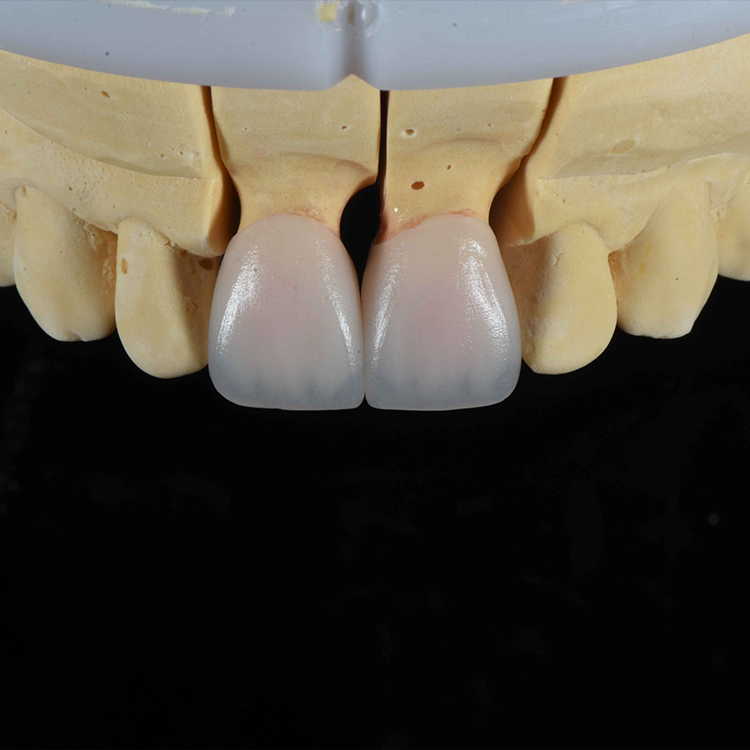
Single Veneer vs Multi-Unit Veneers: Why Matching Difficulty Changes
A single veneer sounds like the easy case.
One preparation. One restoration. One insertion.
Yet aesthetically, that one tooth may demand tighter control than six or eight veneers made together.
One tooth exposes.
When only one restoration sits between untreated natural teeth, every difference in value, translucency, cervical saturation, incisal character, fluorescence, surface texture, line angle, and gloss is judged against biological references that the laboratory cannot redesign to make the new veneer look more harmonious.
So why does adding more veneers sometimes make the color problem easier?
Because the task changes.
With a single tooth veneer, we are trying to imitate an existing tooth system. With multiple veneers, we are often creating a new controlled system.
That distinction matters more than the number of units.
Why a Single Veneer Has Almost No Place to Hide
The hardest part of a single veneer is not making attractive porcelain.
It is making porcelain disappear.
Take a maxillary central incisor. The contralateral central provides an unforgiving reference for width, value, incisal translucency, surface reflection, line angles, mamelon effects, cervical chroma, and overall visual weight.
The patient does not need a spectrophotometer to notice that one central looks brighter.
They just see it.
Research gives us a useful numerical reference. A multicenter study published in the Journal of Esthetic and Restorative Dentistry reported CIEDE2000 50:50 perceptibility and acceptability thresholds of approximately ΔE00 0.8 and 1.8, respectively. In practical terms, dental color differences can become visible at surprisingly small numerical deviations. See the original study, Color Difference Thresholds in Dentistry.
That does not mean every ΔE00 of 0.9 causes a remake.
It means our margin is small.
A Single Central Incisor Is Particularly Unforgiving
There is a reason the single central incisor veneer repeatedly appears in esthetic dentistry literature as a difficult restorative problem.
A published clinical report describing restoration of one traumatically discolored maxillary central incisor used a modified feldspathic porcelain veneer specifically to reproduce the neighboring natural tooth. The authors describe the situation as a challenging restorative problem, not a routine one-unit cosmetic case. See Restoration of a Single Darkened Central Incisor With a Modified Porcelain Veneer.
And here is the uncomfortable part.
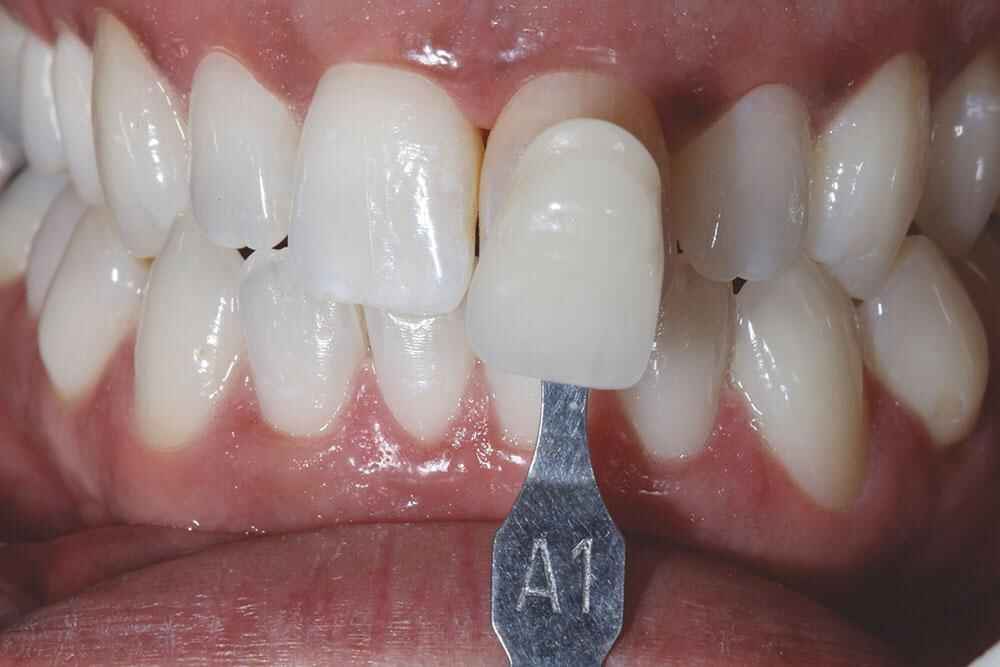
Calling both teeth “A1” does not solve it.
Shade tabs reduce a biological object into a label. A natural central incisor is not one uniform color from gingiva to incisal edge, nor does it reflect light identically across the facial surface.
That is why I would never treat porcelain veneer color matching as a shade-number exercise.
It is an optical reconstruction exercise.
Single Veneer vs Multiple Veneers: What Actually Changes?
The common assumption is simple:
More veneers = more difficult.
Mechanically, logistically, and functionally, that can certainly be true. More preparations create more margins, contacts, insertion considerations, symmetry decisions, occlusal relationships, and cementation steps.
But the matching problem changes in the opposite direction.
Variable
Single Veneer
Multi-Unit Veneers
Main esthetic target
Existing natural adjacent teeth
Harmony across a newly designed group
Shade freedom
Very low
Moderate to high
Value tolerance
Very low
Greater if units remain internally consistent
Incisal characterization
Must imitate a specific neighbor
Can be designed systematically
Surface texture
Must reproduce existing enamel behavior
Can be standardized across units
Stump shade influence
Can create an isolated mismatch
Can sometimes be managed across the planned set
Ceramic selection
Driven heavily by neighboring tooth optics
Driven by both optics and cross-unit consistency
Cement effect
One incorrect unit stands alone
Cement protocol can be standardized across units
Visual comparison
Immediate tooth-to-tooth comparison
Observer often evaluates the smile as a group
Laboratory objective
Make one restoration disappear
Make several restorations belong together
This is why single veneer vs multiple veneers should not be discussed only in terms of unit count.
A four- or six-unit case gives the ceramist something a single veneer does not: control over neighboring restorations.
That is powerful.
Suppose six anterior veneers are being fabricated together. The laboratory can coordinate value, translucency, line angles, lobe anatomy, incisal effects, glaze, texture, and reflective zones across all six.
Now compare that with tooth #8 being restored while #9 remains natural.
Tooth #9 does not negotiate.
The Optical Variables That Break Veneer Shade Matching
“Match the shade” is one of the weakest instructions we can send to a laboratory.
Shade is only one part of the appearance.
For more demanding cases, the lab prescription should communicate optical zones, stump shade, preparation depth, adjacent-tooth references, ceramic thickness, translucency expectations, surface form, and cement strategy. Artist Dental Lab’s guide to writing a veneer lab prescription for natural texture and light behavior expands on exactly those variables.
Value Usually Betrays the Restoration First
Clinicians often focus heavily on hue.
I would watch value first.
A veneer can be technically close in hue and still appear wrong because it is slightly too bright, slightly too opaque, or reflecting too broad a facial highlight.
The central incisors make this especially obvious.
Even morphology changes perceived value. A broad facial reflective zone can make a restoration appear brighter and wider, while changing the line angles can narrow that zone without changing the actual ceramic shade.
This is why Artist Dental Lab’s discussion of surface texture in veneers is relevant to shade matching rather than merely anatomy: surface geometry changes light reflection and therefore changes the way the observer reads brightness, width, depth, and age.
Translucency Can Help — or Ruin the Match
Natural-looking ceramic needs light transmission.
But “more translucent” is not automatically “more natural.”
Thin ceramic allows the underlying preparation to participate strongly in the final color. That may be helpful when the substrate is favorable.
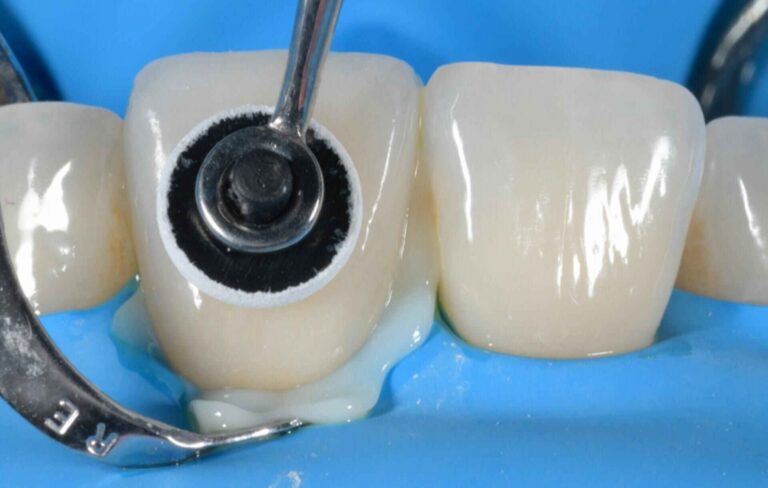
Put the same translucent veneer over a darkened preparation, old composite, endodontically treated tooth, or heavily exposed dentin and the optical equation changes.
Now the technician must decide how much underlying color to allow through and how much to mask.
Too much opacity?
The veneer becomes flat.
Too little?
The stump wins.
That is why material selection should follow the optical problem rather than a favorite ceramic brand. Artist Dental Lab’s comparison of E.max, zirconia, and feldspathic anterior veneers similarly separates the materials according to translucency, masking requirements, bonding conditions, and characterization potential.
Ceramic Thickness Is Part of the Color Formula
Thickness is not merely a strength measurement.
It changes optical behavior.
Research evaluating ceramic thickness and cement shade has repeatedly shown that the final appearance of ceramic veneer systems can be influenced by ceramic thickness together with the luting material underneath. One study specifically concluded that both ceramic thickness and cement shade influenced final color.
Think about what that means for a single tooth veneer.
The lab can fabricate the facial porcelain beautifully and still miss clinically if the real substrate, ceramic thickness, and planned cement are not represented during shade development.
That is not a ceramic failure.
It is an information failure.
Resin Cement Is Not Optically Invisible
Try-in paste and resin cement should not be treated as administrative details at the end of the case.
They are part of the optical stack.
An experimental study examining ceramic veneers found that resin cement shade could influence color and translucency. Other investigations have reached similar conclusions, particularly with thin and translucent ceramics.
The thinner the veneer and the more translucent the ceramic, the less sensible it becomes to pretend that only the ceramic shade matters.
Change one and the final visual result may change.
Why Multi-Unit Veneers Can Be Easier to Harmonize — Yet Harder to Execute
This needs a qualification.
I am not saying eight veneers are an easier dental case than one veneer.
They usually are not.
What I am saying is more specific:
Multi-unit cases can give the laboratory more control over optical harmony.
If teeth #6 through #11 are being restored together, the technician can create a coordinated system.
Central incisors can share related value.
Laterals can carry intentional variation.
Canines can increase cervical chroma.
Incisal translucency can transition naturally across the arch.
Surface texture can be related without being cloned.
The lab is designing relationships instead of copying one fixed natural target.
That changes everything.
There is another production advantage: several restorations can be processed through a coordinated material, firing, staining, glazing, polishing, and inspection strategy.
For that reason, full-contour and layered ceramics may have different strengths depending on whether the objective is cross-unit repeatability or maximum individual characterization. Artist Dental Lab discusses this tradeoff in Full E.max Veneers vs Layered E.max Veneers.
But more units introduce another risk.
Small errors repeat.
A slightly excessive value reproduced across eight veneers becomes an entire smile that looks too bright. Over-rounded line angles repeated across six units create a uniform manufactured appearance.
Consistency is only valuable when the original decision was correct.
The Hardest Case May Be One Veneer Inside an Existing Veneer Case
There is an even more difficult variation.
One veneer fractures several years after a multi-unit case was delivered.
Now the technician is not matching fresh natural enamel.
They are matching existing ceramic that has already been fired, bonded, exposed to oral conditions, maintained, polished, and visually integrated into the patient’s smile.
The new restoration has to enter an old system.
That means the relevant reference is not simply the original laboratory prescription.
The target is what exists today.
Artist Dental Lab’s detailed guide to replacing one veneer in a multi-unit case discusses this directly: value, chroma, translucency, fluorescence, texture, gloss, substrate, ceramic thickness, and cement conditions all become part of the replacement problem.
This is where I think the industry’s obsession with shade codes becomes especially unhelpful.
“Original case was BL2” is not enough information.
Neither is the old STL.
The lab needs the current visual target.
A More Defensible Workflow for Matching a Single Veneer
If the goal is how to match a single veneer to natural teeth, I would reduce guesswork before asking the technician to perform ceramic magic.
Record the adjacent tooth before dehydration. Take calibrated shade photographs early, because prolonged isolation and dehydration can alter the appearance of natural enamel.
Photograph multiple optical zones. Capture cervical, middle, and incisal regions rather than describing the entire tooth with one shade designation.
Include a recognized shade tab in the same image. The tab, tooth, and camera should be exposed under the same conditions.
Record stump shade after preparation. This becomes increasingly important when ceramic thickness is low or the substrate is discolored.
Send frontal, lateral, retracted, smile, and incisal images. Shape and light reflection cannot be reconstructed reliably from one frontal photograph.
Describe surface texture and gloss. A color-correct but over-glazed central incisor can still stand out immediately.
Tell the laboratory the planned cement strategy. Especially with thin translucent ceramics, the luting material belongs in the color conversation.
Use try-in evaluation as a diagnostic step. Examine value first, then chroma, translucency, incisal effects, texture, and overall integration before permanent bonding.
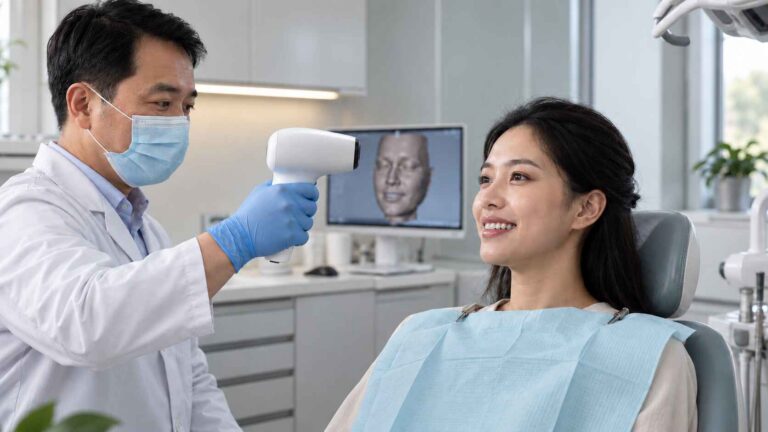
Technology can help, but I would not hand the entire decision to one device.
A 2024 study comparing instrumental and visual shade methods reported accuracy values of 97.50% for OptiShade, 89.38% for VITA Easyshade, and 62.19% for visual matching under that study’s conditions.
Yet other studies have produced different rankings between visual and instrumental techniques, which is exactly why no serious anterior workflow should depend on a single reading from a single instrument.
Use the device.
Use photography.
Use the shade tab.
Use the stump shade.
And use human judgment.
Material Choice Should Follow the Matching Problem
There is no universally best material for every single veneer.
That answer may disappoint anyone looking for a one-line buying recommendation, but it is the useful answer.
Feldspathic Porcelain
Feldspathic porcelain can offer substantial freedom for hand-layered characterization, delicate translucency, incisal effects, and surface texture.
That makes it attractive when the adjacent natural tooth has complex optical features that need to be reproduced individually.
Artist Dental Lab positions its feldspathic veneer specifically around hand layering, enamel-like translucency, complex shade blending, and detailed anterior characterization.
But freedom creates sensitivity.
A technician with more variables does not automatically create a better result.
Lithium Disilicate
An E.max veneer can provide a useful balance between strength, fit, translucency, and repeatable fabrication for single- and multi-unit situations.
The question is not whether lithium disilicate is “esthetic enough.”
The question is whether the selected translucency, thickness, characterization method, stump shade, and cement system can reproduce the target tooth.
Those are different questions.
The Material Cannot Rescue Missing Information
This is the part I would put in every veneer training course.
Do not ask ceramic to repair communication.
A world-class technician who receives one smartphone photograph, “A1,” and no stump shade is being asked to guess.
Sometimes the guess works.
That does not make the workflow good.
If you want to evaluate whether a laboratory really understands this level of control, do not judge only the whitest full-smile transformations. Look at single-unit and mixed-restoration cases. Artist Dental Lab’s guide on what veneer case photos reveal about a lab’s esthetic skill explains why close-up views, texture, value control, incisal behavior, and integration tell far more than a distant before-and-after image.
What Dentists Should Stop Asking the Laboratory
“Can you match A1?”
That question is too simple for the problem.
A stronger question is:
Can you reproduce the neighboring tooth’s value distribution, cervical chroma, body translucency, incisal effects, fluorescence, facial reflection, line angles, surface texture, and gloss while compensating for this specific stump shade and ceramic thickness?
Now we are describing a restoration.
And yes, that sounds demanding.
A single veneer should be demanding.
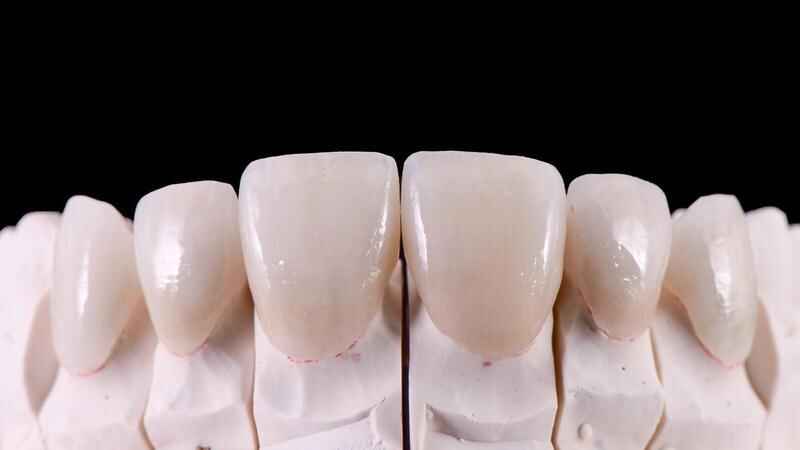
The success criterion is not that the restoration looks beautiful when held alone on a model.
It is that nobody notices which tooth was restored.
FAQs
What is a single veneer?
A single veneer is one thin ceramic or composite restoration placed on a single tooth to modify its color, contour, position, surface, or proportions while requiring the restoration to integrate visually with adjacent untreated teeth rather than relying on neighboring restorations to create a new shared esthetic system.
This is why a single tooth veneer can be more demanding optically than its unit count suggests.
Why is a single central incisor veneer so difficult to match?
A single central incisor veneer is difficult to match because the contralateral natural central incisor provides an immediate reference for value, chroma, hue, translucency, incisal anatomy, fluorescence, width, line angles, texture, and gloss, leaving very little visual tolerance for differences between ceramic and natural enamel.
Even small changes in facial reflection can make two otherwise similar central incisors look different.
Is matching one veneer harder than matching multiple veneers?
Matching one veneer can be harder than matching multiple veneers specifically from an optical standpoint because one restoration must imitate fixed natural neighbors, whereas several veneers fabricated together allow the laboratory to coordinate shade, translucency, texture, contours, line angles, and surface finish across the entire restored group.
Multi-unit cases can still be more demanding clinically because they involve more preparations, contacts, margins, functional relationships, and cementation steps.
How do you match a single veneer to natural teeth?
Matching a single veneer to natural teeth requires recording the neighboring tooth’s value, chroma, translucency, cervical and incisal characteristics, surface texture, stump shade, ceramic thickness, and planned cement while using standardized photography, shade references, clinical try-in, and detailed laboratory communication rather than relying on one shade-tab designation.
The more variables that are documented before fabrication, the fewer variables the ceramist has to estimate.
Does resin cement affect porcelain veneer color matching?
Resin cement can affect porcelain veneer color matching because light passes through many thin ceramic restorations and interacts with the luting layer and underlying tooth, meaning cement shade and opacity may change the restoration’s final value, chroma, translucency, or masking behavior, particularly when the ceramic is thin or highly translucent.
This is why cement strategy should be considered before final fabrication rather than only during bonding.
Which veneer material is best for a single tooth veneer?
The best veneer material for a single tooth is the ceramic system that can reproduce the neighboring tooth’s optical behavior while managing the existing substrate, available thickness, preparation design, functional load, bonding conditions, translucency requirements, surface texture, and degree of individual characterization needed for that specific clinical situation.
Feldspathic porcelain and lithium disilicate can both be appropriate; case conditions should decide which optical compromises are acceptable.
Why can a veneer have the correct shade but still look wrong?
A veneer can have the correct nominal shade but still look wrong because observers perceive much more than hue, including value, chroma distribution, translucency, fluorescence, opalescent incisal effects, surface texture, gloss, line angles, reflective width, ceramic thickness, substrate color, and cement interaction under different lighting conditions.
That is why successful dental veneer matching is better understood as optical integration than simple shade duplication.
Your Next Step: Send the Lab the Variables, Not Just a Shade
If you are planning a difficult single veneer, especially a maxillary central incisor, do not send the laboratory “A1” and hope artistry fills in the missing information.
Send the case.
Send the calibrated shade photographs.
Send the stump shade.
Send the preparation scan.
Send the neighboring tooth from multiple angles.
Send the incisal and texture references.
Send the planned cement strategy.
And tell the technician exactly what must disappear.
For clinics evaluating a laboratory partner for demanding single tooth veneer, porcelain veneer color matching, or multi-unit veneer cases, contact Artist Dental Lab with a representative anterior case and judge the process by the questions the technician asks before fabrication—not merely by how polished the final case photograph looks.