Multilayer Full Zirconia vs Layered Zirconia: Which Is Much better for the Esthetic Area?
The Unpleasant Reality Concerning Zirconia Crowns in the Smile Area
Many zirconia crowns do not fall short because zirconia is weak.
They stop working socially.
The person looks in the mirror, sees worth mismatch, dead incisal edges, grey cervical areas, or a bulky shape that photographs like a bathroom floor tile, and unexpectedly the “high-strength ceramic” conversation indicates absolutely nothing. What does 900 MPa matter if the lateral incisor looks counterfeit?
Chipping eliminates trust fund.
And when a center picks porcelain layered zirconia for the wrong individual, specifically a bruxer, deep-bite case, implant-supported former crown, or tight-clearance reconstruction, the risk is not academic; it becomes a callback, a remake, a chairside apology, and a laboratory invoice nobody intends to review.
So I’ll state the quiet component first: multilayer full zirconia is commonly the much safer esthetic-zone choice for function-heavy situations, yet layered zirconia still has the higher creative ceiling when the situation has area, documents, and a requiring smile-line target.
That is the real response.
Not the prettier sales brochure answer.
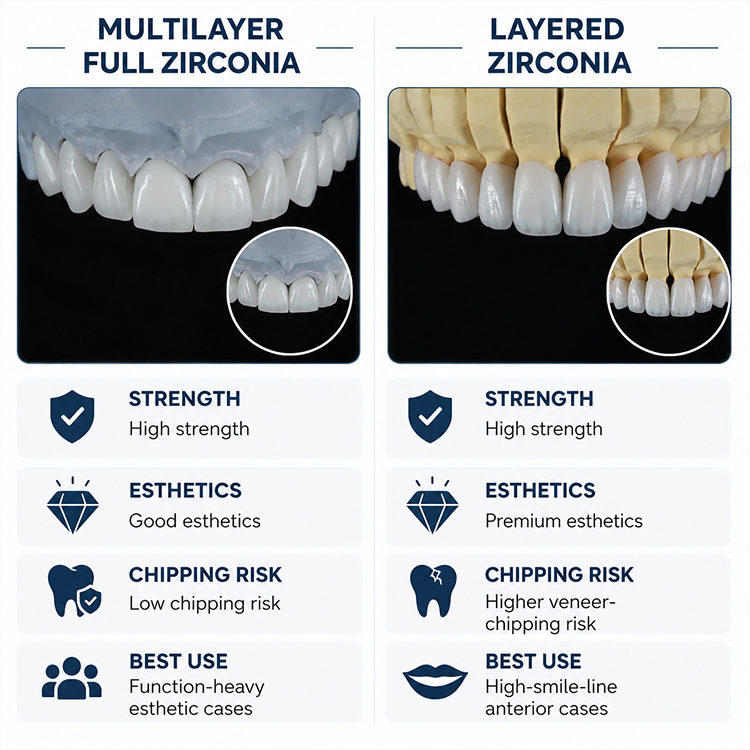
For Artist Dental Laboratory’s item framework, the difference is already noticeable. Their Full Contouring Multi-layer Zirconia page settings the product as monolithic/full-contour multilayer zirconia with slope esthetics and lowered porcelain cracking risk. Their Layered Zirconia Crown page frames layered zirconia as a zirconia core plus porcelain layering for deepness, translucency, and smile-zone characterization.
That split is not aesthetic. It is risk administration.
Table of Contents
What Multilayer Full Zirconia Truly Is
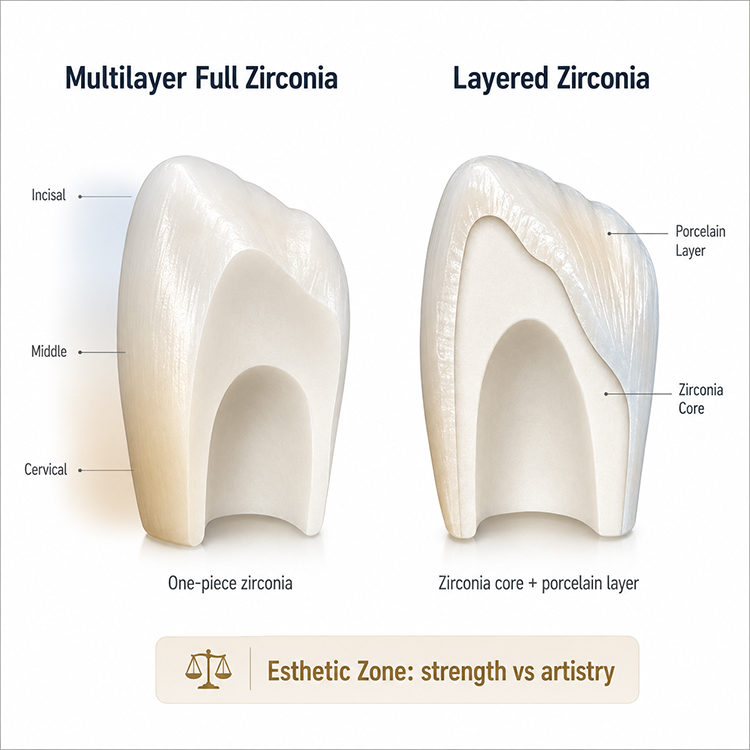
Multilayer full zirconia crowns are full-contour monolithic zirconia remediations milled from a slope zirconia space, generally developed to create cervical chroma, body shade, and incisal translucency without including a separate veneering porcelain layer.
No weak coat.
That matters due to the fact that the crown is one integrated ceramic framework, not a solid zirconia core putting on a more fragile cosmetic coat. In useful lab terms, that suggests fewer user interface issues, less porcelain-layer cracks, and extra foreseeable full shape makeup from CAD/CAM style to sintering to completing.
The chemistry is not basic, and anybody pretending otherwise is selling. Oral zirconia is zirconium dioxide, ZrO TWO, stabilized with yttria, Y TWO O SIX. Traditional high-strength zirconia is commonly gone over around 3Y-TZP, while more translucent materials move right into 4Y and 5Y solutions with more cubic phase and much better light transmission.
However below is the profession: more clarity can indicate much less transformation-toughening behavior. Much better light. Less strength.
That is why “multilayer zirconia crowns” is not a full prescription. I wish to know the tooth number, stump color, reduction, opposing teeth, occlusion, smile-line elevation, dental implant vs natural joint, and whether the patient has actually put on via night guards like they were eating paper.
A 2022 PubMed-indexed clinical contrast evaluated 30 participants with both monolithic high-translucency multilayer zirconia and standard veneered zirconia for single implant repairs in maxillary esthetic locations. Client contentment was comparable, with VAS typicals around 9.0, while specialist White Esthetic Rating preferred veneered zirconia slightly, 7.5 vs 8.0, with clarity showing strong evaluator arrangement. That is the subtlety most sales copy hides: people might approve the monolithic outcome, while skilled eyes still see the optical distinction in many cases.
What Layered Zirconia Still Does Much Better
Layered zirconia crowns are repairs made with a zirconia core and a hand-applied porcelain layer, providing the ceramist much more control over incisal translucency, halo, mammelons, inner effects, surface area texture, and the kind of untidy optical life that natural anterior teeth in fact have.
That last part issues.
Natural teeth are not simply “A1.” They are enamel thickness, dentin chroma, opalescence, fluorescence, surface age, dehydration behavior, and small irregularities that an ideal CAD documents can flatten right into something suspiciously clean.
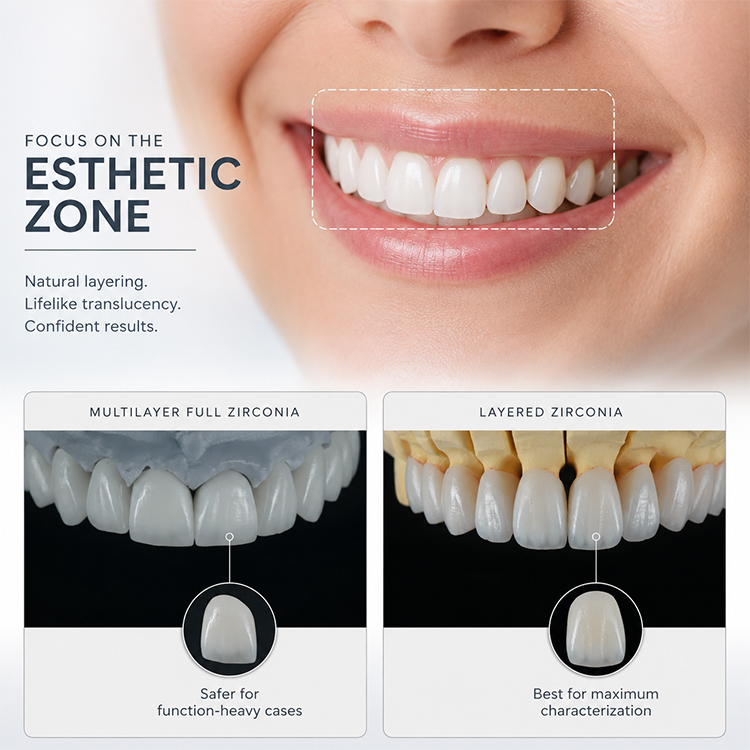
Split zirconia gains its maintain when the client has a high smile line, a single main incisor challenge, visible incisal sides, or surrounding all-natural teeth with intricate characterization. This is where a strong zirconia coping plus porcelain creativity can outperform a full contour zirconia crown, especially when the case is photographed from three angles and judged by an individual that has actually been staring at Instagram veneers for 6 months.
Yet split zirconia has a costs.
The different porcelain layer is the charm and the responsibility. A 2023 organized testimonial and meta-analysis in Professional Oral Examinations concluded that tooth-supported porcelain-veneered zirconia prostheses showed greater failure and complication rates than monolithic zirconia prostheses, with the difference specifically striking for breaking. The authors additionally reported a statistically considerable 5-year distinction in minor or significant damaging between monolithic zirconia and porcelain-veneered zirconia prostheses.
This is the component I want more clinics claimed out loud to clients: the prettier alternative can be the a lot more technique-sensitive option.
And occasionally that is worth it.
Sometimes it is not.
The Esthetic Zone Is Not One Zone
The “esthetic zone” appears tidy. It is not.
A maxillary right central incisor with a high lip line, thin gingival phenotype, and dark stump color is not the same situation as a canine crown in a low-smile-line patient with stable occlusion. A side incisor on a natural tooth is not the exact same danger profile as a dental implant crown without any gum ligament and less forgiving load behavior.
So when people ask, “Which is better, multilayer complete zirconia or split zirconia?” I listen to a weaker question concealing inside a much better one.
Better for what?
Better for fracture resistance? Complete contour zirconia.
Much better for micro-esthetics? Layered zirconia.
Much better for high-function former cases? Typically multilayer full zirconia.
Much better for a solitary main incisor alongside untouched enamel? Usually split zirconia, unless the bite is intimidating the case from the first day.
For very premium enamel mimicry, I would certainly also compare the situation against Feldspathic Veneer style reasoning, also if the final remediation is a crown rather than a veneer. Why? Due to the fact that feldspathic porcelain advises us what real enamel-like clarity and micro-texture resemble when the instance has enough enamel and low practical danger.
For wider anterior corrective preparation, Artist Dental Lab’s overview on E.max, Zirconia, or Feldspathic for Anterior Veneers is also appropriate, because the exact same tough concern keeps returning: are we purchasing toughness, optics, concealing, bondability, or process reliability?
Multilayer Full Zirconia vs Layered Zirconia: The Working Contrast
Requirements careful polish after adjustment to stay clear of roughness and wear worries
Porcelain layer can be readjusted, yet over-adjustment may ruin characterization
My candid take
The much safer default when feature is part of the tale
The far better appeal device when records, area, and occlusion sustain it
The Information Behind the Hard Opinion
I do not trust crown product debates without failing information.
A 2022 organized evaluation of monolithic CAD/CAM tooth-supported zirconia repairs included 9 short articles, 594 individuals, and 1,657 single-tooth repairs, with reported survival prices ranging from 91% to 100% over short follow-up periods. The authors ended that monolithic zirconia might be considered an option for single crowns, particularly posteriorly, while also noting heterogeneity and follow-up restrictions. That is not a triumph parade; it is a mindful green light. Resource: Medical performance of monolithic CAD/CAM tooth-supported zirconia restorations.
There is likewise the finishing problem.
A 2024 research in SAGE Open Medicine tested 60 monolithic zirconia obstructs across clarity levels and ending up techniques, utilizing spectrophotometric dimensions on different history shades. It located that surface ending up affected color and clarity, which polishing produced greater color distinctions and lower clarity values compared with polishing in the checked configuration. That matters chairside since former zirconia adjusted with rubies and left badly brightened can come to be an aesthetic and biological inflammation, not just a “small change.” Source: Translucency and Color Distinction of Monolithic Zirconia Restorations.
So no, complete shape zirconia is not instantly ugly.
And no, split zirconia is not automatically remarkable.
The material is not the crown. The instance is the crown.
My Case-Selection Rules for Zirconia Crowns in the Esthetic Zone
Pick multilayer complete zirconia when function is currently making threats
I select multilayer complete zirconia crowns when the case involves bruxism, restricted clearance, implant assistance, canine support anxiety, edge-to-edge motion, deep bite, or a client history that makes porcelain damaging feel less like a threat and even more like an appointment already arranged.
For these instances, complete contour multilayer zirconia reconstructions make sense due to the fact that they remove the veneering porcelain failure factor while still offering the lab a gradient material to work with. It is not always one of the most romantic former selection. I do not care. Romance does not spend for remakes.
Pick split zirconia when beauty must be built by hand
I choose split zirconia crowns when the instance has enough decrease, stable occlusion, outstanding records, a visible smile line, and a genuine demand for hand-built incisal personality.
A single central incisor is the timeless trap. Complete contour zirconia can function, yes, however if the nearby central has solid enamel clarity, refined trend lines, a clear incisal third, and age-appropriate surface texture, the monolithic crown can look too consistent. Layering offers the ceramist a far better brush.
However do not send out waste records and request magic.
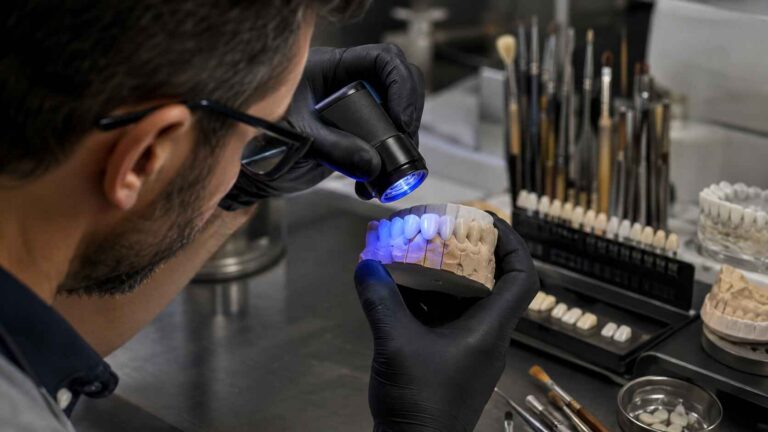
For layered zirconia in the esthetic zone, the laboratory should get STL/IOS scans, stump color, face photos, polarized shade pictures if readily available, smile pictures, prep shade, margin notes, opposing scan, bite record, provisionary photos, and the patient’s accepted esthetic target. Without that, the porcelain layer becomes decor, not diagnosis.
Think about E.max when zirconia is resolving the incorrect trouble
Sometimes the genuine response is not multilayer zirconia or split zirconia.
In some cases it is lithium disilicate.
For anterior crowns with positive stump shade, lower practical danger, and a high requirement for glass-ceramic clarity, E.max crowns deserve a significant look. IPS e.max-style lithium disilicate has a different optical character from zirconia, and in numerous day-to-day anterior cases, that issues greater than chasing maximum strength.
Here is the difficult fact: some dental experts prescribe zirconia due to the fact that they are afraid crack, not because the situation truly demands zirconia. Fear is not a product technique.
The Lab-Side Information And Facts That Make A Decision the Outcome
Stump color can spoil both materials
Dark stump? Slim crown? High translucency demand?
Now we have an issue.
Multilayer complete zirconia can mask much better than some glassier ceramics depending on opacity, density, and product generation, yet high-translucency zirconia can still be affected by the underlying tooth shade. Split zirconia can aid with porcelain characterization, however if the coping value is incorrect or the area is also slim, the result may still go gray.
This is why stump color pictures are not “extra.” They are threat control.
Occlusion determines whether elegance makes it through
Layered porcelain does not appreciate being used as a practical bumper.
If the person has a deep bite, parafunction, or hefty former advice, I need to know before the crown is made. The most awful former zirconia situation is not the one with a tough color. It is the one where the lab was requested for fragile incisal porcelain and then uncovered, after distribution, that the individual functionally abuses the incisal edge every night.
That is not a material failing.
That is preparing failure.
Complete top quality is not aesthetic housekeeping
For complete contour zirconia crowns, the final surface matters. Polishing, glazing, change procedure, and occlusal level of smoothness all impact esthetics and opposing teeth habits.
A crown that leaves the lab glossy but gets ground chairside and inadequately brightened can become a various restoration. That is why chairside groups require completing systems that match the product, not common excitement and an environment-friendly rock.
The Verdict: Which Is Much Better for Anterior Pearly Whites?
For the majority of function-sensitive esthetic-zone situations, I would begin the discussion with multilayer complete zirconia crowns due to the fact that the monolithic design decreases veneering porcelain cracking risk and gives the clinic a cleaner mechanical bet.
But also for premium anterior instances where optical deepness matters greater than brute dependability, split zirconia crowns still are entitled to respect. In the hands of a solid ceramist, with adequate decrease and a disciplined case data, porcelain split zirconia can generate even more convincing incisal vitality than complete shape zirconia.
So my final policy is straightforward:
Make use of multilayer complete zirconia when the situation needs strength to stay out of difficulty. Use layered zirconia when the situation has actually made the right to require elegance.
Not every patient has earned that right.
Not every bite allows it.
Not every laboratory can provide it.
FAQs
What is the difference between multilayer complete zirconia and split zirconia crowns?
Multilayer complete zirconia is a monolithic zirconia crown crushed from a gradient-shaded block, while split zirconia is a zirconia-core crown completed with hand-applied porcelain to boost translucency, incisal results, and surface depth in the aesthetic zone. The initial prioritizes structural simplicity; the 2nd prioritizes tailored optics.
In method, multilayer complete zirconia has fewer material user interfaces, while split zirconia offers the ceramist a lot more space to imitate all-natural enamel. The option depends on occlusion, stump shade, reduction, smile line, and esthetic target.
Are multilayer zirconia crowns great for front teeth?
Multilayer zirconia crowns can be helpful for front teeth when the case needs stamina, chipping resistance, concealing assistance, implant compatibility, or practical stability while still calling for acceptable gradient esthetics in the smile zone. They are not instantly one of the most all-natural option, yet they are often the safer one.
I like them for former situations where function is currently dubious. Bruxers, dental implant crowns, restricted clearance, and edge-to-edge attacks all make me careful concerning hand-layered porcelain.
Do layered zirconia crowns look more natural?
Split zirconia crowns can look more all-natural because hand-applied porcelain permits tailored incisal translucency, halo effects, internal characterization, fluorescence, and surface structure that are difficult to replicate completely in a monolithic full shape zirconia crown. The advantage depends heavily on ceramist skill and case paperwork.
The catch is reliability. If the porcelain is unsupported, as well slim, over-adjusted, or positioned right into a hostile bite, the crown may look stunning before it comes to be an upkeep trouble.
Which zirconia crown is better for bruxers?
Multilayer full zirconia is normally far better for bruxers because its monolithic structure avoids a different veneering porcelain layer, minimizing one of the typical technological risks seen in porcelain-veneered zirconia restorations. The decision still depends on clearance, occlusal plan, opposing material, polishing, and night-guard compliance.
I would certainly be cautious concerning layered zirconia in a heavy bruxer unless the aesthetic need is extreme and the occlusion is regulated with unusual technique.
What should dental practitioners send out to the laboratory for esthetic-zone zirconia crowns?
Dental practitioners must send STL or iphone checks, opposing scans, bite documents, stump color, final color target, face and smile pictures, withdrawed images, margin notes, provisionary references, occlusal advice details, and any type of patient-approved esthetic references for esthetic-zone zirconia crowns. Better documents lower color mismatch, contour errors, and remake danger.
A laboratory can not review the individual’s face from a solitary scan. For anterior zirconia crowns, the instance file matters virtually as long as the material prescription.
Your Following Action: Stop Prescribing Zirconia Like a Group
If you are choosing in between multilayer full zirconia vs split zirconia for the aesthetic area, do not start with the product name. Beginning with the risk account.
Send the instance photos. Send out the stump color. Send out the bite. Send the smile line. Send out the reality.
For function-heavy anterior instances, review Artist Dental Lab’s Full Contouring Multi-layer Zirconia operations. For high-esthetic anterior crowns that need hand-built depth, evaluate the Layered Zirconia Crown option. And if the instance requires a more comprehensive product discussion across zirconia, lithium disilicate, and enamel-like porcelain, contrast it with E.max Crowns and Feldspathic Veneers.
All set to examine a situation instead of presuming? Send the records via Artist Dental Lab’s call web page and ask for a product referral based upon the actual medical file, not a common crown food selection.