How to Evaluate a Lab’s Ability to Deliver Premium Anterior Esthetics
Most Labs Sell Pretty. The Best Ones Sell Control.
I’ve audited enough cosmetic cases to say this plainly: premium anterior esthetics is not a beauty contest, because the central question is not whether a lab can post a glossy before-and-after on Instagram, but whether it can repeat the same optical result across real patients, real stump shades, real prep limits, and real occlusal risk without turning every difficult case into a remake. Why do so many labs still hide that part?
My first filter is blunt. If a lab cannot explain, in clinical language, when to use a layered E.max veneer workflow, when to step down to a full E.max veneer option, and when a feldspathic veneer indication is still the better artistic answer, I assume I am listening to marketing, not judgment. And I do not buy anterior esthetics from marketing.
That distinction matters. Artist Dental Lab’s own architecture quietly admits it: layered E.max is framed around premium anterior characterization, full E.max around predictable fit and multi-unit consistency, and feldspathic around enamel-like translucency and refined surface texture. That is the right hierarchy. Too many labs flatten those differences because “premium” sells better than “case-dependent.” (Site Title)
Table of Contents
Material Honesty Beats Veneer Hype
Feldspathic is still the snob’s material for a reason
Three words only.
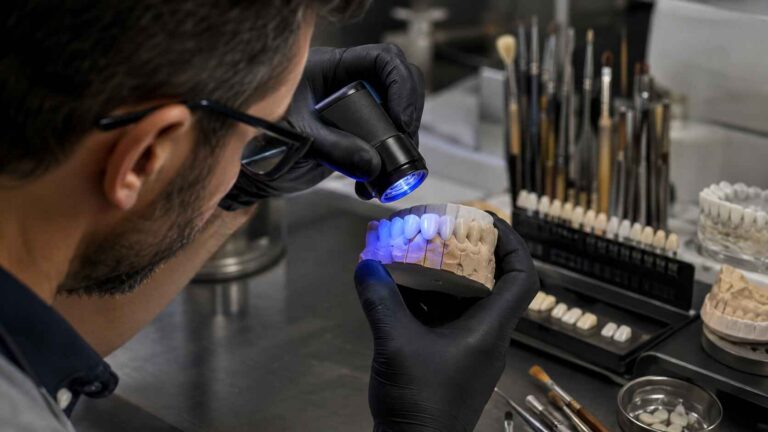
Light behaves differently in feldspathic porcelain, and when a case lives or dies on micro-texture, halo control, edge vitality, and that almost irritatingly natural enamel-like shimmer, I still think many labs reach for lithium disilicate too early because it is easier to standardize, easier to explain, and easier to sell than hand-layered porcelain artistry. But easy is not the same as best, is it?
Layered E.max is premium only when the case earns it
Here is the hard truth.
A lab that pitches layered E.max for every six-, eight-, or ten-unit smile case is usually selling emotion, because layered E.max adds another interpretive step, another thickness variable, another cooling variable, and another chance for shade drift, even though it absolutely earns its fee when the brief is a small, high-visibility anterior case that needs incisal translucency, internal characterization, and custom texture. That is why I respect a lab more when it says “no” than when it says “yes.”
Full E.max is the grown-up answer more often than people admit
I like boring.
Monolithic lithium disilicate is not boring in the final result, but it is boring in the best operational sense: fewer moving parts, more predictable fit, steadier cross-unit consistency, and less room for artistic improvisation to become chairside regret, which is why I think a disciplined full E.max veneer option is often the smarter play for multi-unit cosmetic work than the “handcrafted” solution that makes the sales rep sound poetic. Why confuse craft with variance?
Layered zirconia belongs in the conversation when force gets ugly
And yes, I said it.
If the patient has real functional demand, limited space, or the sort of bite history that makes a ceramist quietly nervous, a layered zirconia crown can be the more honest premium anterior compromise, because it gives you a stronger substructure with esthetic layering on top, instead of pretending every smile-zone case is a pure translucency problem. Beauty still has to survive Monday morning chewing.
The Evidence Gets Awkward Fast
I do not trust adjectives.
A 2025 meta-analysis of ceramic laminate veneers reported pooled survival rates at 10.4 years of 96.13% for feldspathic, 93.70% for leucite-reinforced glass-ceramic, and 96.81% for lithium disilicate, with no meaningful survival difference between the main materials. That should bother every lab that tries to win anterior cases by talking as if one material is a miracle and the others are obsolete. The indication still matters more than the slogan.
Shade is the trap.
A systematic review and meta-analysis on dental color matching found that computerized methods outperformed conventional visual shade guides overall, and another 2023 review concluded that spectrophotometers, digital cameras, and even smartphones produced significantly better shade matching than conventional shade guides. So when a lab says it can hit premium anterior esthetics from one blurry operatory photo and an A1 scribble on a script, I stop the conversation there. Would you accept that level of guesswork in the most visible teeth in the mouth?
The material specs are not vague, either.
Ivoclar’s official IPS e.max CAD data lists lithium disilicate at 530 MPa flexural strength, and the IPS e.max Press system specifically markets thin veneers, HT/MT/LT opacity choices, and even Impulse ingots for more opalescent anterior effects; that means a serious lab should be able to discuss not just “E.max,” but which version, which translucency family, and why. If the answer is just “we use E.max for esthetics,” that is not expertise. That is label worship.
And the compliance angle is real.
The FDA’s 2025 clearance summary for Straumann’s validated digital workflow spells out something many cosmetic labs prefer to keep fuzzy: digital dentistry is a controlled chain of scan data, CAD, CAM, materials, and fabrication rules, not artisanal fog. Meanwhile, the FDA has also warned that dental-device misuse in adults can cause tooth dislocation, exposed roots, bone erosion, and tooth loss, which is my polite way of saying that “premium” without process is a liability generator.
The market has gotten sloppier, too.
The Associated Press reported in October 2024 that veneers commonly cost about $1,000 to $2,000 per tooth, are irreversible, and generally last 5 to 15 years, while the ADA warned in early 2025 that unlicensed veneer services can lead to nerve damage, infections, and choking hazards; that is not just a patient-safety story, it is a reminder that quality control collapses fast when diagnosis, documentation, and licensed oversight disappear. Premium anterior esthetics starts with discipline before it ever reaches artistry.
What a Serious Lab Should Show You Before You Send a Case
I use a scorecard.
Not because tables are glamorous, but because lab selection gets much clearer when you force the conversation away from adjectives and into proof.
Evaluation area
What I want to see from a premium lab
Red flag I do not excuse
Material judgment
A case-based explanation for when to choose feldspathic, layered E.max, full E.max, or layered zirconia
“We use the same premium material for almost everything.”
Shade protocol
Shade, stump shade, retracted photos, smile photos, value notes, translucency notes, and texture references
One face photo and a generic shade tab
Digital workflow
Clear intake for STL, prep, opposing, bite, midline, smile line, and mock-up references
“Just send the scan and we’ll take care of the esthetics.”
QC standard
Documented checks for margins, contacts, incisal symmetry, surface finish, and cross-unit consistency
No defined QC language beyond “handcrafted”
Remake behavior
Honest discussion of remake thresholds, cause analysis, and how they prevent repeat misses
Defensive answers or no remake data
Team communication
A structured back-and-forth between dentist and technician before fabrication
Silence until delivery day
Here is why I like this framework.
The esthetic anterior restoration teamwork article on Artist Dental Lab says the failures that matter usually come from misalignment on shade, material, contours, reduction, and functional limits, not from some mythical lack of hand skill alone, and I think that diagnosis is dead right. Most anterior misses are communication failures wearing ceramic clothing.
Files, Photos, and the Remake Story Tell You More Than the Gallery
Pretty photos lie.
What exposes a lab is paperwork: what it asks for, what it refuses to guess, what it documents, and how it behaves when a case is at risk of drifting off course, which is why I pay more attention to intake standards and remake systems than to polished smile shots with suspiciously perfect lighting. Isn’t that where the real competence lives?
On this site, the strongest internal signals are not even the product pages. They are the process pages. The client cases and success stories page says the lab serves partners in 20+ countries with a typical 7–14 day turnaround, and it describes a 28-clinic North American DSO that cut standard turnaround from 15–20 days to 9–11 days while reporting fewer remakes and fewer appointment reschedules. That does not prove every anterior case will sing. But it does prove the lab understands repeatability, and that matters more than mood-board vocabulary.
I also like that the OEM / ODM quality control and traceability page talks in measurable language about margin integrity, contacts, occlusal verification, packaging checks, case identifiers, material lot information, QC logs, and country-specific compliance requests. That is the kind of operational detail I want near anterior work, because premium esthetics collapses the minute traceability becomes optional.
And yes, bonding matters.
If a lab writing about anterior cases also publishes a disciplined veneer teamwork framework and insists on defined inputs like STL scans, shade, stump shade, high-quality photos, midline notes, and surface texture targets, I take it more seriously than the lab that acts as if the ceramist can psychically recover missing data. My bias is simple: the best esthetic labs are not psychic; they are strict.
FAQs
What is premium anterior esthetics in dental laboratory work?
Premium anterior esthetics is the lab’s ability to produce front-tooth restorations that match facial context, value, translucency, texture, incisal effects, and symmetry while still fitting precisely, bonding predictably, and holding up under function; it is a controlled clinical outcome, not just a pretty restoration photographed under flattering light.
I judge it by whether the lab can define the optical target, choose the right ceramic, ask for stump shade and photo data, and keep the result consistent across units without turning delivery into an adjustment marathon.
How can a dentist tell if a lab really understands shade matching?
A lab really understands shade matching when it requires structured inputs such as shade, stump shade, retracted photographs, smile photographs, value and translucency notes, and sometimes instrumental color data, because anterior shade selection is a data problem first and an artistic problem second.
I do not trust labs that still rely on a single shade tab and optimism, especially when systematic reviews show instrumental methods outperform conventional visual shade guides for dental color matching.
Which material is usually best for premium anterior esthetics?
The best material for premium anterior esthetics is the ceramic whose optical behavior, thickness tolerance, and strength match the specific tooth, prep, stump shade, and occlusal risk, which means feldspathic, layered E.max, full E.max, and layered zirconia all have valid roles and all become bad choices when forced outside their indications.
My own bias is simple: feldspathic for top-end light behavior, layered E.max for selective high-visibility characterization, full E.max for multi-unit control, and layered zirconia when the bite is asking for more backbone.
Why do premium anterior cases still get remade?
Premium anterior cases get remade because the original workflow usually failed in one of five places: reduction design, material choice, shade communication, surface-texture planning, or functional planning, and the lab was forced to interpret missing information after the point where interpretation was safe.
That is why I care about structured intake, technician feedback before fabrication, and whether the lab can show a history of fewer remakes rather than just a gallery of finished smiles.
What should a dentist send a lab for an anterior esthetics case?
A dentist should send a premium anterior case with STL scans or impressions, opposing and bite records, shade and stump shade, retracted and full-smile photos, midline and smile-line notes, prep guidance, provisional or mock-up references, and clear comments on value, translucency, texture, and functional limits.
Anything less is gambling. The best labs on this site repeatedly ask for that level of input on their layered E.max, standard E.max, and teamwork pages, and that is exactly what I would want.
Your Next Step
Do this tomorrow.
Pick one anterior case on your schedule and interrogate the lab before you prescribe the material: ask what ceramic they would choose if the stump shade darkens by one step, ask what photos they still need, ask how they control cross-unit value in a six-unit case, ask what their remake trigger is, and ask whether they want layered E.max, full E.max, feldspathic, or layered zirconia for that exact patient. Then listen carefully.
A premium lab will not sound slick. It will sound specific.