Which Veneer Material Offers the Best Control of Surface Texture?
Feldspathic porcelain offers the highest ceiling for delicate, individualized veneer surface texture, provided the case is properly selected and the restoration is fabricated by a technician with strong hand-layering and finishing skills. Layered lithium disilicate comes second, while monolithic lithium disilicate usually wins on repeatability rather than maximum artistic freedom.
Texture exposes everything.
A technician may select the correct shade, reproduce the approved tooth length, and hit the requested translucency, yet the restoration can still look strangely broad, flat, plastic, or lifeless because its line angles, developmental lobes, perikymata, gloss zones, and polishing sequence were handled as finishing details rather than as part of the design.
Why does the industry still ask for the “best veneer material” as though the ceramic chooses its own anatomy?
It does not.
The hard truth is that material affects the range of possible texture, but the final result is controlled by four interacting factors: ceramic structure, fabrication method, available thickness, and the technician’s ability to finish the surface without leaving clinically undesirable roughness.
The Verdict: Feldspathic Porcelain Wins the Texture-Control Contest
When the question is strictly which dental veneer material offers the greatest control over fine, natural surface characterization, my ranking is:
Hand-layered feldspathic porcelain
Layered lithium disilicate
Monolithic lithium disilicate
Indirect or direct composite resin
Monolithic zirconia
That ranking is not a universal treatment hierarchy. It only measures control over visible surface anatomy, selective gloss, enamel-like irregularity, and localized characterization.
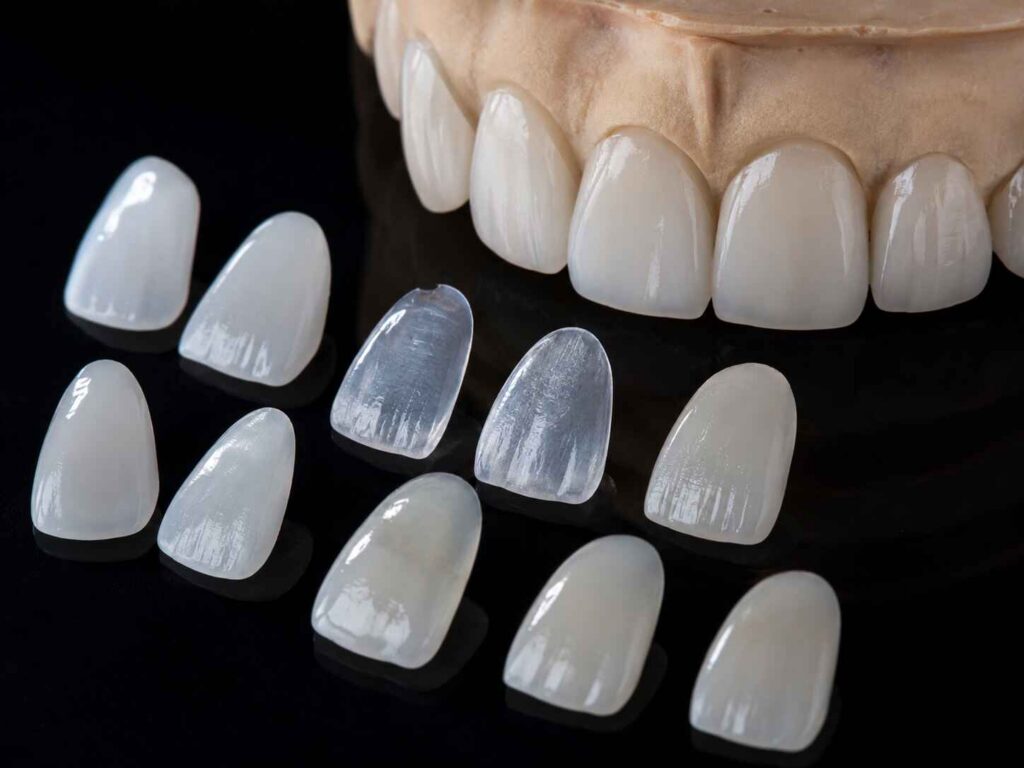
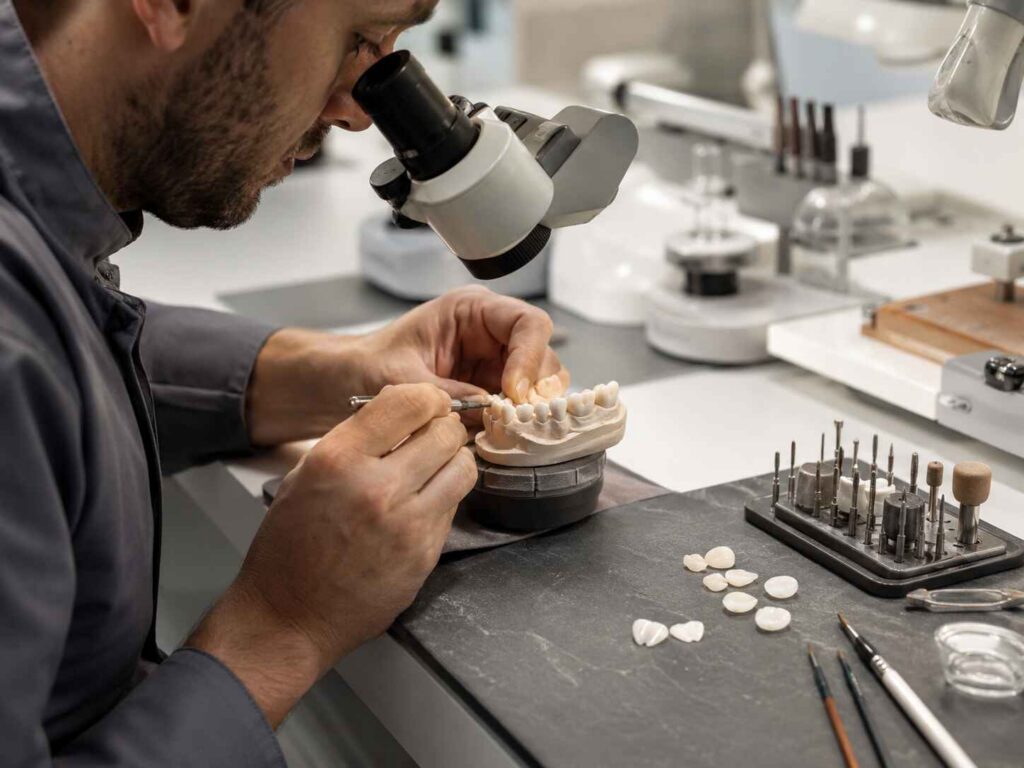
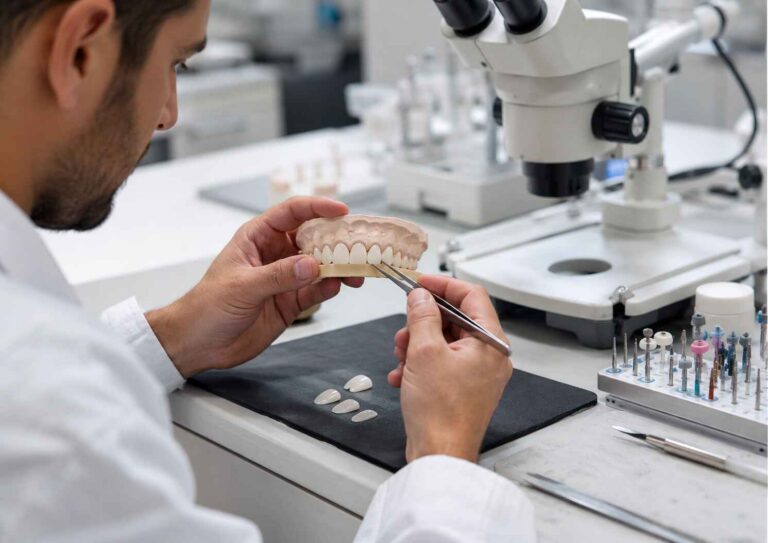
A feldspathic veneer can be built and refined in extremely thin ceramic increments. This gives the technician broad freedom to control facial contour, line angles, faint horizontal perikymata, vertical developmental lobes, shallow depressions, incisal wear, and changing levels of gloss across one restoration.
The site’s specification for hand-layered feldspathic veneers reflects this narrow but valuable indication: premium anterior cases requiring enamel-like translucency, microtexture, craze-line effects, incisal characterization, and case-specific light behavior.
But there is a price.
Feldspathic porcelain provides less mechanical reserve than lithium disilicate, is more dependent on enamel support and adhesive bonding, and is less forgiving when the preparation, occlusion, substrate color, or laboratory prescription is poor. A material that gives the technician more artistic freedom also gives the clinical team more ways to fail.
Surface Texture Is an Optical System, Not Controlled Roughness
Natural enamel is composed primarily of hydroxyapatite, chemically represented as Ca₁₀(PO₄)₆(OH)₂. Its external surface is not uniformly flat or uniformly shiny.
It carries multiple levels of anatomy:
Primary texture
Primary texture includes the overall facial contour, cervical emergence, incisal profile, and mesial and distal transition line angles.
These features establish the broad reflection pattern. A wide central reflective zone can make a tooth appear wider and brighter. Moving the transition lines inward can make the same physical crown appear narrower without changing its mesiodistal measurement.
Secondary texture
Secondary texture includes facial lobes, vertical developmental depressions, incisal wear planes, and broader horizontal patterns.
These features influence apparent age, tooth length, facial prominence, and the relationship between adjacent units.
Tertiary texture
Tertiary texture includes very fine perikymata, shallow grooves, selective surface interruptions, and subtle changes in polish.
This is where feldspathic porcelain often separates itself from less technique-sensitive materials. The technician can create delicate irregularities without forcing the entire facial surface into one uniform milled or glazed finish.
The broader optical relationships are explained in Artist Dental Lab’s guide to dental veneer surface texture and patient-specific expression. The key point is simple: surface texture changes how the observer reads value, width, depth, age, and symmetry.
Texture is therefore not decoration.
It is geometry that controls light.
Comparing Dental Veneer Materials by Real Texture Control
Veneer material
Fine-texture freedom
Unit-to-unit repeatability
Mechanical reserve
Long-term polish considerations
Best use
Hand-layered feldspathic porcelain
Excellent
Moderate
Lower
Can retain refined characterization when properly polished
Premium enamel-dominant anterior cases
Layered lithium disilicate
Very high
High
High
Supports internal and external characterization
High-esthetic cases needing more strength
Monolithic lithium disilicate
High
Excellent
High
Texture depends heavily on contouring and final polishing
Multi-unit cases requiring consistency
Composite resin
High initially
Operator-dependent
Moderate
More vulnerable to wear, roughness, and gloss change
Repairable, additive, or transitional cases
Monolithic zirconia
Moderate
Excellent
Very high
Requires disciplined polishing after adjustment
Cases prioritizing masking or functional resistance
The table exposes an important distinction: maximum control and predictable control are not the same thing.
Feldspathic porcelain offers the greatest artistic range. Monolithic lithium disilicate usually offers better reproducibility across six, eight, or ten units. Layered lithium disilicate sits between them.
That middle position is why I consider layered lithium disilicate the most practical answer for many demanding anterior cases, even though feldspathic still wins the narrow contest for maximum microtexture freedom.
Why Feldspathic Porcelain Carries Fine Texture So Well
Feldspathic porcelain is a highly glass-rich ceramic associated with constituents such as SiO₂, Al₂O₃, K₂O, and Na₂O. Its relatively low crystalline content supports translucency and delicate hand layering, but it also contributes to lower mechanical strength than reinforced glass-ceramic systems.
A widely cited review reported typical feldspathic porcelain flexural-strength values of approximately 60–70 MPa, although actual values vary with material, specimen design, processing, testing method, and manufacturer.
That modest strength is not the reason clinicians select it.
They select it because the technician can build optical depth and surface morphology in thin increments instead of relying primarily on a milled full-contour body and external stain.
With feldspathic porcelain, the technician can:
Vary ceramic thickness by facial zone
Refine line angles without making the whole surface flatter
Place faint perikymata selectively rather than uniformly
Change gloss between central, proximal, cervical, and incisal regions
Introduce controlled asymmetry between contralateral teeth
Integrate surface detail with internal mamelons, halo, translucency, and opalescence
Reproduce adjacent enamel rather than copying a generic digital library
But there is a catch.
A feldspathic veneer fabricated over a poorly documented preparation remains a poorly planned restoration. No amount of surface carving can compensate for undocumented stump shade, insufficient enamel, uncontrolled functional loading, poor margin design, or an unrealistic masking demand.
Lithium Disilicate: Less Delicate Freedom, More Structural Reserve
Lithium disilicate, commonly represented as Li₂Si₂O₅, contains an interlocking crystalline phase within a glass matrix. Compared with conventional feldspathic porcelain, it provides substantially greater mechanical reserve and supports pressed, milled, monolithic, cut-back, and layered workflows.
Current manufacturer data for IPS e.max CAD reports a mean biaxial flexural strength of 530 MPa, fracture toughness of 2.11 MPa·m¹ᐟ², and documented average survival of 95.2% over periods extending to 15 years. Those values apply to the named material and test system, not automatically to every lithium-disilicate veneer or every clinical situation. Ivoclar’s current IPS e.max CAD technical information also describes polished, stained-and-glazed, cut-back, and layered finishing options.
Strength changes the workflow.
A monolithic restoration can preserve a continuous body of lithium disilicate while the technician establishes texture externally through diamond instrumentation, rubber polishers, stain, glaze, and selective mechanical polishing.
This often produces excellent clinical texture. It also improves consistency across multi-unit cases because the basic contours can be designed digitally before the technician begins hand finishing.
The limitation is depth.
With a full-contour restoration, much of the characterization lives on or near the surface. The technician cannot create the same layered relationship between internal optical effects and overlying enamel porcelain that is possible with a fully hand-layered feldspathic veneer or a carefully cut-back lithium-disilicate restoration.
Monolithic E.max Is Better at Repetition Than Improvisation
A well-produced monolithic E.max veneer can carry convincing lobes, line angles, incisal irregularity, faint horizontal detail, and selective polish.
What it does especially well is repetition.
Consider an eight-unit case. Digital design can establish:
Consistent facial-volume limits
Coordinated transition-line positions
Controlled central reflection widths
Matched incisal planes
Repeatable proximal contours
Predictable contact-area placement
A shared baseline texture before individual finishing
The technician can then break that uniformity deliberately.
This is much safer than carving eight unrelated surfaces by eye and hoping they belong to the same smile. But it also creates the classic digital trap: units become too identical, too smooth, and too perfectly mirrored.
Symmetry sells in screenshots.
It often fails in faces.
My opinion is blunt: monolithic lithium disilicate should not be treated as an esthetic downgrade, but a generic milled surface followed by one coat of glaze is not advanced surface characterization. It is unfinished design wearing a reflective coating.
Layered Lithium Disilicate Is the Best Practical Compromise
Layered lithium disilicate uses a lithium-disilicate core or facial framework with added veneering ceramic in selected regions.
This allows the technician to combine:
Structural support from the reinforced glass-ceramic base
Controlled digital or pressed contour
Added enamel depth
Localized incisal effects
Improved control of internal characterization
More freedom over surface texture and gloss
For many cases, this is the most defensible balance.
It does not offer quite the same unrestricted thin-layer artistry as a traditional feldspathic veneer, but it provides more optical and textural control than a purely monolithic restoration while retaining more mechanical reserve than a fully feldspathic construction.
I would favor layered lithium disilicate when the case requires pronounced characterization but also includes one or more complicating factors: reduced restorative space, greater functional demand, longer incisal extension, mixed substrate conditions, or a need for more consistent multi-unit geometry.
Composite Resin Offers Immediate Control but Loses the Stability Argument
Composite resin gives the clinician or technician direct control over texture, contour, line angles, gloss, and localized repair.
That flexibility is real.
A composite surface can be modified chairside, recontoured without remaking the entire restoration, and polished through sequential abrasives. This makes composite valuable for additive cases, provisional evaluation, younger patients, repairs, and situations where future modification is expected.
But initial controllability is not the same as long-term stability.
Resin-composite surfaces are affected by filler size, filler loading, resin chemistry, finishing sequence, abrasive system, operator pressure, maintenance, diet, brushing, and aging. A 2023 systematic review found that the final surface roughness of anterior composite restorations depends on both the composite and the polishing protocol rather than on one universal finishing method.
Another systematic review and network meta-analysis evaluated surface smoothness across resin-composite polishing systems, again reinforcing that material category alone does not predict the final finish.
That is the weakness.
Composite gives the operator rapid control, but maintaining high gloss and low roughness over time is harder than with a well-finished ceramic surface.
Visible Texture Must Not Become Plaque-Retentive Roughness
This distinction deserves more attention than it receives.
A veneer may need visible surface anatomy, but it should not be left microscopically rough simply to make it look “natural.” Macrotexture and microtexture describe designed morphology. Surface roughness describes the microscopic irregularity remaining after finishing and polishing.
Those are not interchangeable.
The frequently cited Ra 0.2 μm figure is often described in dental-material literature as a threshold above which plaque accumulation may increase. It should not be treated as a universal biological cliff applying identically to every material and oral environment, but it remains a useful warning against poorly finished restorative surfaces. An NIH-hosted study discussing the 0.2 μm threshold summarizes the underlying concern.
So the technician’s job is not to make the veneer rough.
The job is to create anatomy that remains polished.
A believable restoration can show developmental lobes, line-angle transitions, faint perikymata, and incisal wear while still feeling smooth to the tongue and resisting unnecessary plaque retention or staining.
What the Clinical Evidence Actually Says
Material-selection debates often misuse survival data.
A 2016 systematic review and meta-analysis evaluated 13 studies covering approximately 2,848 ceramic veneers. It estimated an overall cumulative survival rate of 89% over a median follow-up of nine years, with approximately 94% for glass-ceramic veneers and 87% for feldspathic porcelain veneers. Fracture and chipping were the most frequently reported complications.
A newer systematic review reported pooled survival estimates at roughly 10.4 years of 96.13% for feldspathic veneers and 96.81% for lithium-disilicate veneers, with no statistically significant difference between the principal ceramic groups. Differences in included studies, bonding substrates, case selection, follow-up, preparation design, and definitions of failure explain why headline percentages should not be compared casually.
These figures do not prove that feldspathic and lithium disilicate behave identically.
They prove that both can perform well when used in appropriate cases.
And they expose the weakness in material-only thinking. Enamel bonding, preparation geometry, functional loading, ceramic thickness, cementation, and technician execution can matter as much as the material label printed on the prescription.
The Best Material Changes With the Texture Objective
Choose feldspathic porcelain when:
The case is enamel-dominant
Preparation is minimal and well controlled
Functional risk is low
The adjacent teeth carry complex natural texture
Very thin ceramic increments are needed
Selective translucency and microtexture matter more than maximum strength
The laboratory has proven feldspathic expertise
Choose layered lithium disilicate when:
High-level characterization is required
More mechanical reserve is desirable
Internal depth and external texture must work together
The case includes longer edges or greater functional demand
Multi-unit consistency still matters
A monolithic surface alone would appear too uniform
Choose monolithic lithium disilicate when:
Repeatability across multiple units is a priority
Digital contour control is valuable
Moderate-to-high texture can be created externally
The case needs a balance of strength and esthetics
The laboratory has a disciplined mechanical-polishing protocol
Choose composite resin when:
Additive treatment is preferred
Repairability matters
Chairside modification is expected
The restoration is transitional
The clinician can maintain and repolish the surface over time
How to Control Veneer Surface Texture Without Guessing
Material selection is only the opening decision. The prescription determines whether the technician receives usable information.
“Natural texture” is not usable.
Neither is “medium anatomy.”
A stronger veneer surface-characterization prescription should include:
1. The approved visual reference
Identify whether the target comes from the patient’s untreated teeth, a diagnostic wax-up, provisionals, a preoperative scan, or another approved design.
2. The desired reflective width
State whether the teeth should appear narrow, balanced, broad, dominant, soft, or sharply defined. Transition-line position matters more than decorative grooves.
3. Texture by facial third
Define the cervical, middle, and incisal thirds separately.
Middle third: soft vertical lobes, narrow central reflection
Incisal third: slight wear, restrained halo, irregular but not serrated edge
4. Gloss level and distribution
Do not prescribe one gloss level for the entire facial surface. Natural teeth often show different reflection intensity centrally, proximally, cervically, and incisally.
5. Age and wear reference
Use existing enamel, mandibular incisors, canines, posterior wear facets, and smile video as evidence. Do not ask the technician to manufacture “young texture” or “mature texture” from age alone.
6. Value, stump shade, and ceramic thickness
Surface reflection cannot be separated from brightness and translucency. A broad, high-gloss surface can appear too white even when the shade designation is correct.
The related guide explaining why value matters more than the shade tab shows why ceramic thickness, stump shade, cement, facial contour, and texture must be planned together.
FAQs
Which veneer material offers the best control of surface texture?
Hand-layered feldspathic porcelain offers the greatest control over delicate veneer surface texture because technicians can build, contour, stain, glaze, and polish very thin ceramic layers while individually adjusting line angles, developmental lobes, perikymata, incisal irregularity, selective gloss, and enamel-like optical effects across each facial zone.
It is not automatically the best clinical material. Feldspathic porcelain is more technique-sensitive and provides less mechanical reserve than lithium disilicate, so preparation design, enamel support, functional loading, bonding, substrate color, and laboratory skill must justify its use.
Are feldspathic veneers more natural-looking than E.max veneers?
Feldspathic veneers can appear more natural than E.max veneers when a highly skilled technician uses their thin hand-layered structure to reproduce complex enamel translucency, microtexture, incisal effects, and selective gloss, but material choice alone does not guarantee a superior result or compensate for weak records and poor case selection.
A layered E.max veneer can equal or exceed a mediocre feldspathic veneer. The better restoration is the one whose material, thickness, substrate, contour, surface finish, and internal characterization match the actual case.
Can lithium disilicate veneers have natural surface texture?
Lithium disilicate veneers can carry highly natural surface texture through controlled facial contouring, line-angle placement, diamond finishing, staining, glazing, and mechanical polishing, while layered or cut-back designs add further freedom for internal depth, localized translucency, incisal characterization, and differentiated surface effects.
Monolithic lithium disilicate is especially useful when a multi-unit case requires consistent contours. Layered lithium disilicate provides additional artistic freedom when the case demands more individualized depth.
Is composite resin easier to texture than porcelain?
Composite resin is easier to modify immediately because clinicians can add, remove, reshape, repair, and repolish the material chairside, but its final surface quality depends heavily on filler composition, finishing instruments, abrasive sequence, operator technique, maintenance, and aging, making long-term gloss and texture stability less predictable than ceramic.
Composite is therefore highly controllable during treatment but may require more maintenance. It is particularly useful for additive cases, provisional evaluation, repairs, and cases expected to change later.
Does more surface texture make veneers look more natural?
More surface texture does not automatically make veneers look more natural because realistic texture depends on the correct scale, orientation, location, symmetry, age relationship, gloss, and reflective pattern; excessive grooves, repeated perikymata, sharp lobes, or uniformly matte finishing can make a restoration appear manufactured rather than biological.
The most convincing surface is often restrained. It carries enough anatomy to control reflection but not so much that the viewer notices the texture as a separate feature.
Should veneers be glazed or mechanically polished?
Veneers may be glazed, mechanically polished, or finished with a controlled combination of both, depending on the ceramic system, characterization method, adjustment history, and manufacturer instructions; the objective is a stable, smooth surface with intentional gloss distribution rather than one uniformly glassy or visibly rough facial finish.
Mechanical polishing can preserve selected anatomy and reduce excessive mirror-like reflection. Glaze may help seal and finish the surface, but thick or uniform glaze can visually flatten delicate characterization.
Is feldspathic porcelain weaker than lithium disilicate?
Feldspathic porcelain generally has lower flexural strength and fracture resistance than reinforced lithium-disilicate glass-ceramic, making it more dependent on conservative case selection, enamel bonding, controlled ceramic thickness, suitable occlusion, careful handling, and an experienced laboratory, even though it provides exceptional translucency and surface-characterization freedom.
Lower strength does not make feldspathic porcelain obsolete. It means the material belongs in a narrower indication range where its optical and textural advantages justify the added technique sensitivity.
What information should a veneer texture prescription include?
A usable veneer texture prescription should identify the approved reference, material, teeth involved, facial contour, transition-line position, macrotexture, microtexture, incisal wear, gloss distribution, age and wear references, desired asymmetry, stump shade, ceramic thickness, and the photographs or scans the technician must use for verification.
Replace vague phrases such as “natural,” “medium texture,” or “make it youthful” with visible, zone-specific instructions that the laboratory can manufacture and inspect.
Send the Lab a Texture Brief, Not the Word “Natural”
The narrow technical answer is clear: feldspathic porcelain offers the greatest control over fine surface texture.
The practical answer is more useful.
Choose feldspathic porcelain for maximum individualized enamel reproduction in carefully selected cases. Choose layered lithium disilicate when you need advanced characterization with greater structural reserve. Choose monolithic lithium disilicate when multi-unit consistency and reproducible contour matter most. Use composite when repairability and chairside modification outweigh the need for long-term ceramic polish stability.
Then document the surface.
Send full-face photographs, retracted frontal and lateral views, 45-degree reflection images, stump shades, approved provisionals, scans, bite records, material thickness targets, and a zone-by-zone texture prescription.