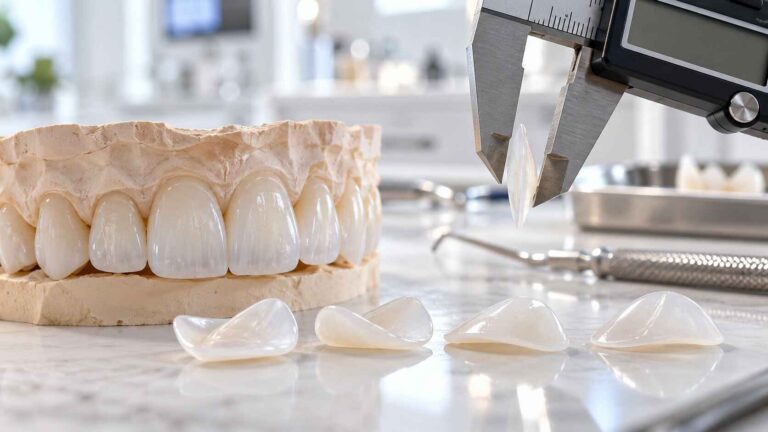
Which Veneer Material Works Best for Dark Stump Cases?
Dark stumps punish. When the prep is A4-dark, endo-shifted, tetracycline-banded, or just ugly enough to kill brightness from underneath, the material that looked “natural” on a model can turn gray, chalky, or overbuilt in the mouth, because masking is not a style choice but a controlled optical fight between ceramic thickness, translucency, cement shade, and the underlying tooth. So which veneer material actually wins when the stump is dark?
My answer is blunt. For most real-world dark stump cases, monolithic or lower-translucency lithium disilicate is the best veneer material, because it gives the cleanest compromise between masking, bondability, prep discipline, and believable esthetics; layered lithium disilicate is the premium move when the records are excellent, feldspathic porcelain is beautiful but selective, and zirconia veneer is the tough-guy option I reserve for functional or masking-heavy edge cases. Isn’t that a lot less romantic than the average veneer brochure?
Dark stump shade is not a veneer problem. It is a masking problem.
One issue first. A 2020 study on lithium disilicate specifically tested whether the material could reproduce an A2 shade while masking A4 substrates, and a 2024 paper on minimally invasive lithium disilicate restorations again focused on the same variables smart labs obsess over: ceramic thickness, translucency, and cement color. I read that as a direct warning against lazy material debates. Dark stump cases are not solved by “better porcelain” in the abstract; they are solved by a masking system.
That is why the best internal page on this site to set the tone is the predictable veneer plan for tetracycline-stained teeth. It is one of the few pieces that treats dark stump shade like the real problem it is: not a sales question, but a planning question built around severity, value control, and how much opacity you can afford before the case starts looking fake.
Table of Contents
My ranking after the sales pitch ends
Here it is. I’ve watched too many clinicians treat dark stump cases like a beauty pageant, when the smarter move is to ask which ceramic can hide enough darkness without forcing reckless reduction, dead translucency, or a remake nobody wants to pay for. Why pretend all four materials deserve equal billing?
Material
What it handles well in dark stump cases
What it gives up
Where I would use it
My verdict
Monolithic / low-translucency lithium disilicate
Strong masking-to-esthetics balance, reliable adhesive workflow, better repeatability across multiple units
Slightly less “magic” at the incisal edge than a masterfully layered case
Most dark anterior veneer cases, especially multi-unit smile work
Best overall
Layered lithium disilicate
Better depth, vitality, halo, and characterization when the stump is controlled properly
More technique sensitivity, more room for shade drift, more variability
Premium anterior showpiece cases with excellent records
Best-looking when everything else is already good
Feldspathic porcelain
Elite enamel mimicry and micro-texture
Weakest tolerance for severe dark show-through unless thickness and opacity rise
High strength, stronger masking bias, useful in demanding functional cases
Less forgiving bonding conversation, less mature veneer-specific esthetic evidence than lithium disilicate
Heavy bite, compromised habits, durability-first cases
Specialist tool, not the everyday answer
The site’s own structure quietly agrees with that hierarchy. The monolithic full E.max veneer workflow is framed around predictable fit, consistent strength, and shade control; the layered E.max veneer option is positioned for incisal effects and high-end characterization; the hand-layered feldspathic veneer page openly leans toward mild discoloration coverage and enamel-like light behavior; and the zirconia veneer indications are written for higher functional demand and fracture resistance. That is not random website copy. That is the lab telling you, in plain English, which material tolerates darkness and which one needs prettier starting conditions.
What the evidence actually says when the stump is ugly
Real cases matter. The older Journal of Dentistry study on 546 tetracycline-stained teeth still matters because scale matters, the 2017 grade IV feldspathic veneer clinical report still matters because severe discoloration exposes optical limits fast, and the 2024 14-month lithium disilicate recall case report matters because it shows what current digital lithium disilicate workflows can do when the case is sequenced honestly. But look closely and the same hard truth keeps showing up: severe discoloration can be blocked out, yet something usually gets traded away—extra thickness, reduced translucency, more controlled cement selection, or tighter indication discipline. Isn’t that exactly the kind of trade-off glossy veneer ads hate discussing?
And the longer-view data is even less sentimental. A 2024 literature review reported that dental veneers generally show survival rates above 90% for more than 10 years, which is reassuring, but it is not a free pass to ignore dark substrates, because survival is not the same as optical success and a technically surviving veneer can still look flat, gray, or overbuilt if the stump-shade plan was lazy. I care about both. Professionals should too.
Why I usually choose lithium disilicate first
Three reasons only. Lithium disilicate, chemically a Li₂Si₂O₅ glass-ceramic, gives me the most balanced answer to the four ugly questions dark stump cases ask: can I mask enough, can I still bond predictably, can I stay conservative, and can I avoid turning the smile into a row of bathroom tiles? Why chase extremes when the middle ground is often where good dentistry lives?
The ADA’s materials review is useful here because it strips away some of the fan fiction. It reports that glass-ceramic laminate veneers outperformed feldspathic porcelain veneers in one systematic review, cites 94% cumulative survival after 7 years for glass-ceramic veneers versus 87% after 8 years for porcelain veneers, and notes that evidence for zirconia is promising but still more limited long-term, with chipping and fracture remaining part of the conversation. That is not a coronation. But it is enough for me to say this: if I am choosing one “best veneer material for dark stump cases” for most anterior work, I’m still picking lithium disilicate before I pick feldspathic porcelain or zirconia.
But I would be lying if I said lithium disilicate always wins. If the prep is heavily restored, the enamel is gone, or the case is drifting out of veneer territory and into structural rehabilitation, the honest internal link is the E.max crowns page, not another veneer page pretending biology can be negotiated. That page says the quiet part clearly: stump shade information supports value control in thinner areas, and multi-unit esthetic cases need a defined target for value and translucency. That is workflow talk. I trust workflow talk more than marketing adjectives.
The hard truth labs know and dentists sometimes ignore
Bad records kill. The product pages across this site keep repeating the same intake pattern—shade, stump shade, photos, scans, margin notes, texture targets, smile-line notes—because dark stump cases are where incomplete prescriptions become expensive mistakes, not charming chairside improvisations. So why are so many veneer failures still blamed on the ceramic when the handoff was weak from the start?
And yes, there is an industry angle here. In October 2024, the Associated Press reported that veneers usually cost about $1,000 to $2,000 per tooth, while the ADA warned in May 2024 against so-called “veneer technicians,” and the FDA’s September 30, 2024 dental ceramics guidance states these devices are prescription use only. That matters more than people admit, because dark stump cases are exactly where undertrained providers start over-prepping healthy teeth in a desperate attempt to force translucency to do an opaque job. Cheap veneer culture is not just tacky. It is destructive.
FAQs
What is the best veneer material for dark stump cases?
The best veneer material for dark stump cases is usually a lower-translucency or monolithic lithium disilicate veneer, because it offers the most reliable balance between masking dark substrates, preserving adhesive predictability, controlling final value, and keeping the restoration believable in the smile zone. I would only move away from it when the case demands more artistry or more brute-force durability.
Are zirconia veneers better than porcelain veneers for severely discolored teeth?
Zirconia veneers are better than porcelain veneers for severely discolored teeth only when the case is dominated by fracture risk, heavy function, or extreme masking demands that make durability more important than the last bit of enamel-like translucency in the anterior zone. I do not treat zirconia as the automatic winner, because most dark stump cases still need bond-friendly optics, not just toughness.
Can feldspathic porcelain mask a dark stump shade?
Feldspathic porcelain can mask a dark stump shade in selected cases, but it works best when the discoloration is moderate, prep space is controlled, and the clinician accepts that the more darkness you try to hide, the more likely you are to sacrifice the airy optical quality that made you choose feldspathic in the first place. I love feldspathic on clean substrates more than on ugly ones.
How do you mask dark stump shade with veneers?
Masking dark stump shade with veneers means controlling the entire optical stack—ceramic thickness, translucency level, cement shade, prep depth, stump shade mapping, and photography—so the final restoration lands at the right value without looking chalky, over-opaque, or structurally over-prepared. Material matters, sure. But dark stump success is still a systems problem before it becomes a ceramic problem.
Your next move
Stop guessing. If you are treatment-planning a dark stump case, start by documenting the stump shade honestly, deciding how much translucency you can afford to lose, and asking whether the tooth still deserves to stay in veneer territory at all.
Then use the internal pages the way a skeptical professional would use them, not the way a shopper would. Compare the monolithic full E.max veneer workflow against the layered E.max veneer option, sanity-check the esthetic ceiling on the hand-layered feldspathic veneer page, and keep the E.max crowns page in view if the case is already drifting past conservative veneer logic. My opinion is simple: in most dark stump cases, pick lithium disilicate first, pick zirconia selectively, and pick feldspathic only when the substrate has earned the right to be delicate.