価格・サンプルに関するお問い合わせ
ジルコニアクラウン、二ケイ酸リチウムクラウン、ベニア、OEMサービス、あるいは修復物の卸売り注文を比較検討している歯科技工所、歯科医院、販売代理店、および調達担当者の方へ。.
取り扱い製品の種類、素材、月間販売数量、輸出先国、およびサンプルのご要望をお知らせください。営業チームが適切な対応策を講じることができます。.

For ultra-thin veneers of roughly 0.3–0.5 mm, a translucent or neutral light-cure cement is the safest default. Choose a different shade only when a try-in paste, used on the actual veneer over the actual preparation, shows a specific value or warmth correction. The reason is optical. At this thickness the ceramic no longer controls final color on its own. The prepared tooth, the cement layer, and the veneer behave as one optical stack, and the cement can shift value enough for a patient to notice.
This guide covers four questions. How does cement shade interact with ceramic thickness and stump shade? When is light-cure the right curing mode? How far can try-in paste be trusted? What does a laboratory need to know before it fabricates the case? It is written for clinic owners, dental technicians, and lab buyers who specify or accept thin ceramic work.
Cement shade matters more as ceramic gets thinner because less ceramic means less masking and more light reaching the cement and the tooth. A manufacturer’s veneer cementation guidance from Solventum makes the same point. Cement color makes little difference under thicker veneers, but it can influence the final esthetics of 0.3–0.5 mm veneers, so several shades should be on hand. This is a manufacturer source, so treat it as practical guidance rather than independent evidence.
Independent research points the same way. A 2026 systematic review of resin cement shade in ceramic veneers included ten in vitro studies. It found that white opaque and high-chroma cements produced larger color changes (ΔE above 3.3), especially under thin or highly translucent ceramic. Translucent and low-chroma cements gave more favorable results, and thinner veneers amplified the effect of cement shade. The authors also note that the evidence is mostly laboratory-based and that clinical trials are needed.
The practical consequence is that cement shade cannot be chosen after the ceramic has already been treated as the complete color solution. Artist Dental Lab’s review of how ceramic thickness and substrate color work together in ultra-thin veneers covers the same stack of tooth, cement, and ceramic from the design side.
Light-cure cement is usually the better fit for thin, translucent glass-ceramic veneers because it tends to hold its color better over time. Dual-cure cements historically contain tertiary amines and benzoyl peroxide, which are linked to yellowing as they age. An in vitro study of resin cement type and thickness found that amine-free dual-cure and light-cure cements both showed clinically acceptable discoloration (ΔE of 3.3 or less). Light-cure cements still showed better color stability.
Two qualifications apply:
Light-cure also gives the operator unlimited working time. That helps in multi-unit cases, where seating several thin veneers in sequence is easier when the cement does not start setting on its own.
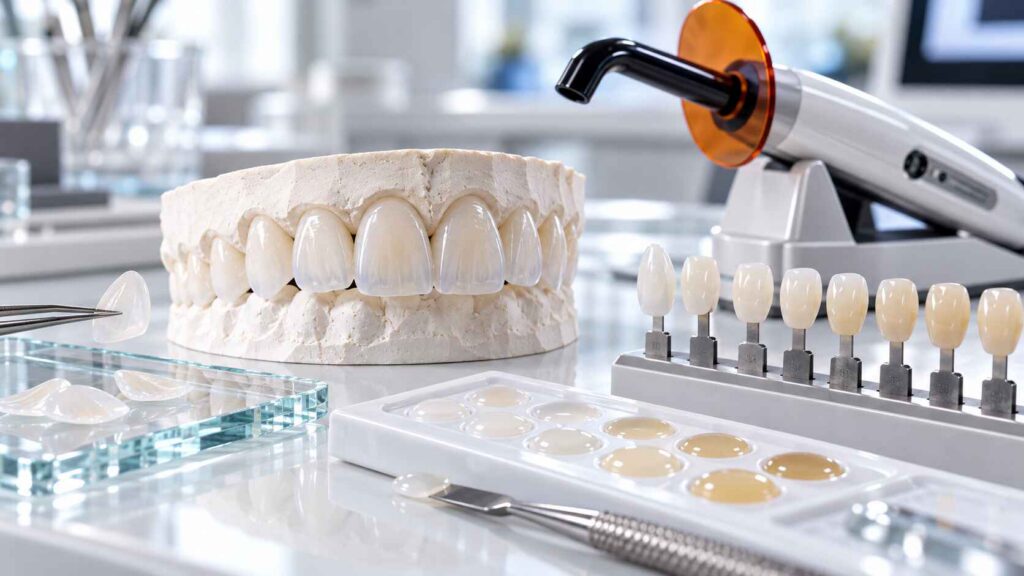
Brand shade names are not standardized. One manufacturer’s “white” or “bleach” may differ in opacity from another’s, so the table groups shades by optical behavior. It is a qualitative guide drawn from the studies above, not measured data for any specific product.
| Cement shade family | Typical optical effect under thin ceramic | Best-fit situation | 主なリスク | Verify before bonding |
|---|---|---|---|---|
| Translucent / clear / neutral | Least change to the ceramic; lets enamel and ceramic color dominate | Favorable enamel substrate, ceramic already fabricated to the target value | Cannot lift value or mask | Try-in paste over the real preparation, teeth hydrated |
| Light / bleach / soft white (lower opacity) | Raises value modestly and cools the result | Small value correction when the ceramic reads slightly low | Can flatten depth if overused | Compare against translucent paste on the same veneer |
| White opaque | Raises value and brightness more strongly, reduces translucency | Mild substrate darkening, only when depth loss is acceptable | Larger color shifts; reviewed studies linked these shades to ΔE above 3.3 | Evaluate in a full-face view, not only a retracted view |
| Warm / yellow (A-shade) | Adds chroma and warmth | Ceramic reads too cool or gray beside neighboring teeth | Can look dull or too yellow at the cervical third | Compare at conversational distance and under two light sources |
| Dark / brown | Lowers value, adds saturation | Rare corrections for over-bright restorations | Easy to overshoot | Usually discuss with the lab before choosing |
Cement is a fine-tuning tool. A few steps of value or warmth are realistic. A rescue for the wrong ceramic is not.
Three variables decide the cement choice before any paste is opened: the substrate, the ceramic, and the cement film itself.
The darker or more uneven the preparation, the more the veneer must mask, and the less a translucent cement can do for you. Artist Dental Lab’s review notes that laboratory research found about 0.8 mm of multilayer IPS e.max Press ceramic was needed to mask severe discoloration under the tested conditions. That is not a universal figure, but it shows that a 0.2–0.3 mm veneer cannot reliably hide a dark stump through a brighter cement alone.
Ask the following before choosing a cement shade:
If the answer is no, the fix belongs in the design: more preparation space, a more opaque ceramic, or a different restorative plan. Cement should not carry that load.
High-translucency ceramic transmits more light, so cement color shows more. A laboratory study of try-in paste and cement agreement under ultra-translucent multilayered zirconia veneers tested 0.5 mm and 0.7 mm specimens. It found that both cement shade and ceramic thickness significantly affected agreement. Agreement was better with the thicker veneers, and the white and opaque shades showed larger gaps than the clear, universal, and brown shades. That study used zirconia, so do not transfer its numbers directly to lithium disilicate or feldspathic porcelain. The direction of the effect, however, is consistent with the glass-ceramic findings above.
For lithium disilicate and feldspathic work, confirm the ingot translucency or layering plan with the lab, and share the cement plan while the lab is developing the shade. Artist Dental Lab’s ultra-thin veneers page lists IPS e.max lithium disilicate and feldspathic porcelain as the available material options for these restorations.
Cement color influence grows with the thickness of the cement layer. When a veneer is only 400 μm thick, an uncontrolled cement region of 150–200 μm is a large share of the whole restorative system. Artist Dental Lab’s article on seating pressure and cement film thickness in ultra-thin veneers summarizes a 2024 study. Under the same 30 N load, film thickness ranged from 6 μm to 200 μm across 21 resin materials. Seating force alone does not fix the cement layer, so the cement chosen for color should also be one that seats predictably.
Try-in paste previews cement shade, but it does not reproduce the cured cement exactly. The zirconia study above reported perceptible color differences between try-in paste and cured cement for most of the shades investigated. Solventum’s guidance also recommends a try-in paste, or at least a drop of water, because a dry try-in confirms fit but does not replicate final shade.
Several habits keep the try-in useful:
The single-unit case needs extra care. Artist Dental Lab’s analysis of why single-veneer matching is harder than multi-unit matching explains why one veneer beside natural teeth exposes small value errors. In a multi-unit case, the cement protocol can at least be standardized across units. With a single unit, a paste that looks neutral in isolation may still read bright next to a dehydrated neighbor.
Not reliably, and this is the assumption most worth qualifying. The common advice is to choose a whiter cement to lift a veneer that looks gray. That works only within a narrow range. White opaque cement raises value, but it also cuts translucency, and the reviewed studies tied these shades to the largest color shifts under thin ceramic. The result can look acceptable under one light and flat under another.
Consider an illustrative example, not a real case. A technician receives a request for a bright shade over a preparation with mild darkening. The ceramic is made slightly low in value, on the assumption that the clinic will correct it with a brighter cement. If the clinic uses translucent cement instead, the veneer reads gray. If it uses white opaque cement, the veneer may look brighter but lose depth. In both cases the failure started with an undocumented cement plan.
The more defensible default is the reverse. Build the target value into the ceramic, use translucent or neutral cement as the baseline, and keep lighter or warmer pastes for small, defined corrections. This applies to favorable-enamel cases. Where the substrate is severely discolored, no cement strategy replaces more ceramic thickness.
A lab can only account for cement if it is told about it. For an accurate quotation and a predictable first fit, include the following:
Artist Dental Lab’s page on 超薄型ベニア is the product reference for these restorations. For a trial case, send the file set above so ceramic thickness, material, and cement strategy are reviewed together before fabrication. Confirm pricing, MOQ, and lead time directly with the lab, since this article does not state them.
Translucent or neutral light-cure cement is the usual starting point for 0.3–0.5 mm veneers because it alters the ceramic least. Move to a lighter or warmer shade only after try-in paste on the actual veneer shows a specific value or warmth correction.
Light-cure cement is generally preferred for thin, translucent glass-ceramic veneers because in vitro data show better long-term color stability. Dual-cure is considered when light access is limited, such as with thicker or more opaque restorations. Follow the manufacturer’s instructions for the specific ceramic.
Yes, but only to a limited degree. White or opaque cement can raise value under a thin veneer, yet a systematic review of in vitro studies linked these shades to larger color shifts, often above ΔE 3.3. Cement cannot reliably replace ceramic value or masking thickness.
No. Try-in paste is a guide, not a guarantee. Laboratory studies have measured perceptible differences between try-in paste and cured cement for most shades tested, and the gap changes with ceramic thickness. Evaluate with the veneer fully seated, teeth hydrated, and the matching paste from the same system.
Usually not. At 0.3–0.5 mm, a dark substrate shows through even with opaque cement, and added opacity costs translucency and depth. Severe discoloration generally calls for more ceramic thickness, more preparation space, or a different material plan, decided before fabrication.
Yes. Cement shade is part of the optical stack, so the lab should know the planned brand and shade, plus stump shade and target ceramic thickness. Otherwise the technician may develop shade on one assumption while the clinic bonds with another.